

NCBR wants defence and dual-use research to shape Europe’s next framework programme
Poland’s research agency is calling for earlier influence and a stronger coordinating role for Central and Eastern Europe. The opportunity is programme design, not a newly opened grant.
- Poland
- NCBR
Poland’s National Centre for Research and Development, NCBR, has called for defence and dual-use technologies to be priorities in the EU’s next research framework programme. Its 21 October account of the CETEF forum in Poznań also argues that Central and Eastern Europe should move towards a stronger coordinating role.
The intervention matters because programme architecture can determine which industrial problems receive support and how smaller research ecosystems enter European partnerships. It is a policy position reported by NCBR, not a funding decision or evidence that a Polish share of a future budget has been reserved.
Our analysis connects that intervention to the Commission’s published proposal for Horizon Europe 2028-2034. The practical issue for Polish firms and research organisations is how to shape and lead a useful research agenda before specific calls are written.
A coordinating role requires more than participation
NCBR’s National Contact Point director, Piotr Świerczyński, argued for involvement from the earliest stage of programme design and said the region does not fully use its Horizon Europe potential. The report presents that assessment without a participation ranking or a quantified regional funding gap.
For an industrial consortium, our interpretation is that a stronger role should be visible in responsibility for the research question, the integration plan and the use of results. Being listed among partners and being able to organise a coherent programme of work are different forms of participation. The latter requires administrative capacity as well as technical expertise.
The Commission proposal already contains a defence direction
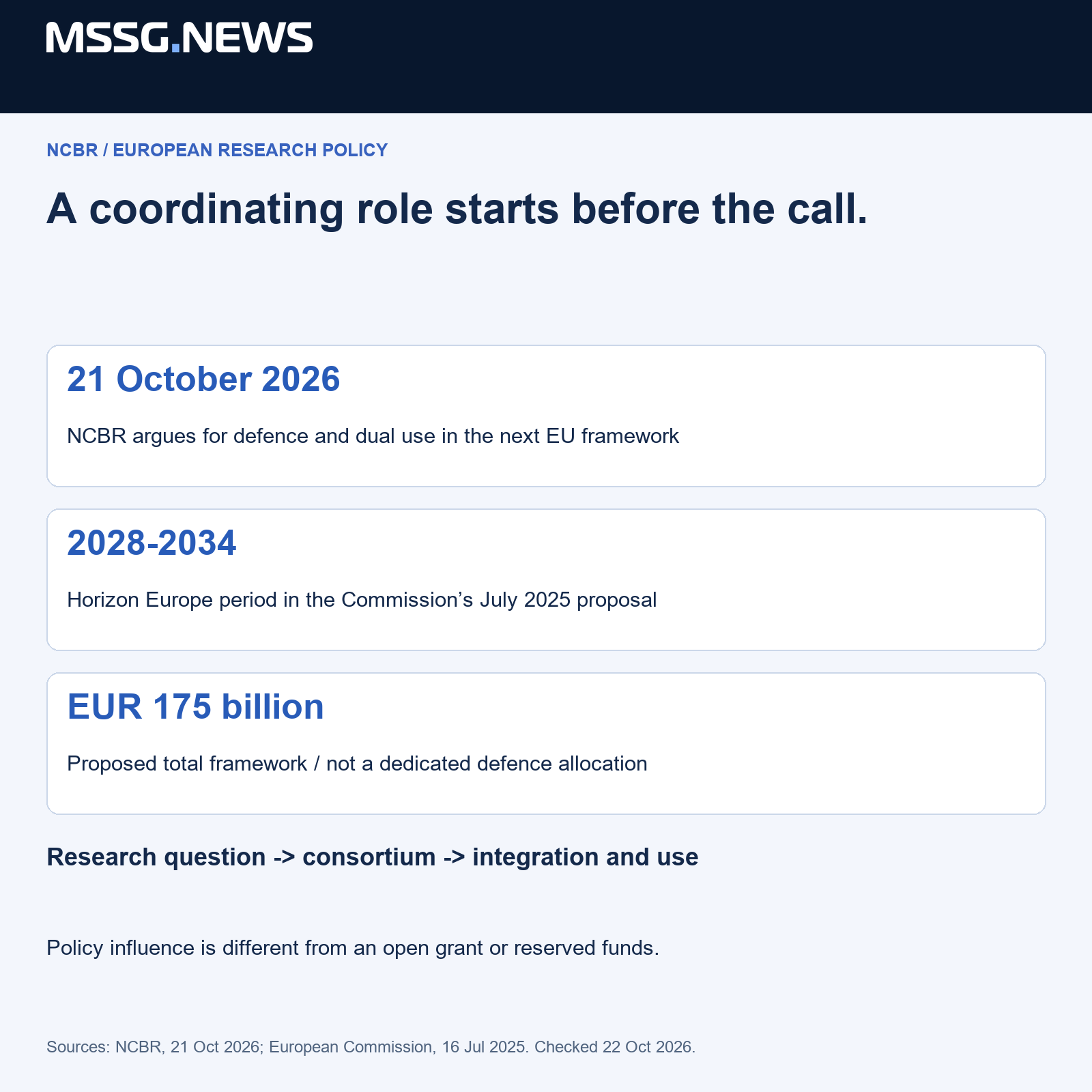
In its July 2025 proposal, the Commission set out a €175 billion framework for 2028-2034, with four pillars. Its Competitiveness and Society pillar includes defence, industry and space in cooperation with the proposed European Competitiveness Fund. The Innovation pillar expands the European Innovation Council and introduces a focus on defence and dual-use start-ups.
These are features of the proposal described by the Commission. The €175 billion figure concerns the overall research framework, not a dedicated defence allocation. It must not be turned into a current grant pot or an entitlement for a particular country, company or Ukrainian partner.
Translate influence into an industrial research agenda
A useful contribution from a Polish consortium could identify a bottleneck shared by several potential users, the research needed to resolve it and the route from experimental evidence to a demonstrator. Our recommendation is to connect the scientific task to access rights, integration responsibility and a realistic plan for exploiting results.
That would make a coordinating role substantive. It would also help separate a research project’s shared European objective from each participant’s commercial interest. Questions about background intellectual property, test access and maintenance are easier to address before a consortium freezes its work plan.
NCBR’s intervention is therefore a signal to engage with programme formation. The eventual rules, budgets and work programmes will determine concrete opportunities. Firms should continue checking existing calls on their own terms rather than assuming that a future defence focus has already changed today’s eligibility conditions.
Sources & context
- NCBR: CETEF report and framework-programme priorities, 21 October 2026 ↗
- European Commission: Horizon Europe 2028-2034 proposal, 16 July 2025 ↗
Published by Mitchell Strategic Solutions Group. See our editorial standards and corrections policy. Read more →
Related reporting

ESSOR starts its narrowband phase. Poland’s Radmor is part of the common radio architecture.
AGILE: Europe’s €115 million route from civilian technology to defence trials