
AGILE: Europe’s €115 million route from civilian technology to defence trials
The Council has adopted the SME-focused programme. Before the expected 2027 call, firms can prepare a credible adaptation project and examine the funding conditions.
- EU
- AGILE
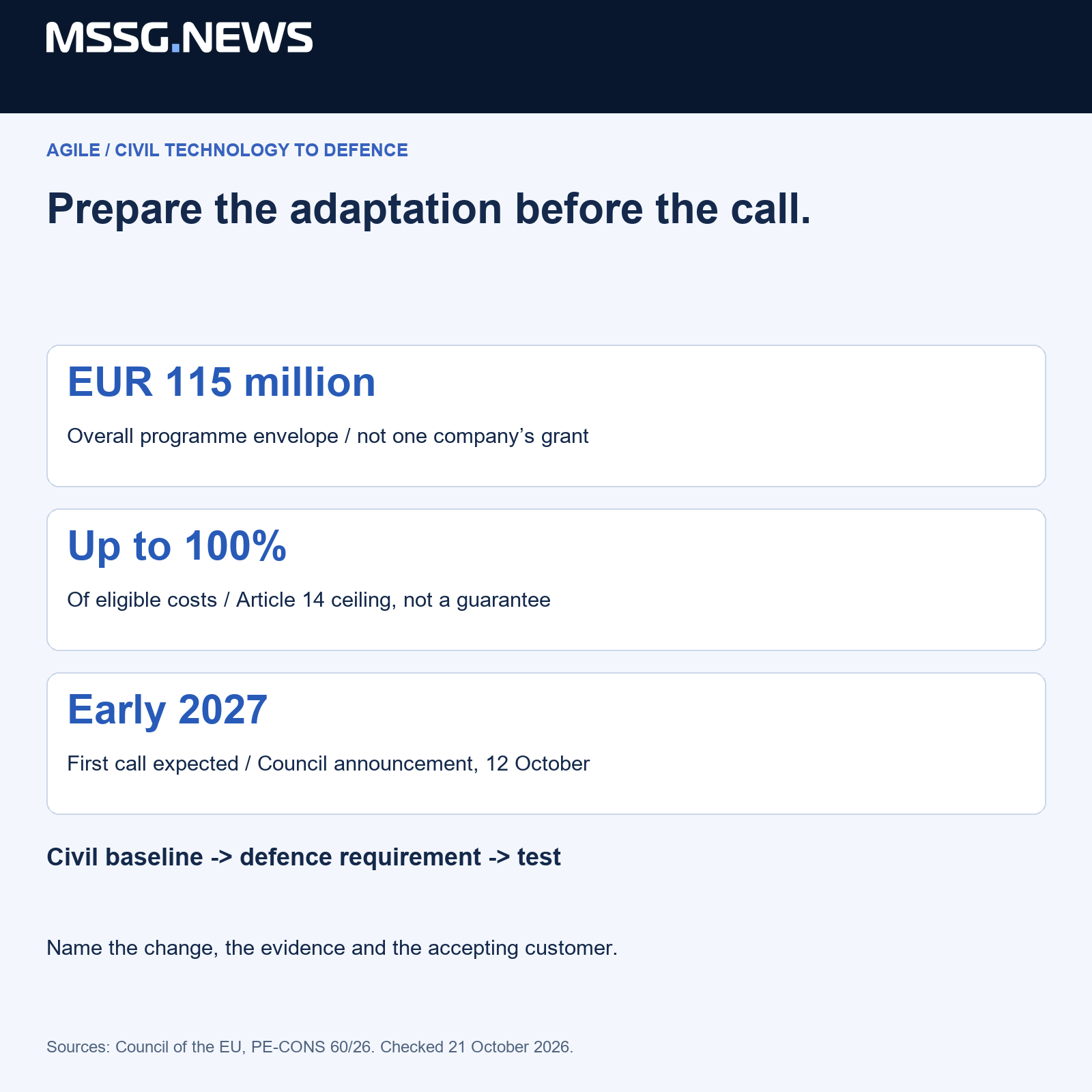
The Council of the EU adopted AGILE on 12 October, establishing a €115 million instrument for rapid defence innovation. It targets SMEs, including start-ups and scale-ups, and explicitly includes adapting civilian technologies to defence needs.
That makes the programme relevant to companies whose sensing, robotics or software already solves a civil problem but needs a different specification, test environment or customer integration for defence. The Council says the first call is expected at the beginning of 2027. This article is preparation for that opportunity, not a notice that applications are open.
The security context is explicit in the adopted text: Russia’s war against Ukraine requires a lasting improvement in European readiness. AGILE’s proposed contribution is a faster path through development and testing for smaller innovators.
Speed depends on a narrow, testable project
The Council describes a four-month time-to-grant and an ambition for relevant products to reach defence forces within one to three years. Member states are to help define challenges, while testing access and connections with major defence firms support uptake. These are programme objectives, not a promised delivery date for every applicant.
Our view is that a civil-to-defence proposal should identify the adaptation itself. A team should show what already works, which requirement changes, what experiment resolves the uncertainty and who can assess the result. Repeating a civil demonstration without identifying the defence requirement would leave the core question unanswered.
Eligible costs and eligibility are separate tests
Article 14 of the adopted regulation permits funding of up to 100% of eligible costs. The ceiling does not make every cost eligible or guarantee a full award. Articles 7 and 9 govern association and participation; a reference to Ukraine in the association framework does not automatically qualify every Ukrainian company.
Company establishment, management, control and the location of relevant resources therefore deserve an early review against the text and, when available, the work programme and call. Article 15 also preserves national export-policy discretion. Grant support is not an export authorisation.
Prepare the experiment and the next buyer
A practical preparation pack would connect the technical change to a test, its cost and the person responsible for acceptance. It should also identify what happens after the funded work: integration effort, maintenance and a prospective purchasing route. Those are our planning recommendations, not additional eligibility rules.
The Council’s announcement places Official Journal publication and entry into force after adoption. We are reporting the adopted design, without claiming a verified commencement date. The eventual work programme and call remain the documents that will turn a broad innovation instrument into specific application choices.
Sources & context
Published by Mitchell Strategic Solutions Group. See our editorial standards and corrections policy. Read more →
Related reporting

A new AI grant asks for experimental proof. A better chatbot wrapper will not qualify.
Apply by 2026-11-18
SAFE: how European loans become industrial procurement