NATO scales up its counter-drone network. Ukraine helps shape the test.
Crucible 4-26 connects counter-UAS cells across greater distances. NATO is testing the system between suppliers, as well as the equipment itself.

- NATO
- Counter-UAS
A drone spotted by one system is useful intelligence only if the people and systems that must act can use it. NATO is taking that problem into a larger counter-drone experiment in Latvia, bringing Ukrainian experience into the scenarios.
In its 16 October update, Allied Command Transformation described Crucible 4-26 as the next expansion of its Layered Counter-UAS Initiative, LCI-X. The test connects cells containing sensors, command and control, and equipment that counters drones, across greater distances and more complex structures.
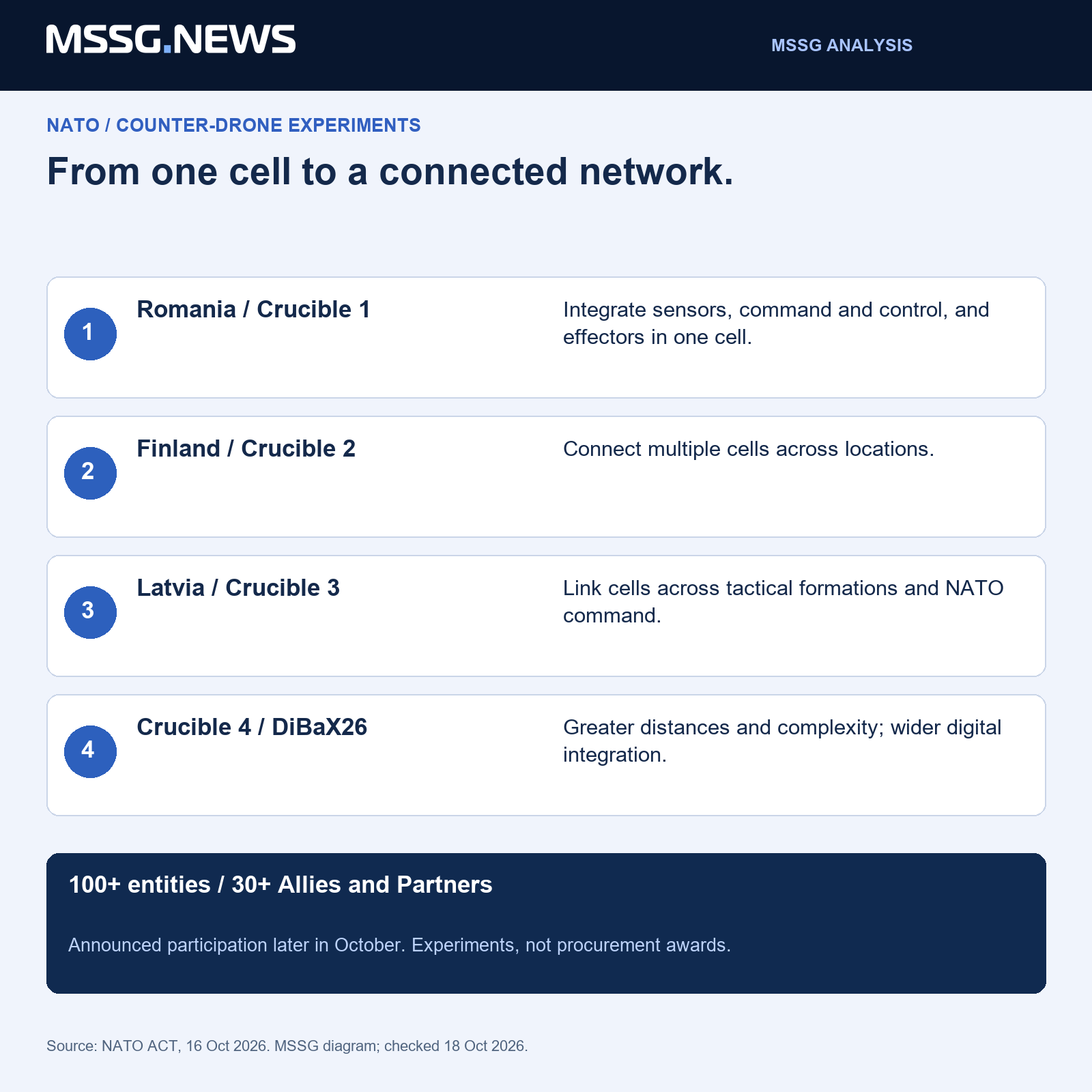
ACT expects more than 100 NATO, Allied and industry entities from over 30 Allies and Partners later in October. These are announced participation figures for an experiment, not evidence of systems bought or an operational shield already deployed.
Four trials build a larger network
The progression explains the purpose. Romania tested integration within one cell. Finland connected several cells across locations. Latvia's third trial moved into tactical formations and NATO command systems. The fourth adds scale and integration with DiBaX26 and Next Generation Targeting experiments.
That changes what a convincing demonstration looks like. A vendor can show a good detection on its own screen; a connected trial asks whether another component receives information in time and interprets it correctly. Our analysis is that the handover between systems deserves as much scrutiny as each product's headline specification.
For European forces, that is a practical role for NATO: provide a shared environment in which nationally developed equipment meets other nations' systems before procurement decisions lock in the architecture.
Ukraine supplies experience, not a decorative case study
ACT says the NATO-Ukraine Joint Analysis, Training and Education Centre, JATEC, is bringing battlefield lessons and Ukrainian industry into the experiment. The relevance is direct: Ukraine's defence against Russia gives the testing programme experience of an evolving drone threat.
The industrial value lies in turning that experience into scenarios against which different suppliers can be compared. The release does not publish results or interception rates. Those should be assessed when evidence from the trial becomes available.
Communications is part of counter-drone capability
DiBaX26 carries LCI-X data and lets NATO examine how the digital infrastructure handles the resulting traffic. The same information can feed wider targeting experiments. This makes communications part of the capability under examination, rather than a background service assumed to work.
For dual-use companies, the connection is relevant to networks, data exchange and integration testing as well as sensors. ACT also identifies border and critical-infrastructure protection as potential applications of connected cells. That does not make a military trial a civilian product approval.
The outcome to watch is whether the experiment produces usable integration requirements and evidence that national buyers can act on. NATO's contribution is to make a multinational response testable. Europe's next counter-drone purchase will be stronger if it buys equipment that has proved it can work with the rest.
Sources & context
Published by Mitchell Strategic Solutions Group. See our editorial standards and corrections policy. Read more →