NATO backs seven counter-drone innovators: a faster route from dual-use to defence
Seven development contracts put DIANA companies into NATO’s counter-drone effort. The important shift is a funded route to military users, against a much larger Allied investment ambition.

- NATO
- Dual-use
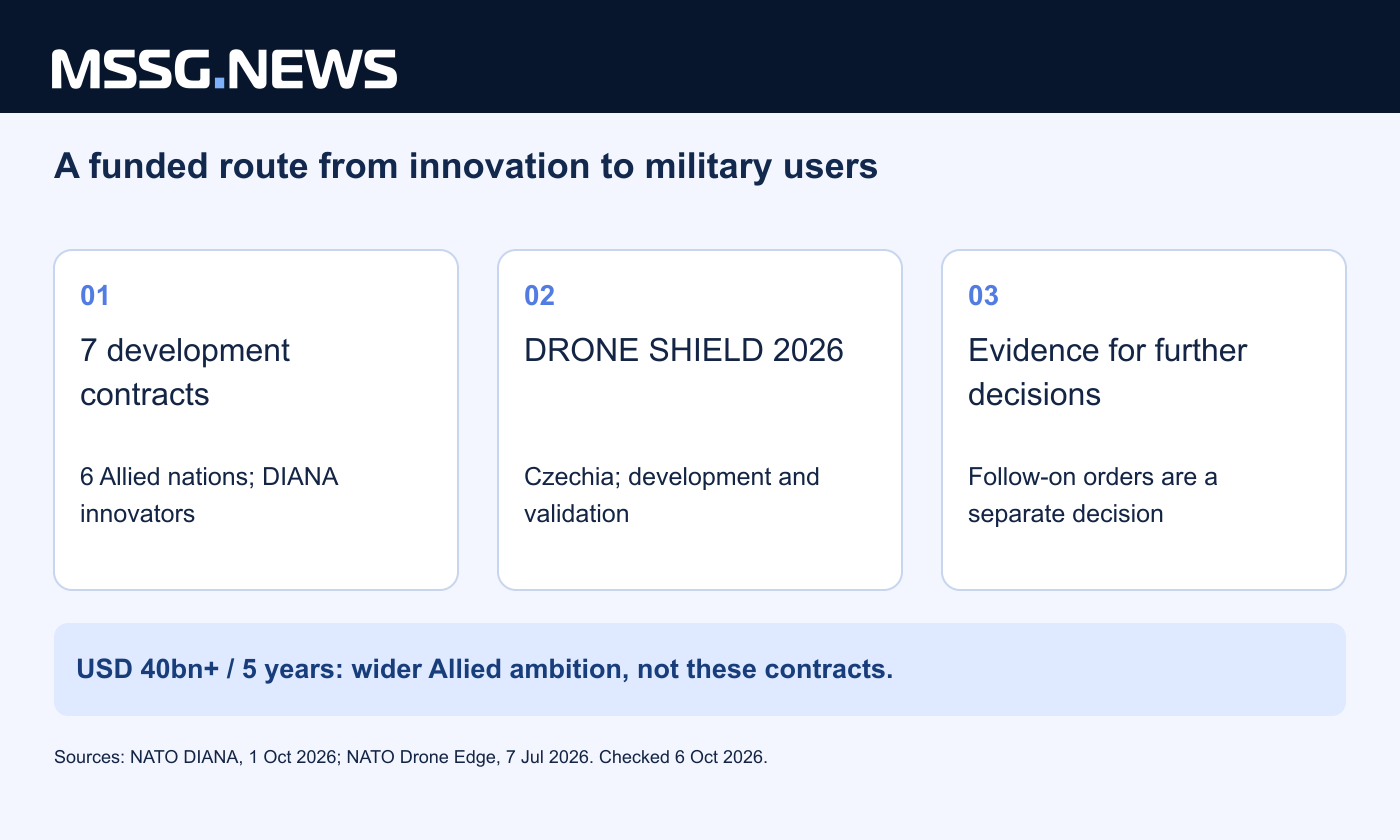
NATO is paying to move counter-drone innovation closer to military users. DIANA announced seven capability-development contracts on 1 October, the first use of its Rapid Adoption Service by NATO Headquarters. For dual-use companies, that is a concrete step beyond accelerator participation: a funded development task with an operational context.
The latest announcement names Milliray, Dronetag, Robotto AI, Arcani, Aerix Systems, NeuralAgent and Mara. They span six Allied nations. The contracts support participation in DRONE SHIELD 2026 in Czechia; they are not seven announced fleet purchases. Their practical value is the opportunity to develop against a defined defence need.
This sits inside a much larger political commitment. NATO’s July Drone Edge statement sets out more than USD 40 billion of Allied counter-drone investment over five years and a planned NATO marketplace alongside national procurement routes. That figure is an Alliance-wide ambition, not the value of the seven contracts or a DIANA grant fund.
The opportunity is in the connections
The Czech Defence Ministry’s 1 October field report records 49 counter-drone companies and 24 companies testing uncrewed ground systems, with more than 1,000 participants overall. These are different participation categories, not a count of suppliers selected for NATO contracts. The scale matters because a new entrant has to work with a crowded ecosystem of other technologies.
The ministry’s earlier explanation identifies data exchange between suppliers as a central task. A detection system can produce useful information yet fail to deliver it in the format another system needs. This makes integration a commercial issue as well as an engineering one: the customer buys a usable result, not a collection of disconnected specifications.
Our analysis: this creates an opening for firms whose expertise sits between products. Software integration, dependable data handling and user interfaces deserve attention alongside the visible hardware. A company does not need to present itself as a complete defence system to explain which part of the shared task it solves.
Why this belongs in the European security story
NATO’s Drone Edge statement explicitly links the initiative to drone warfare in Ukraine and incidents affecting Allies, particularly on the eastern flank. Russia’s war therefore matters here not only as a political background, but as a reason to shorten the gap between new technology and usable protection.
The Alliance adds something an individual startup cannot assemble on its own: a common demand context across national boundaries. In our assessment, that is the strategic significance of the seven contracts. Pooling the development problem can make a small firm’s work relevant to more than one national customer, even while purchasing decisions remain separate.
The next useful evidence is what the development work produces: better integration, clearer user requirements and results that inform subsequent decisions. The contract award already answers who has a funded opportunity. It does not yet answer which solution will receive a follow-on order. Keeping those stages separate makes the industrial story sharper, not weaker.
Sources & context
- NATO DIANA: seven capability-development contracts, 1 October 2026 ↗
- NATO: Drone Edge, 7 July 2026 ↗
- Czech Ministry of Defence: Drone Shield field report, 1 October 2026 ↗
- Czech Ministry of Defence: the integration task, 10 September 2026 ↗
Published by Mitchell Strategic Solutions Group. See our editorial standards and corrections policy. Read more →
Related reporting

NATO’s counter-drone problem is also a network problem: where 5G and dual-use fit
NATO’s quantum roadmap sets an industrial clock. Suppliers need evidence before 2027