NATO puts dual-use technology in front of operators. SHINE turns the pitch into a test
At SHINE 2026 in Canada, military users tested emerging technologies against operational problems. Ukrainian battlefield experience fed into logistics work. The industrial lesson is clear: integration evidence matters more than another demonstration.

- NATO
- Dual-use
NATO has just completed a practical test of its innovation pipeline. SHINE 2026 ran from 5 to 9 October at COVE in Dartmouth, Canada, bringing military users and technology developers into the same experimentation environment. ACT published its account on 9 October. The focus was on testing against military problems and producing evidence for further development.
One connection matters directly to European security: the NATO-Ukraine Joint Analysis, Training and Education Centre, JATEC, contributed battlefield experience to work on logistics and sustainment. It puts experience from Ukraine into the process that shapes Allied technology development, rather than leaving it in a separate lessons-learned discussion.
The programme covers a broad technological space, including AI, cyber resilience, counter-drone systems and infrastructure protection. That creates a route for civilian technology firms as well as defence specialists. The decisive question for a supplier is whether its product solves a defined user problem and works within the wider system.
Four stages make the experiment useful
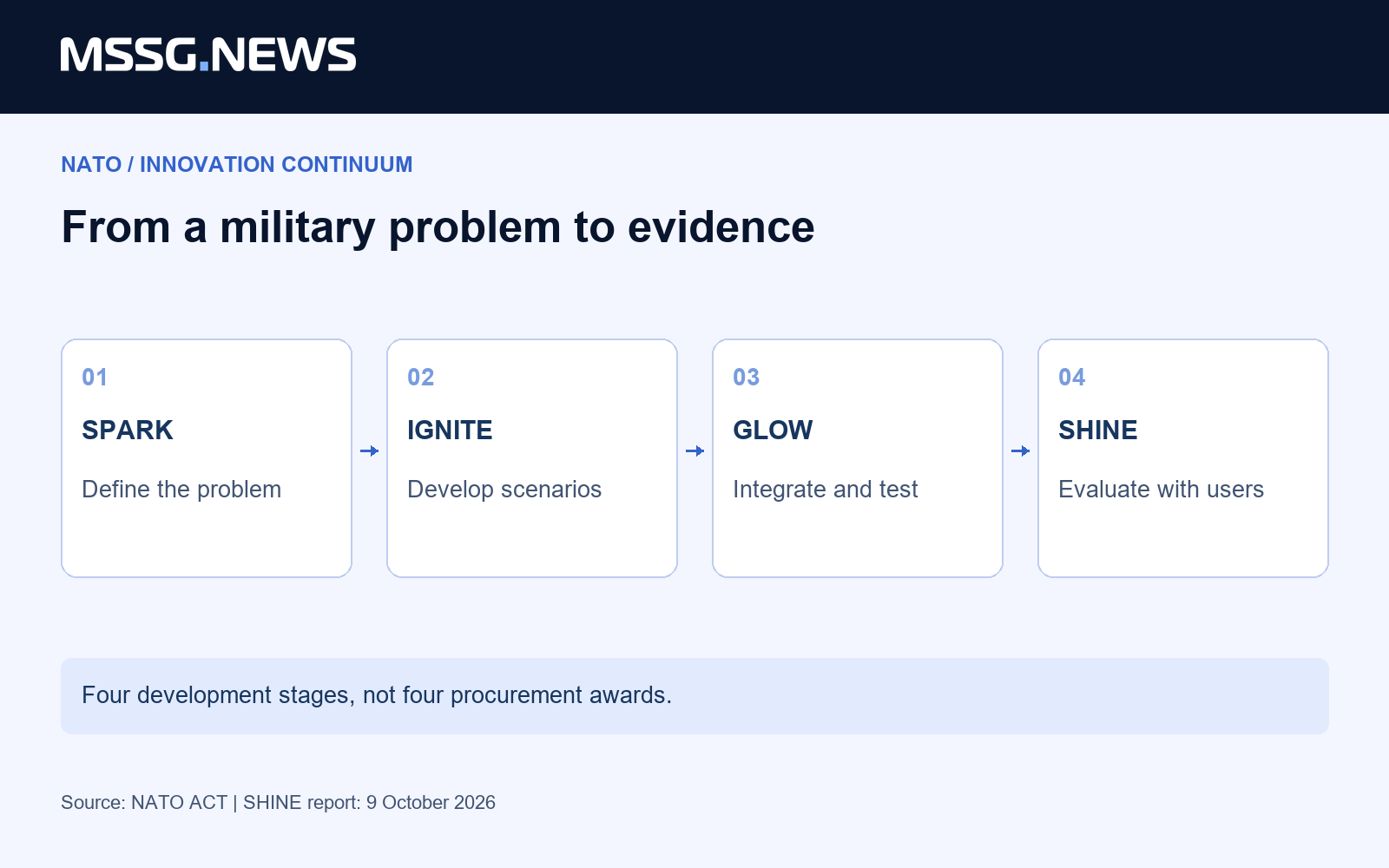
The Innovation Continuum sequences four different tasks. SPARK defines the challenge; IGNITE develops scenarios; GLOW integrates and tests technologies; SHINE evaluates them with users. In the 2026 programme, the earlier stages connected Sofia and Warsaw to Canada. These are stages of one development process, not four interchangeable trade fairs.
Our assessment is that the sequence changes what a convincing industrial proposal looks like. A polished standalone demonstration answers a narrow question: can this product work under its chosen conditions? An integrated experiment asks something harder: can another organisation use it, connect it to its systems and learn enough to decide what should happen next?
For an SME, preparation should therefore include the integration interface, the evidence already available and the remaining engineering work. Those three items make a discussion with an operator concrete. This is our recommendation for suppliers, not an additional NATO eligibility rule or an open call announced by SHINE.
The next opportunity is integration
ACT says observations from SHINE will feed the Innovation Continuum report and subsequent experimentation, including work connected to Task Force X-Arctic. Its June project description sets a demonstration objective for summer 2027 and assigns different roles to ACT, the maritime research centre CMRE and Allied Maritime Command. The October report is a new contribution to that continuing effort.
For Europe, that matters because security depends on combinations of capabilities: sensing, communications, software and people who can use them together. Civilian expertise in networks, data assurance or maintenance can become strategically useful at those interfaces. Our industrial reading is that a firm should identify the interface it improves, rather than claim to deliver an entire military capability.
SHINE’s public account reports experimentation and follow-on work; it does not announce fleet purchases or publish comparative product scores. The useful next question is specific: which observation becomes a further test, a changed requirement or a development project? That progression will show whether the experiment is shortening the path from invention to usable Allied capability.
- Event
- 5-9 October 2026, Dartmouth
- Source report
- 9 October 2026
- Output
- Experimentation evidence; follow-on development
Sources & context
- NATO ACT: SHINE results, 9 October 2026 ↗
- NATO ACT: Innovation Continuum stages ↗
- NATO ACT: Task Force X-Arctic, 12 June 2026 ↗
Published by Mitchell Strategic Solutions Group. See our editorial standards and corrections policy. Read more →
Related reporting

NATO’s quantum roadmap sets an industrial clock. Suppliers need evidence before 2027

NATO’s counter-drone problem is also a network problem: where 5G and dual-use fit