NATO’s counter-drone problem is also a network problem: where 5G and dual-use fit
ACT is bringing communications and counter-drone experimentation together. The industrial opportunity lies in keeping systems connected across vendors and nations, using lessons from Ukraine.

- NATO
- Dual-use
A counter-drone system can fail at the connection between two otherwise capable products. NATO’s current experimentation programme puts that problem at the centre: how to keep information moving across manufacturers and national systems. Our analysis is that this creates a defence opportunity for commercial communications and software expertise, not just for companies making interceptors.
In its 29 September update, Allied Command Transformation describes work linking the Digital Backbone eXperimentation programme, DiBaX, with layered counter-drone experimentation and a separate data-driven decision project. The communications work includes secure 5G and continuity across different networks when one is disrupted.
The public LCI-X programme description supplies the security context. NATO and Ukraine work through JATEC in Poland to learn from Russian drone attacks. The programme connects national systems and NATO command-and-control. This is an effort to turn wartime experience into shared Allied capability, rather than requiring every country to solve the integration problem alone.
Three industrial layers, three different problems
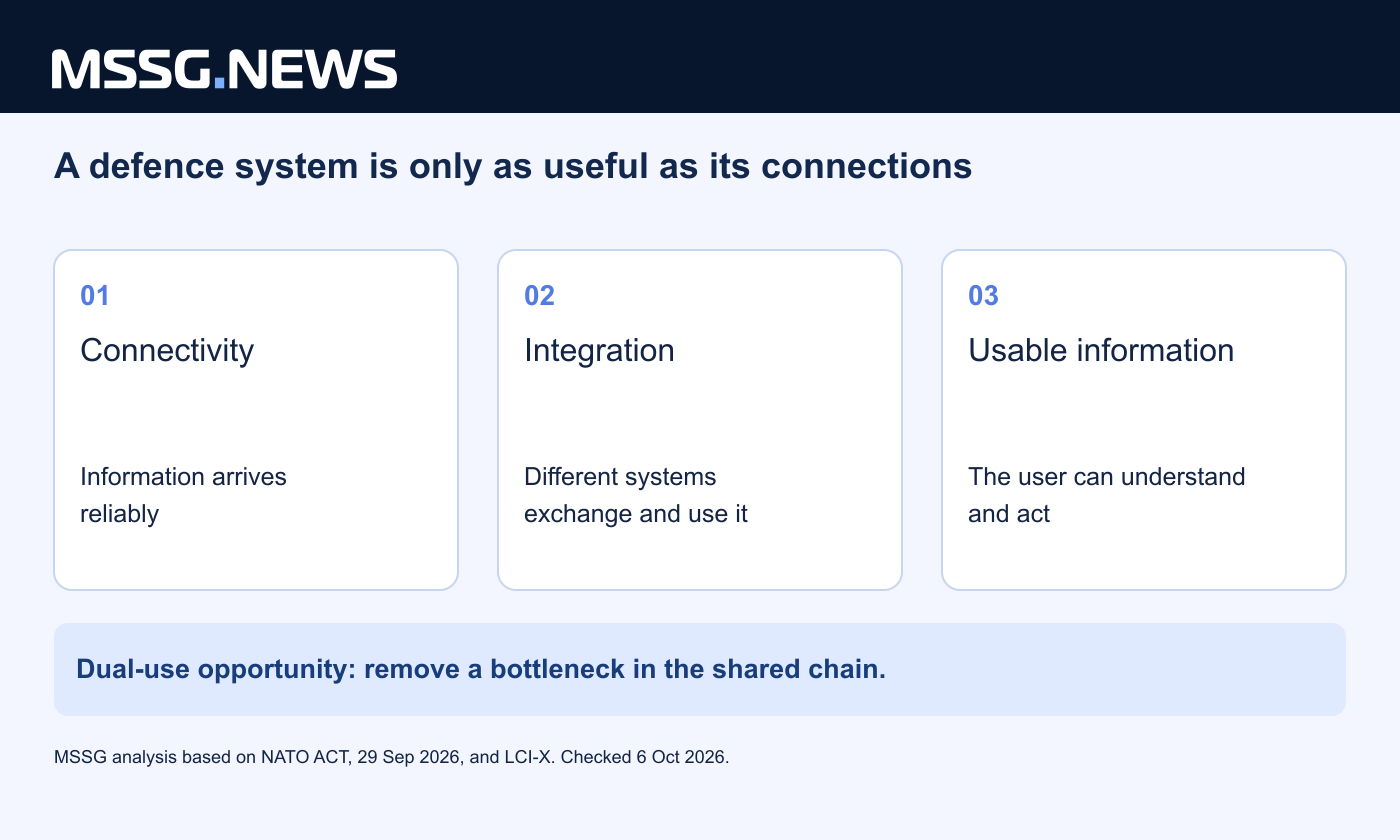
Start with connectivity. A communications supplier helps information arrive reliably. Then consider integration: the receiving system has to interpret and use it. Finally, the user needs a clear presentation that supports a decision. These are our analytical categories, not three procurement lots announced by NATO.
The distinction matters for dual-use. A firm with strong civilian networking expertise may be relevant at the first layer without owning a drone detector. An integration specialist may contribute at the second without manufacturing a radio. A software team may improve the third without building either. The useful commercial question is which failure the product removes from the shared chain.
This is also why the performance of a single component is an incomplete measure of value. A faster sensor can add little if its information cannot enter the next system. A more sophisticated display can add little if the underlying data arrive late or inconsistently. The value of an improvement depends on the bottleneck it actually changes.
NATO provides the shared test, not just another product
ACT’s August account of LCI-X Crucible 3-26 describes work with Latvia’s armed forces and the NATO Communications and Information Agency. That earlier event is context for the September update, not a newly completed October exercise. It illustrates the mix needed for integration: military users, national institutions, NATO expertise and industry.
In our assessment, the Alliance’s added value lies in arranging a problem that crosses all those boundaries. A vendor can improve its own product. It cannot alone decide what another country’s systems must share, how users will assess the result or which common working assumptions the partners will adopt. Those are collective tasks.
The programme therefore gives substance to NATO’s role in European security. Against Russia’s evolving drone threat, protection depends on the ability of Allies to work together as well as on the quantity of equipment. Learning from Ukraine and connecting national capabilities address that second requirement directly.
These are public experiments and development activities, not a report that the entire architecture is deployed. The industrial implication is nonetheless immediate: businesses should explain where their technology strengthens the common chain. That is a more useful proposition than describing an isolated product as “NATO-ready” without showing what it can connect to.
Sources & context
- NATO ACT: experimentation to capability, 29 September 2026 ↗
- NATO ACT: LCI-X and lessons from Russian drone attacks ↗
- NATO ACT: Crucible 3-26, 13 August 2026 ↗
Published by Mitchell Strategic Solutions Group. See our editorial standards and corrections policy. Read more →
Related reporting

NATO backs seven counter-drone innovators: a faster route from dual-use to defence

NATO’s quantum roadmap sets an industrial clock. Suppliers need evidence before 2027