
LIFT wins a ten-year USAF helmet contract: a route from flight tests to production
An $83.4 million ceiling gives the AV2.2 a long-term procurement framework. The initial funding and the remaining qualification work show where the programme stands.
- LIFT Airborne
- USAF
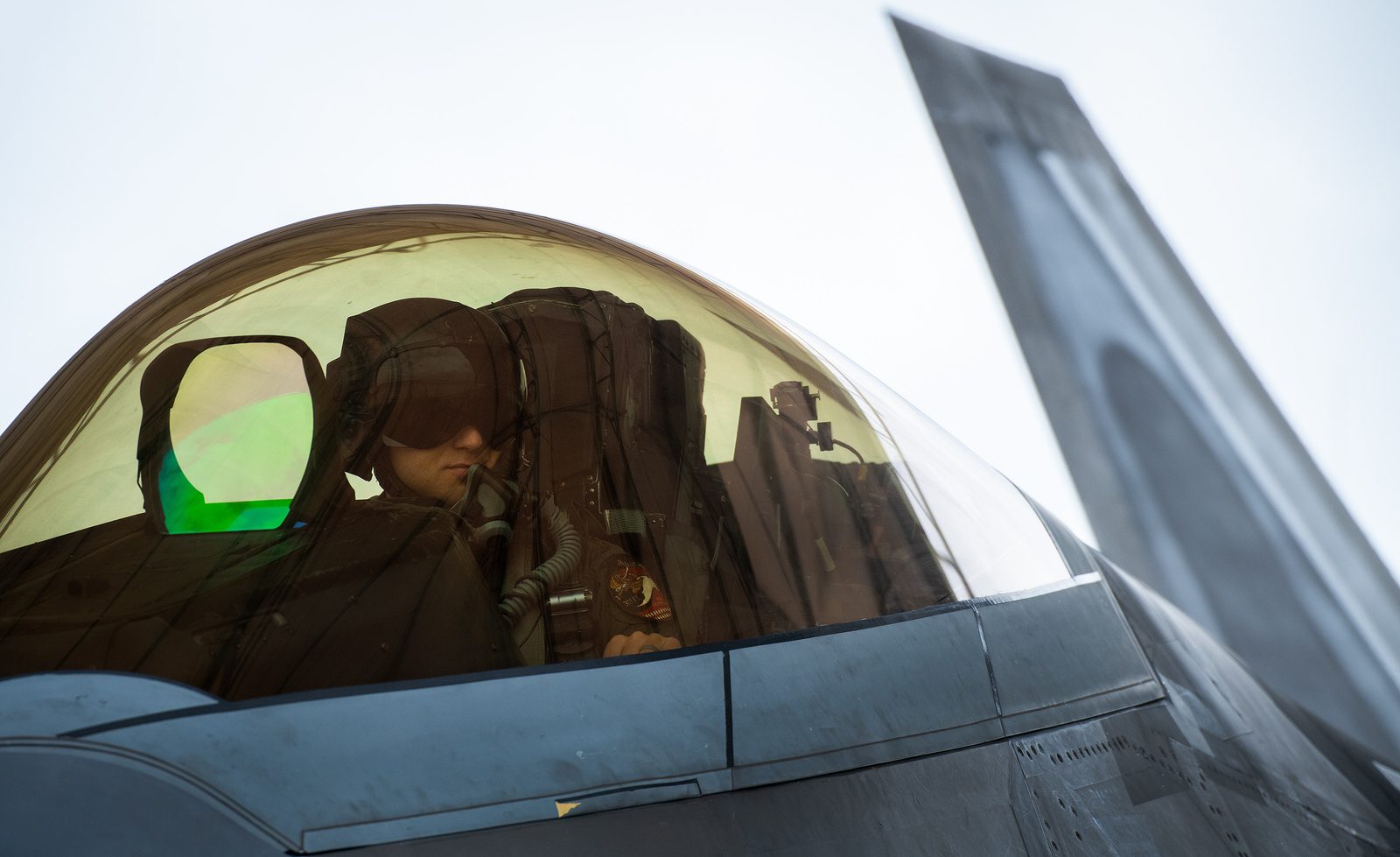
LIFT Airborne Technologies has secured a ten-year U.S. Air Force contract covering further development, qualification, production and fielding of its next-generation fixed-wing helmet. For the AV2.2 programme, the important change is a contractual route from development work to deliveries under one long-term framework.
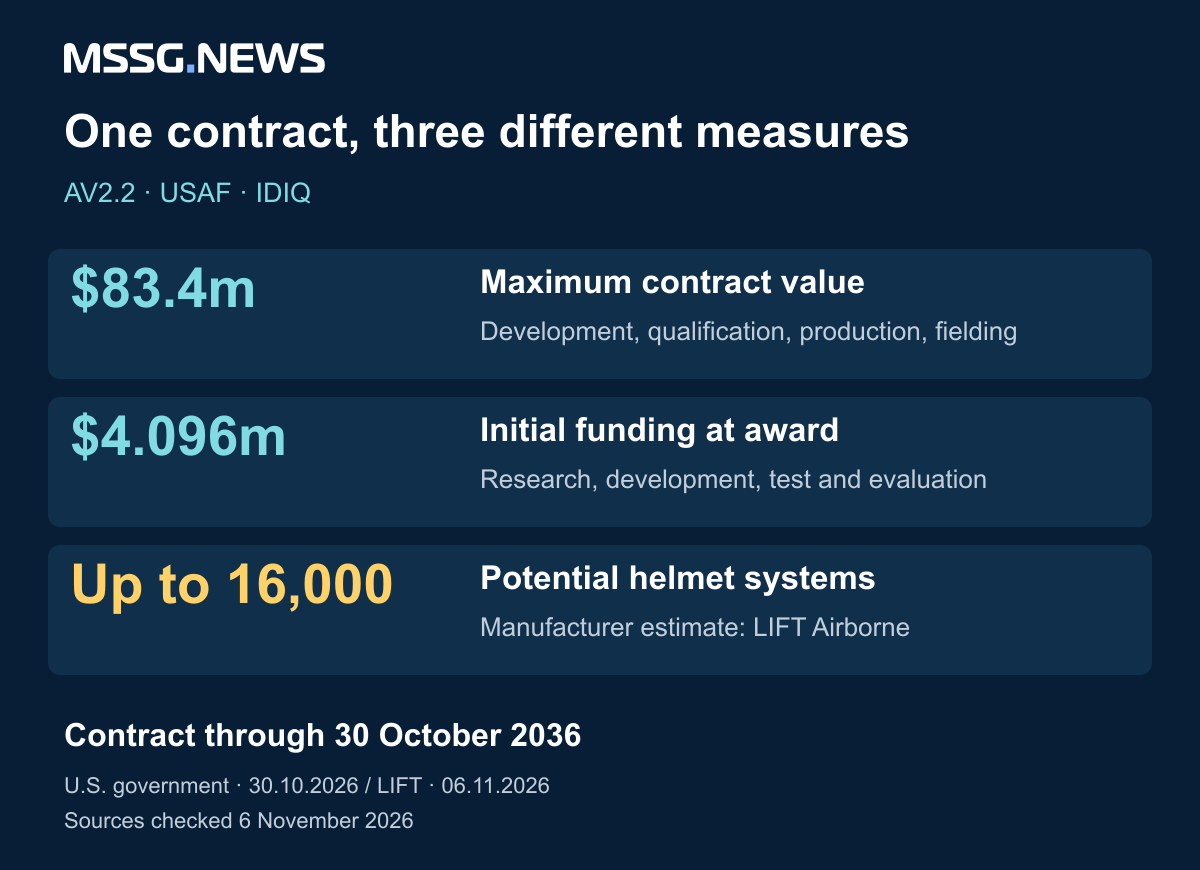
The U.S. government announced contract FA8606-27-D-B002 on 30 October. It sets a ceiling of $83.4 million and commits $4,095,959 in fiscal-year 2026 research, development, test and evaluation funding at award. Work will take place in Carson City, Nevada, with completion expected by 30 October 2036.
In the press release sent to MSSG.news on 6 November, LIFT describes a potential procurement scope of up to 16,000 helmet systems. That is the manufacturer’s anticipated quantity, not a confirmed order for 16,000 units. The IDIQ structure allows the Air Force to issue orders against the contract as requirements develop.
Three figures describe different stages
The ceiling, the initial funding and the potential number of helmets answer different questions. The $83.4 million figure defines the framework’s maximum value. The $4.096 million committed at award finances initial contracted activity. The possible 16,000 systems describe the scale envisaged by the supplier.
This also makes dividing the ceiling by 16,000 a misleading way to calculate a helmet price. The contract covers development and qualification as well as production and fielding, while the final quantities and mix of orders have not been specified in the announcement.
The helmet is also an equipment-integration platform
LIFT describes the AV2.2 around weight distribution, ventilation and modular integration with communications, oxygen equipment, night vision and future helmet-mounted displays. The engineering problem is to carry that equipment while keeping the helmet stable and usable during flight.
The Air Force’s own account of developmental testing at Eglin in April 2023 explains the practical demand. Approximately five F-22A pilots were providing feedback on wearability, visibility and communications. Engineers passed that feedback to the manufacturer. The service also highlighted built-in night-vision mounting provisions and an adjustable rear support, features that could simplify fitting and maintenance compared with the HGU-55.
LIFT now reports that the AV2.2 has passed the USAF-specific 600 KEAS sled-test requirements. This is the manufacturer’s statement about a defined test; the public contract notice still includes further development and qualification within the work to be performed.
A development programme gains a production framework
The government identifies the award as an SBIR Phase III follow-on acquisition. The procurement therefore carries earlier small-business innovation work into a contract that includes production and fielding. AFLCMC at Wright-Patterson Air Force Base is the contracting activity.
Our assessment is that this transition matters more commercially than the headline ceiling alone: LIFT has a mechanism through which the Air Force can continue development and place subsequent orders. The next milestones to watch are qualification progress and actual delivery orders, which will show how quickly that framework becomes fleet equipment.
Sources & context
- LIFT Airborne: AV2.2 contract announcement; press email received 6 November 2026 ↗
- U.S. government: contracts for 30 October 2026, FA8606-27-D-B002 ↗
- U.S. Air Force: F-22A developmental helmet testing, 10 April 2023 ↗
Published by Mitchell Strategic Solutions Group. See our editorial standards and corrections policy. Read more →
Related reporting
NATO opens a counter-drone catalogue: selection moves ahead of national orders
JASPER puts GNSS-interference awareness beside the cockpit’s existing navigation