
Galileo orders grow to 16 second-generation satellites. The new four are due in 2031.
ESA has added two spacecraft each at Airbus and Thales Alenia Space. The industrial commitment is immediate; the navigation upgrade follows a separate test, launch and service timetable.

- Galileo
- Navigation
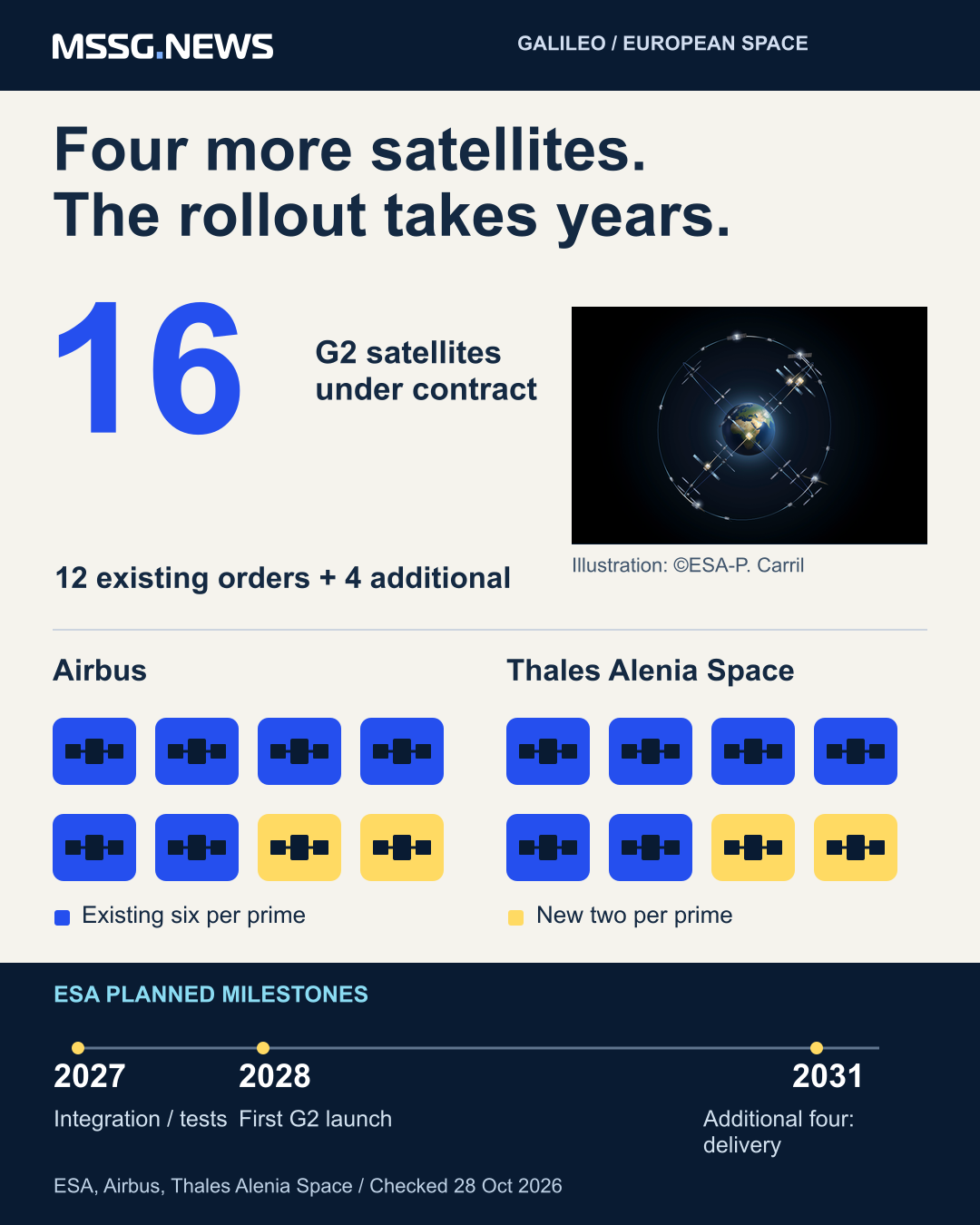
Europe has bought more continuity for its satellite-navigation programme, rather than an immediate increase in operational spacecraft. ESA announced four additional Galileo Second Generation satellites on 27 October, taking the G2 order book from twelve to sixteen. Airbus and Thales Alenia Space will each build two more.
The contracts extend the manufacturers’ existing programmes. ESA says the additional four are scheduled for delivery in 2031, with launch afterwards. The first G2 launch is planned for 2028, following integration and testing of initial spacecraft in 2027. Those are different milestones, not interchangeable descriptions of availability.
Our reading is that the award strengthens the industrial pipeline before it changes a user’s navigation performance. For buyers of timing, positioning or resilient-navigation equipment, the useful question is which capability is available now, which is being qualified, and which depends on the later constellation.
Two production lines, a longer commitment
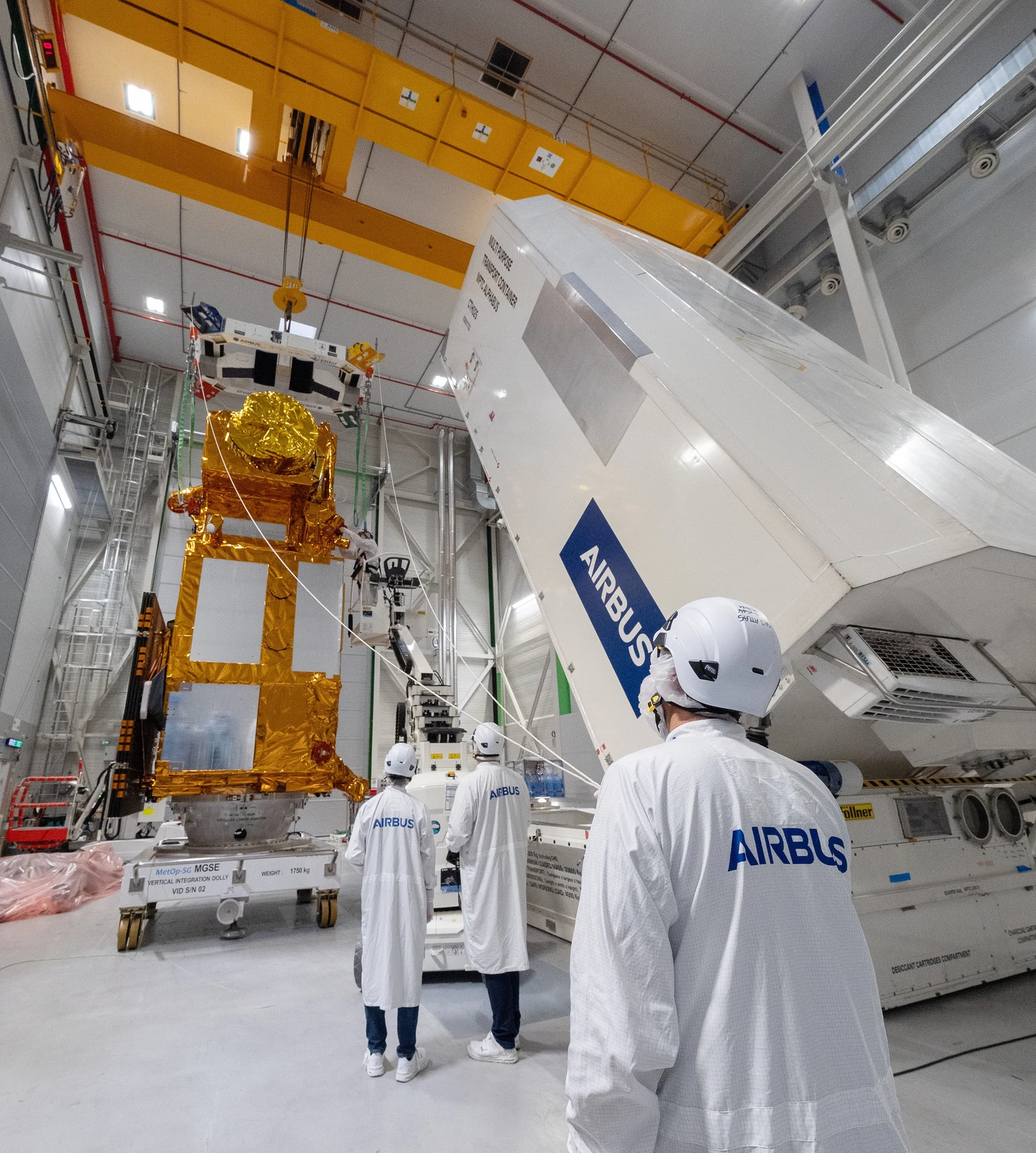
Each prime contractor previously had six G2 spacecraft under contract. The new pairs bring both manufacturers to eight. Thales Alenia Space identifies its Rome Space Smart Factory for integration and testing; Airbus names a production network across Germany, Spain and France. The announcements do not disclose a price for the additional four.
For a supplier, our analysis is that repeating an established configuration can give production and integration work a longer planning horizon. It does not, by itself, prove a new open subcontracting competition or guarantee access to either supply chain. The contracted spacecraft count is the evidence; a particular supplier’s future revenue remains a separate proposition.
Digital payloads still need an end-to-end service
ESA describes digital navigation payloads, improved antennas, inter-satellite links and advanced clock configurations. Airbus says its payload can be reconfigured in orbit and describes anti-jamming and anti-spoofing features. These are programme and manufacturer statements about the new generation, not an independent measurement of protection already available to every receiver.
A stronger space segment and a dependable user service are connected but different engineering tasks. In our view, customers should ask how receiver support, ground-system readiness, signal monitoring and service introduction fit the same timetable. An orbital feature becomes useful through that complete chain, rather than through the procurement announcement alone.
Keep the institutional responsibilities visible
The European Commission manages and funds Galileo. ESA leads technical development and qualification; EUSPA provides services and oversees operation and introduction into service. The order was placed on behalf of EUSPA for the European Union. Sixteen is the contracted G2 total, not the entire mixed-generation constellation or a count of spacecraft currently operating.
That division gives a practical way to follow progress: distinguish the industrial delivery, the technical test result, the launch and the service decision. The new award is meaningful because it extends production. Its operational value should be judged against the later evidence for those subsequent steps.
Sources & context
- ESA procurement announcement, 27 October 2026 ↗
- Airbus announcement, 27 October 2026 ↗
- Thales Alenia Space announcement, 27 October 2026 ↗
Published by Mitchell Strategic Solutions Group. See our editorial standards and corrections policy. Read more →