EUDAMED’s rollout has a boundary medtech teams cannot afford to blur
Four modules became mandatory in May. The vigilance and post-market surveillance module is still in development. That distinction separates database implementation from the manufacturer’s ongoing monitoring responsibilities.
- medtech
- EUDAMED
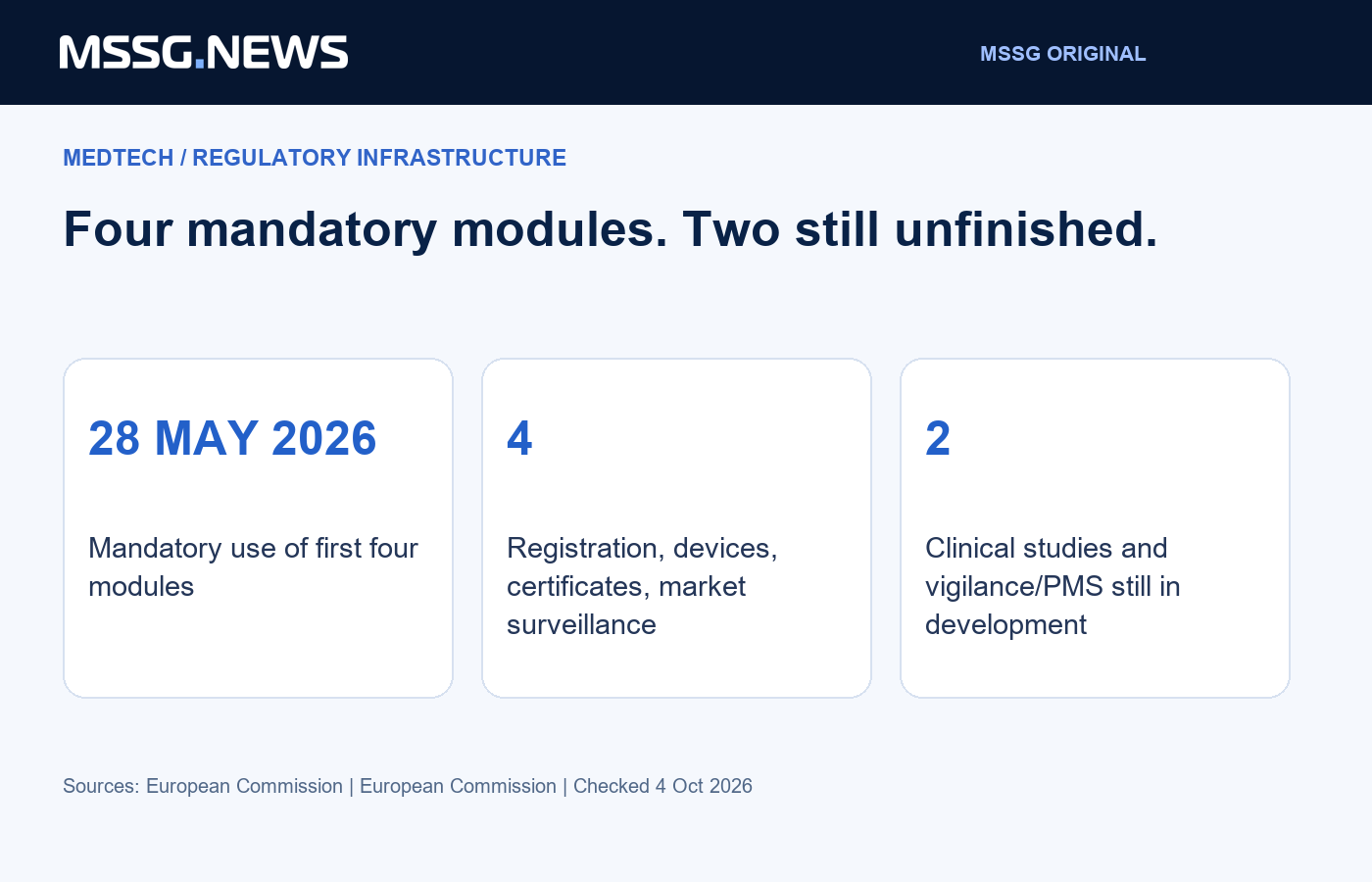
EUDAMED is now a mandatory part of several European medical-device processes, but its rollout is not complete. The European Commission’s overview says four modules became mandatory on 28 May 2026. It separately lists vigilance and post-market surveillance, and clinical investigations and performance studies, as unfinished modules.
The four mandatory modules concern actor registration, UDI/device registration, notified bodies and certificates, and market surveillance. The last of these serves competent authorities and the Commission. It should not be confused with a manufacturer’s post-market surveillance process simply because the names sound similar.
This boundary is particularly relevant during the 6-8 October European PMS and Vigilance conference in Amsterdam. The meeting brings monitoring and vigilance specialists together; it does not change the legal status of EUDAMED modules. We checked the Commission’s implementation overview on 4 October.
A platform milestone is not the whole lifecycle
A manufacturer needs to connect information about a device with experience after it reaches users. Registration establishes identifiable records; monitoring asks what subsequent evidence says about performance and safety. Treating the former as a substitute for the latter would leave a basic information gap.
MSSG.news’s organisational reading is that regulatory, quality and technical teams need one consistent device identity and a shared escalation process. A change in database obligations can expose weaknesses in ownership and data quality that were already present internally.
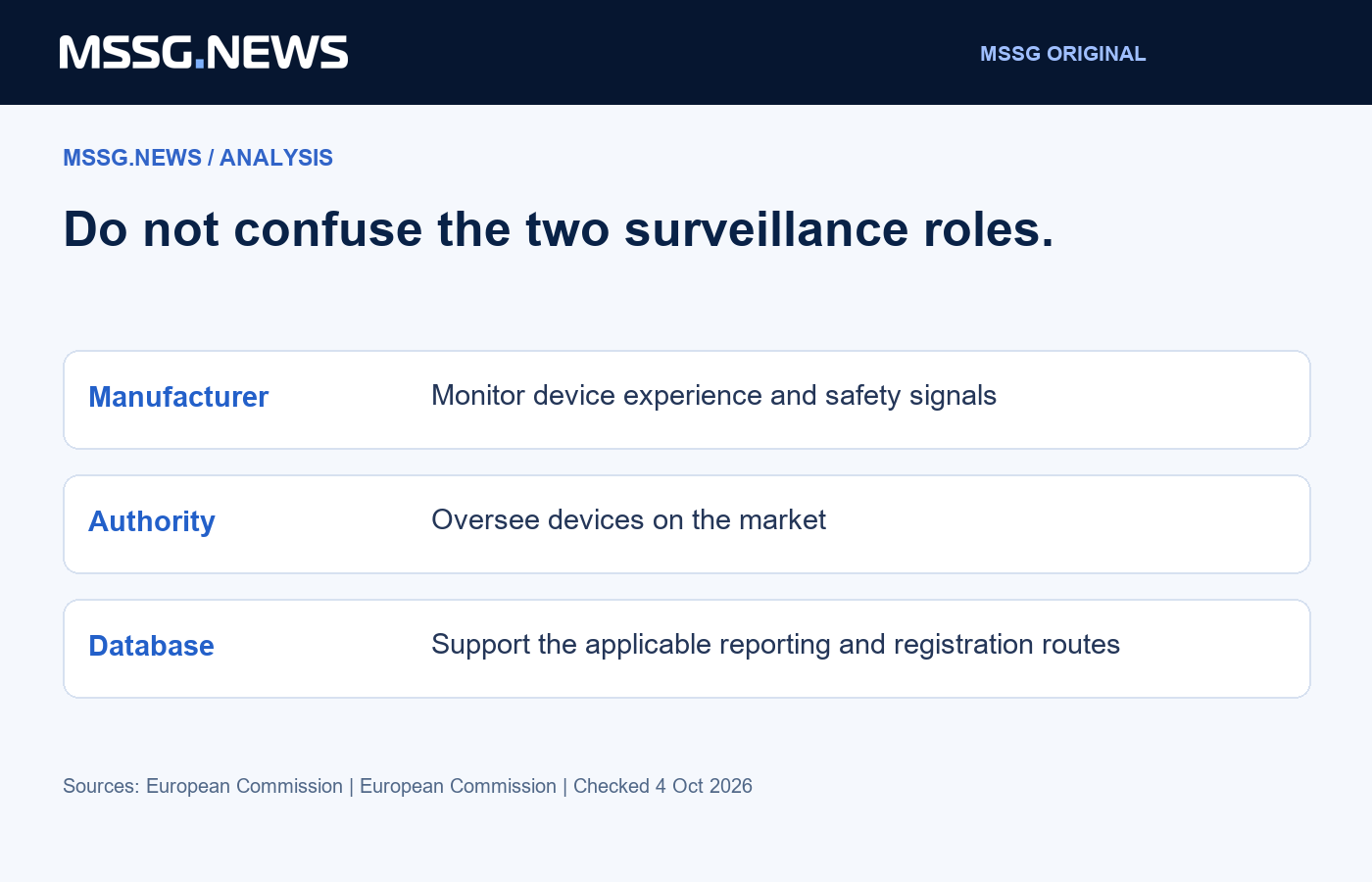
Two meanings of surveillance
Market surveillance involves oversight by competent authorities. Post-market surveillance is the manufacturer’s monitoring of the device after market placement. Vigilance includes the relevant incident and corrective-action processes. The distinctions matter when deciding who collects information, who evaluates it and which route is used to report it.
The Commission published MDCG 2025-10 guidance in December 2025 covering post-market surveillance for medical devices and in vitro diagnostics. Its availability and the database rollout belong to different layers of the system. Teams should use the applicable legal and guidance documents for their own device category and role.
The workflow worth examining
Our suggested organisational test follows information through collection, evaluation, decision and follow-up. Can a reported issue be linked to the right device and version? Does someone own the assessment? Can the team retrieve the rationale for action or for continuing observation? These are process questions, not a new official checklist.
The practical takeaway is to maintain a module-by-module implementation map alongside the monitoring workflow. EUDAMED’s staged rollout makes that separation essential. A module still being developed is a platform fact; it is not a reason to suspend the underlying work of understanding device experience.
Sources & context
- European Commission: EUDAMED overview and mandatory modules from 28 May 2026 ↗
- European Commission: MDCG 2025-10 post-market surveillance guidance ↗
- Organiser: European Medical Device and Diagnostic PMS and Vigilance Conference, 6-8 October 2026 ↗
Published by Mitchell Strategic Solutions Group. See our editorial standards and corrections policy. Read more →
Related reporting
Europe is spending more on defence. It still buys too much in separate lanes.

EU and Singapore examine undersea infrastructure security. Cooperation is still being defined