Europe is spending more on defence. It still buys too much in separate lanes.
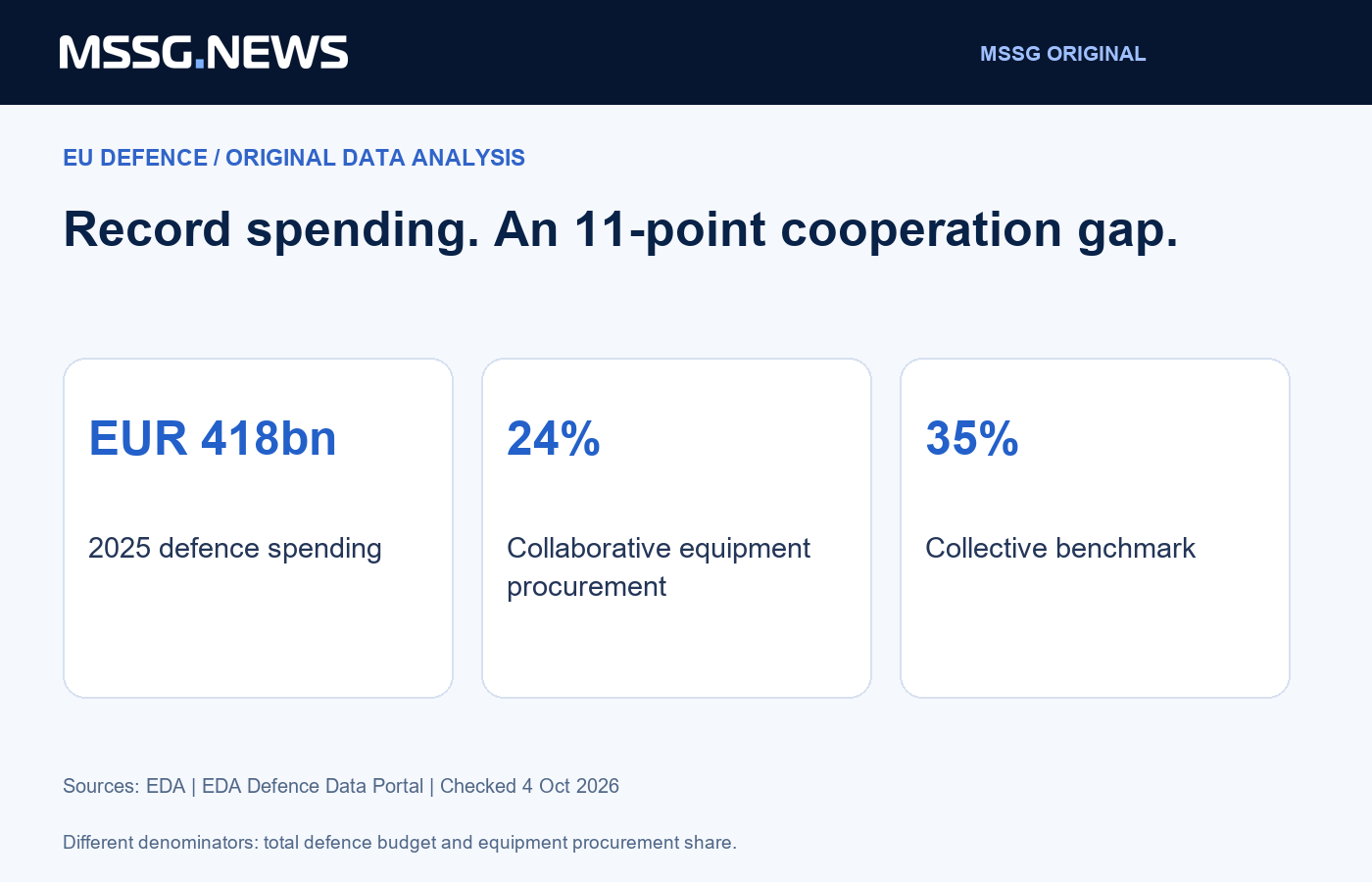
EDA puts EU defence spending at EUR 418 billion in 2025. Collaborative equipment procurement was 24%, still 11 percentage points below the collective benchmark. Our analysis explains why the spending boom alone cannot fix industrial fragmentation.
- EU
- EDA
Europe’s defence spending boom has a cooperation problem. The European Defence Agency records EUR 418 billion in spending by the EU’s 27 states in 2025, up 20% from 2024. Yet collaborative procurement represented only 24% of equipment spending. The collective benchmark on EDA’s data portal is 35%. MSSG.news calculates an 11-percentage-point gap.
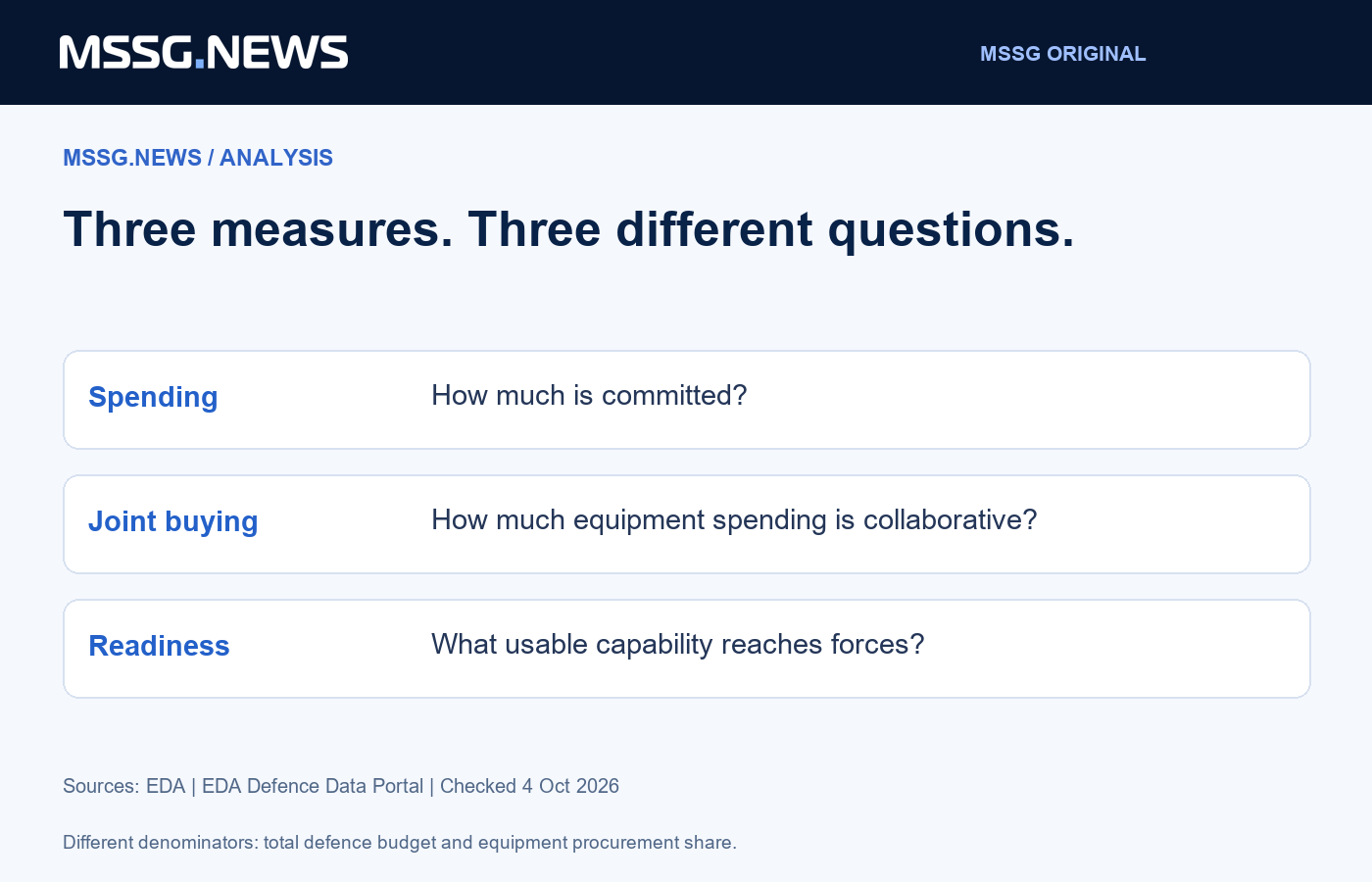
That gap matters because larger national budgets can still sustain separate specifications, small production runs and incompatible support arrangements. Money changes the size of the market; the structure of purchasing changes how efficiently industry can serve it. The two should not be treated as the same success metric.
EDA published these figures on 16 July. We revisit them as an industrial baseline for the autumn, rather than presenting them as a new October statistical release. The agency’s EUR 454 billion figure for 2026 is a projection, so our graphic keeps it separate from the recorded 2025 spending.
One denominator makes the difference
The 24% share concerns equipment spending. It is not 24% of the entire EUR 418 billion defence budget. Applying that percentage to all defence expenditure would mix different measures and produce a misleading euro total. The 35% benchmark uses total equipment spending as its reference.
The difference is 11 percentage points, not an 11% shortfall. These distinctions are easy to lose in a headline, but they determine whether a chart says anything useful about procurement. Our visual deliberately compares the two shares without converting them into a made-up common spending envelope.
Why a common order can change factory economics
MSSG.news’s industrial reading is that a shared specification gives suppliers a more coherent demand signal. A manufacturer can plan tooling, qualification and support around a larger common requirement instead of repeatedly adapting the same product for separate small orders. That potential depends on governments actually aligning their needs.
Joint procurement also creates choices about lead buyers, delivery schedules and responsibility for maintenance. Calling a project European does not settle those questions. The useful measure is whether cooperation reduces duplication while preserving an executable route from contract to available equipment.
The metric worth watching next
The next comparison should track collaborative procurement alongside total spending, equipment purchases and delivery performance. A rising budget with an unchanged collaboration share would indicate that scale and integration are moving at different speeds. That is an analytical test, not a forecast about the next EDA release.
For smaller suppliers, the practical consequence is to map the participating buyers and integrators behind a common programme. The size of Europe’s budget attracts attention; a defined requirement, accessible procurement route and credible production schedule create the actual business opportunity.
Sources & context
- EDA: Defence Data 2025-2026 announcement, 16 July 2026 ↗
- EDA Defence Data Portal: collective equipment procurement benchmark ↗
Published by Mitchell Strategic Solutions Group. See our editorial standards and corrections policy. Read more →