
Ukraine-Moldova defence agreement puts maintenance and testing alongside new projects
The five-year framework covers the working life of equipment as well as research. Its practical value will depend on specific projects and responsibilities.
- Ukraine
- Moldova
Ukraine and Moldova have signed a military-technical cooperation agreement covering equipment support, specialist training, testing and joint development. Ukraine’s defence ministry announced the framework on 26 October; the Cabinet of Ministers separately confirmed the signing that day.
The industrial significance is the breadth of the proposed cooperation.
Repair and maintenance appear alongside research and technology exchange. Our assessment is that this creates room to discuss the support needed to keep equipment useful, rather than concentrating only on a new product demonstration.
A framework spanning equipment and people
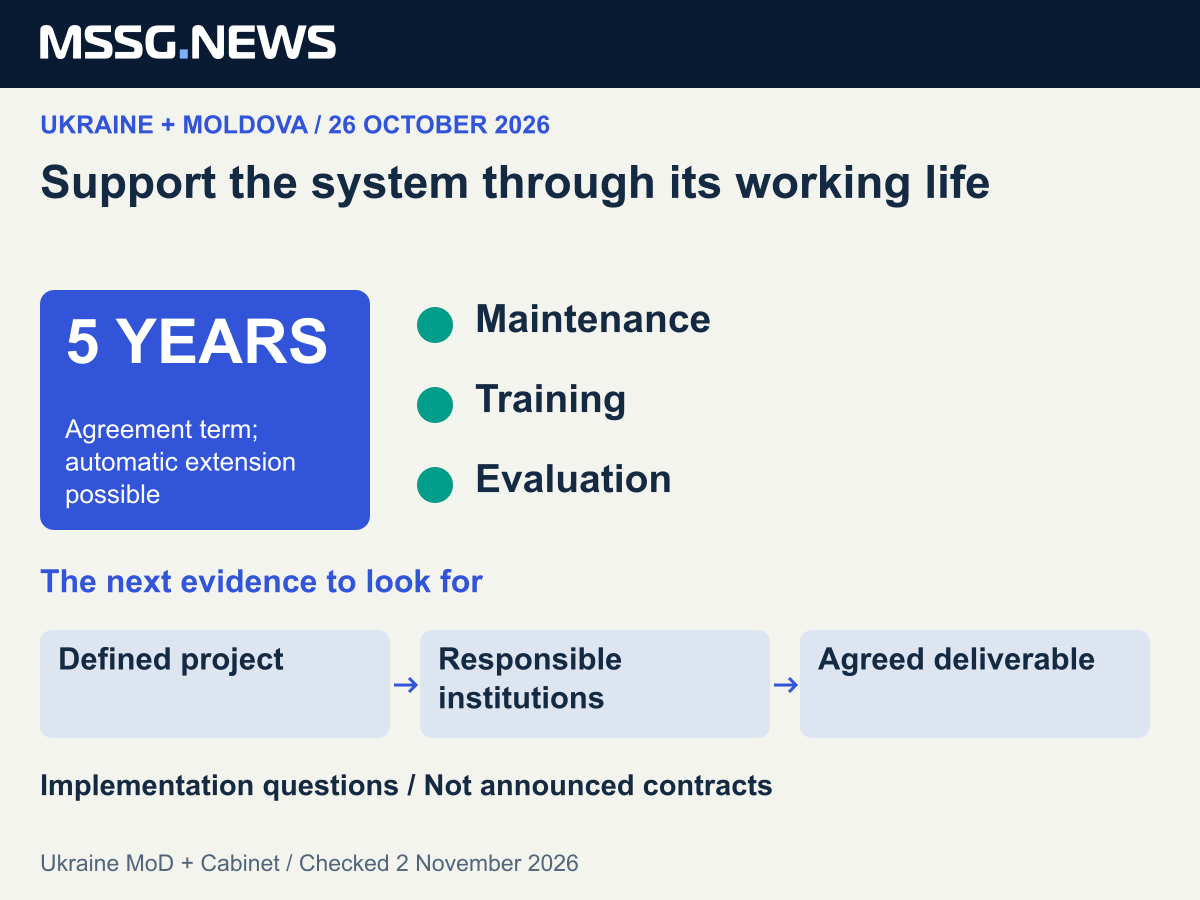
The ministry describes a five-year agreement with provision for automatic extension. Its stated fields include equipment modernisation and maintenance, logistics and infrastructure protection, professional training, product evaluation, joint research, cyber defence and airspace protection. The ministry says implementation preserves Moldova’s constitutional neutrality.
The announcement describes consultations, technical and scientific exchanges and work on identified projects. It does not identify a company competition, an awarded industrial contract or a delivery schedule. Those are the details that would make a particular commercial opportunity assessable.
The overlooked industrial task: supporting an existing system
For a potential equipment or engineering partner, the useful distinction is between supplying a component and accepting responsibility for a system over time. A repair project needs an agreed configuration and access to relevant documentation. Training needs a defined user group and a way to establish whether the required skills were acquired. These are our implementation questions, not obligations announced in the agreement.
Testing has a similar boundary. A result obtained with one configuration should identify that configuration and its conditions before another customer relies on it. Discussing evaluation in the same framework as maintenance could help connect a test finding to a practical change. The public statement does not establish that such a shared procedure already exists.
Follow the project, not just the signing
The Cabinet’s account places the agreement within wider bilateral discussions on transport, energy and European integration. That context helps explain the relationship, but it should not be read as a single combined funding programme. The defence announcement remains the source for the military-technical scope.
The next useful evidence would be a named work package, responsible institutions, an agreed deliverable and published participation or procurement terms where relevant. A manufacturer can then judge the required support and resources. Until those details emerge, the agreement is a framework for cooperation rather than an order book.
Sources & context
Published by Mitchell Strategic Solutions Group. See our editorial standards and corrections policy. Read more →
Related reporting
DIANA and Ukraine sign a testing partnership. The practical work starts with requirements.

Ukraine wants predictable defence orders. Factory capacity is the other half of the bargain.