

Ukraine wants predictable defence orders. Factory capacity is the other half of the bargain.
A 24 October meeting with manufacturers puts realistic capacity, procurement visibility and domestic military needs ahead of proposed controlled exports.

- Ukraine
- Defence industry
Ukraine’s Ministry of Defence has brought manufacturers into a discussion about predictable procurement and the production capacity behind it. Its account of the 24 October meeting frames the relationship as reciprocal: clearer state demand must be matched by credible industrial delivery.
The announcement is a statement of priorities, not a new purchasing calendar or a contract award. It does not quantify extra orders, approve a specific export transaction or name a factory receiving expansion funding.
The distinction between demand and capacity is the useful industrial question. A production line is not secured by an expression of interest; a state order is not delivered simply because a manufacturer announces a nominal output rate.
Forecasts need to become delivery assumptions
The ministry asks industry for realistic assessments of production capacity, technological development and growth. It identifies the needs of the armed forces as the primary criterion and calls for profits to be reinvested in modernisation and expansion.
Our reading is that a useful production forecast should distinguish installed equipment from sustainable output, and available output from capacity committed elsewhere. Predictable demand becomes more valuable when it includes a stable product definition and a decision timetable. A credible capacity commitment needs corresponding assumptions about components, staffing and acceptance. None of those detailed commitments is published in this meeting notice.
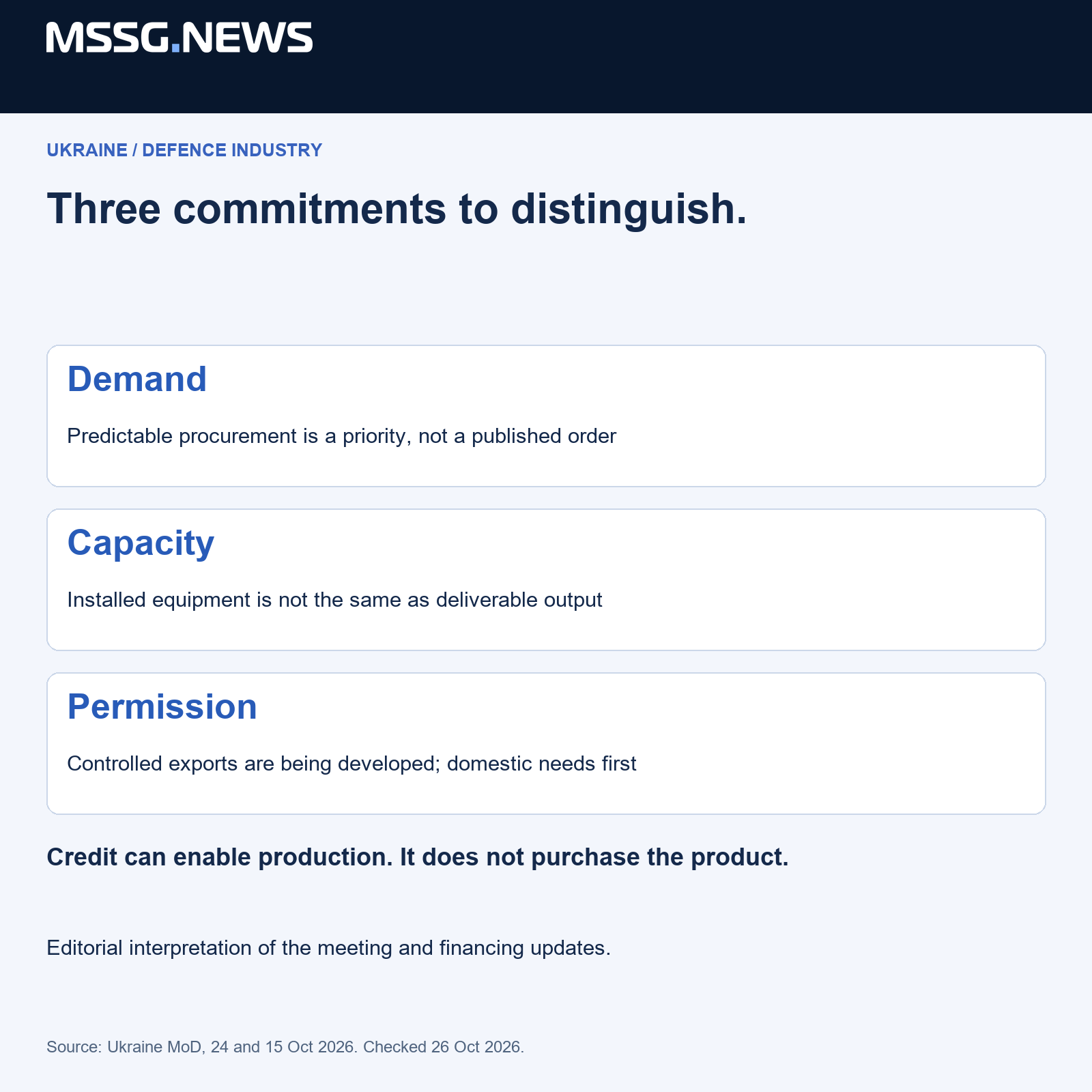
Finance enables production; it does not buy the output
The ministry’s 15 October financing update reported 211 concessional loan agreements totalling UAH 12,509.88 million. It described a 5% annual borrower rate, investment lending for up to five years and working-capital lending for up to three. Those financing arrangements are separate from the procurement discussion.
Credit can finance equipment or the period between purchasing inputs and receiving payment. It does not establish who will buy the finished product, which configuration will be accepted or when payment falls due. Conversely, a stated requirement without workable financing can leave an order beyond the supplier’s deliverable capacity. Matching those two timetables is a commercial task, not a result established by the loan total.
Controlled exports remain conditional
The 24 October statement says mechanisms for controlled exports are being developed, with domestic military requirements supplied first. It presents export opportunities as a possible route to wider markets, scale and reinvestment. That is not a general opening of exports or approval for a named sale.
European partners should keep three conversations distinct: what Ukraine needs, what an industrial partner can reliably deliver and what cross-border activity is authorised. A partnership becomes more assessable when each has an identified decision-maker and evidence. The meeting sets the direction; signed orders, capacity evidence and applicable permissions would establish the transaction. The public statement does not transfer any of those decisions to a prospective foreign partner.
Sources & context
Published by Mitchell Strategic Solutions Group. See our editorial standards and corrections policy. Read more →
Related reporting

Britain opens a permanent industrial gateway in Kyiv. SMEs need more than another trade mission

TrophyLab: more than 430 applications for access, not 430 approved users