Ukraine cleared more domestic defence models by 25 September than in all of 2025
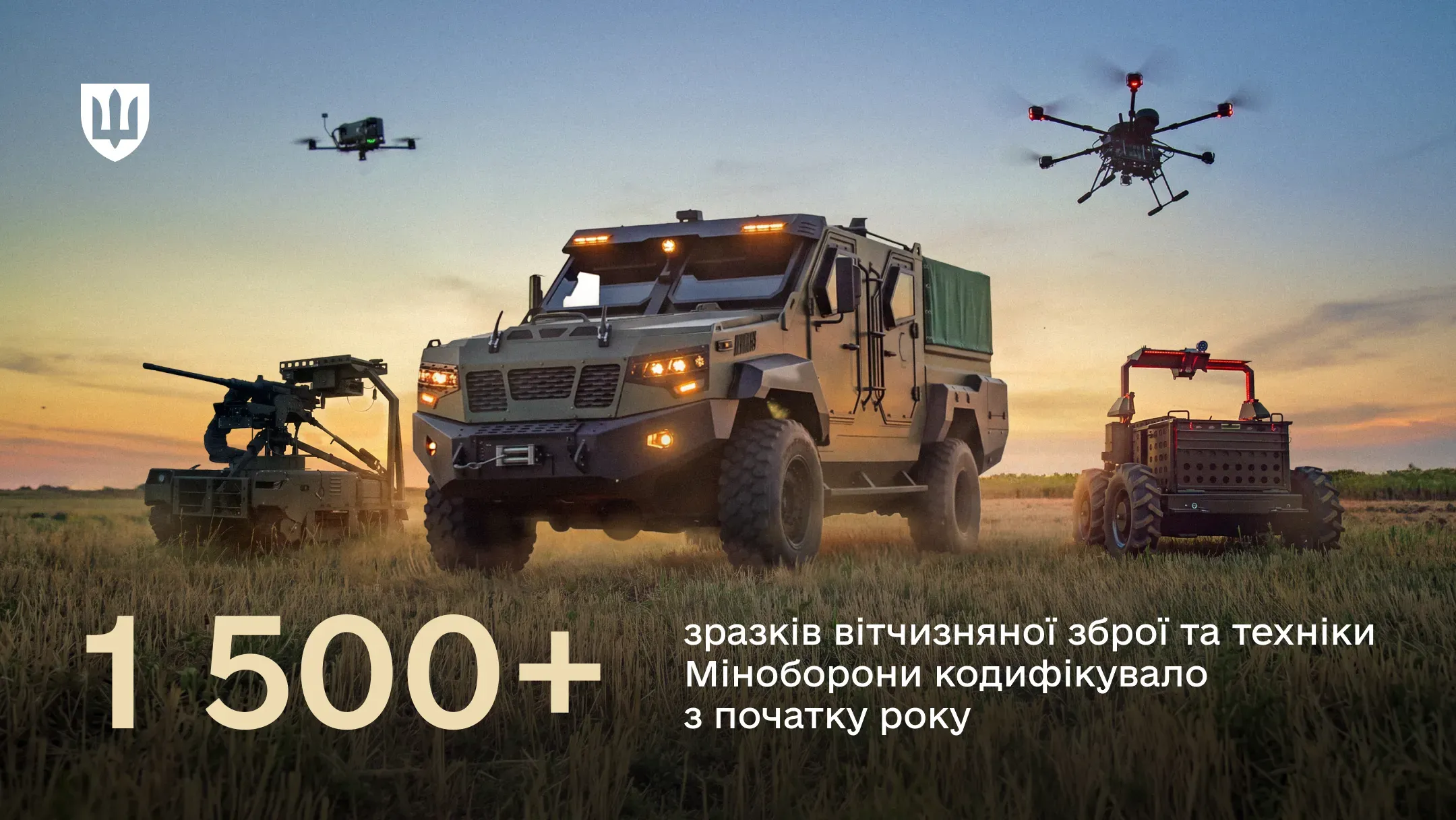
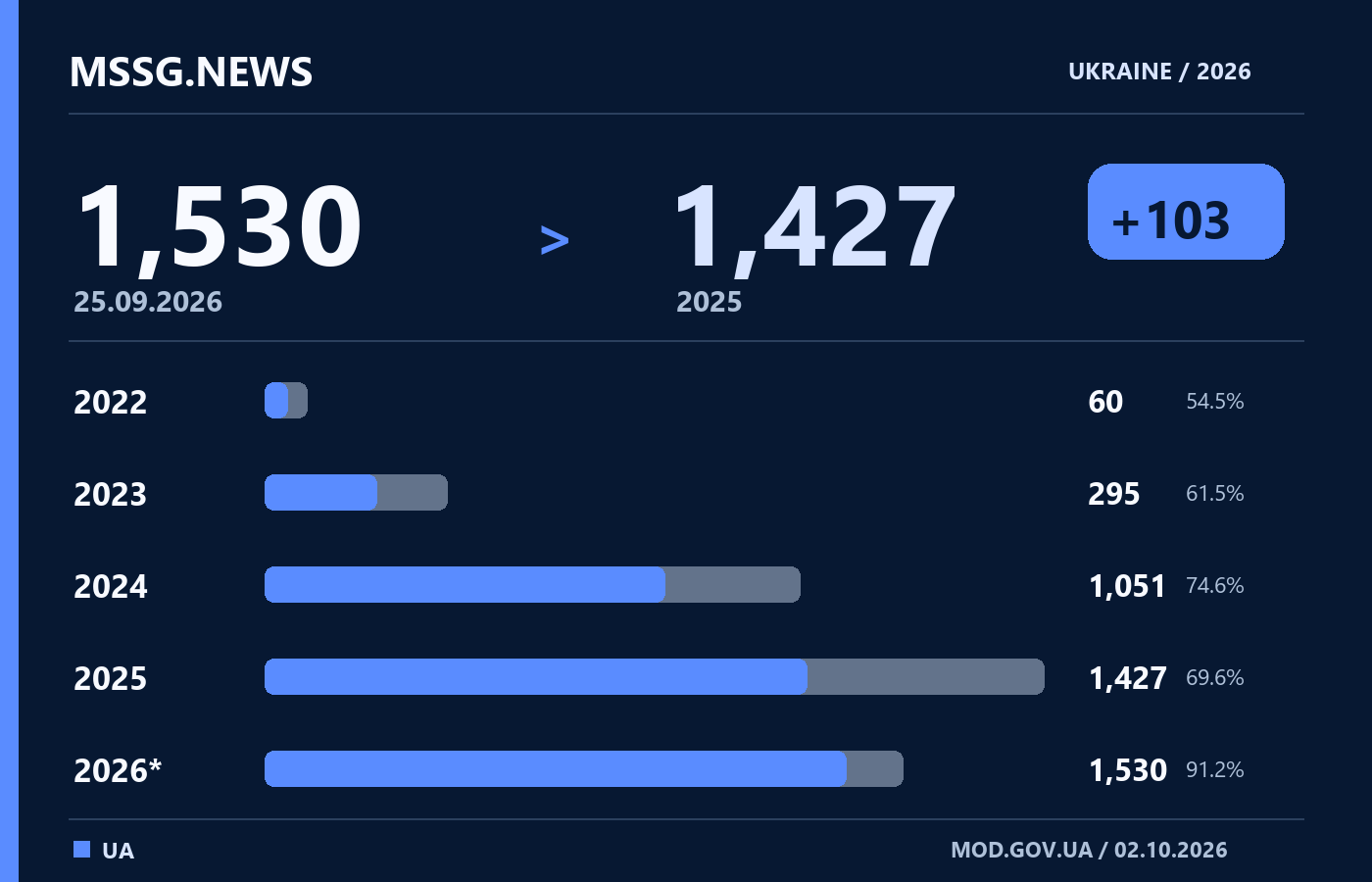
By 25 September, Ukraine had codified 1,530 domestically made weapon and equipment models, already 103 more than in the whole of 2025. The bigger story is the shift in the approval pipeline: 91.2% of this year's newly codified models were Ukrainian-made.
- Ukraine
- defence industry
Ukraine's defence ministry has admitted more domestically made weapon and equipment models for operational use in the first nine months of 2026 than it did during all of 2025. By 25 September, 1,530 Ukrainian-made models had been codified, against 1,427 across the previous full year. MSSG.news calculated the 103-model difference from the ministry's newly published annual table.
The composition of that pipeline changed just as sharply. Domestic products accounted for 91.2% of the 1,678 newly codified models in the partial 2026 data, up from 69.6% of 2,050 in 2025: a rise of 21.6 percentage points. That is not a simple five-year climb. Ukraine's domestic count also grew in 2025, but its share fell from 74.6% in 2024. The latest figure reverses that share decline while surpassing last year's domestic count before year-end.
Codification is a formal gate for a defined model, not a count of factory output. According to the ministry, the process records a product's identity and characteristics, places it in the supply catalogue and assigns a NATO stock number. It makes official procurement possible. These numbers do not say how many units were ordered, built, delivered or effective in combat; those are different measures of industrial and military performance.
A larger route into the supply catalogue
The ministry's 2026 procedural changes help explain why codification is a useful indicator to watch. In March it separated technical evaluation from an immediate state declaration of demand. A product can be codified even if it is not in a current purchasing plan. That creates a route for manufacturers to establish a formally identified model before a buyer commits to an order. It also moves a crucial decision downstream: a procurement authority still has to identify a need, fund a purchase and choose a supplier.
The ministry says earlier changes shortened the codification process from months to roughly ten days for the relevant procedure. Its October figures are consistent with a much larger throughput than in 2022, when 60 domestic models were admitted. They do not isolate how much of the 2026 increase came from faster administration, more manufacturers or new designs. Treating the whole increase as the measured effect of one reform would overstate the evidence.
A model count also reflects how products evolve
One more distinction matters in a fast-changing equipment market: not every revision becomes a new model. The ministry explains that a substantial redesign with changed performance can need its own codification and stock number. Smaller improvements may retain the existing number after the prescribed checks, while equivalent replacement components can also remain within the same model record. The annual total therefore tracks the official catalogue's model decisions, not every engineering iteration.
For Ukrainian manufacturers, the milestone makes a stronger case that the formal entry pipeline is no longer only a story about a few prototypes. The next test is whether domestic designs also take a larger share of actual orders and deliveries. Compare the catalogue by category with contract awards, production continuity and feedback from users. A large gap would tell buyers where to investigate: demand, budgets, manufacturing capacity or adaptation after field use. The ministry's annual table provides the first half of that comparison; procurement and delivery figures would complete it.
Sources & context
- Ukraine Ministry of Defence: 2022-2026 codification figures, 2 October 2026 ↗
- Ukraine Ministry of Defence: adoption, authorisation and codification explained, 18 April 2025 ↗
- Ukraine Ministry of Defence: decoupling codification from immediate demand, 2 March 2026 ↗
- Ukraine Ministry of Defence: when a modified model needs a new code, 1 February 2026 ↗
Published by Mitchell Strategic Solutions Group. See our editorial standards and corrections policy. Read more →
Related reporting
Ukraine pitches its counter-drone technology to the JEF: from aid recipient to security supplier
Ukraine puts interceptor supply at the centre of its German industrial push