

NATO brings exercise-content tools into Maven for Steadfast Dagger
The Joint Warfare Centre is using its ECCOH content hub within the Maven ecosystem as headquarters train for the Allied Reaction Force's 2027 role. The work reaches the team that builds the exercise, as well as the people taking part.
- NATO
- Exercises
NATO's Joint Warfare Centre is using a new content-development capability inside the Maven ecosystem during STEADFAST DAGGER 2026. The exercise began on 24 November and prepares the Allied Reaction Force's headquarters and component commands for their 2027 role.
JWC's announcement names the Exercise Content Creation Operational Hub, or ECCOH, alongside NATO Maven Smart System. The immediate story is a change in how a headquarters exercise is prepared and run: software is supporting the exercise-making work behind the training audience.
Nearly 1,600 military and civilian personnel are participating. The exercise rehearses non-Article 5 operations outside the Alliance's area of responsibility, bringing military activity and civil actors into the same fictional crisis. The announcement describes an exercise under way, rather than its final results.
The exercise needs its own production team
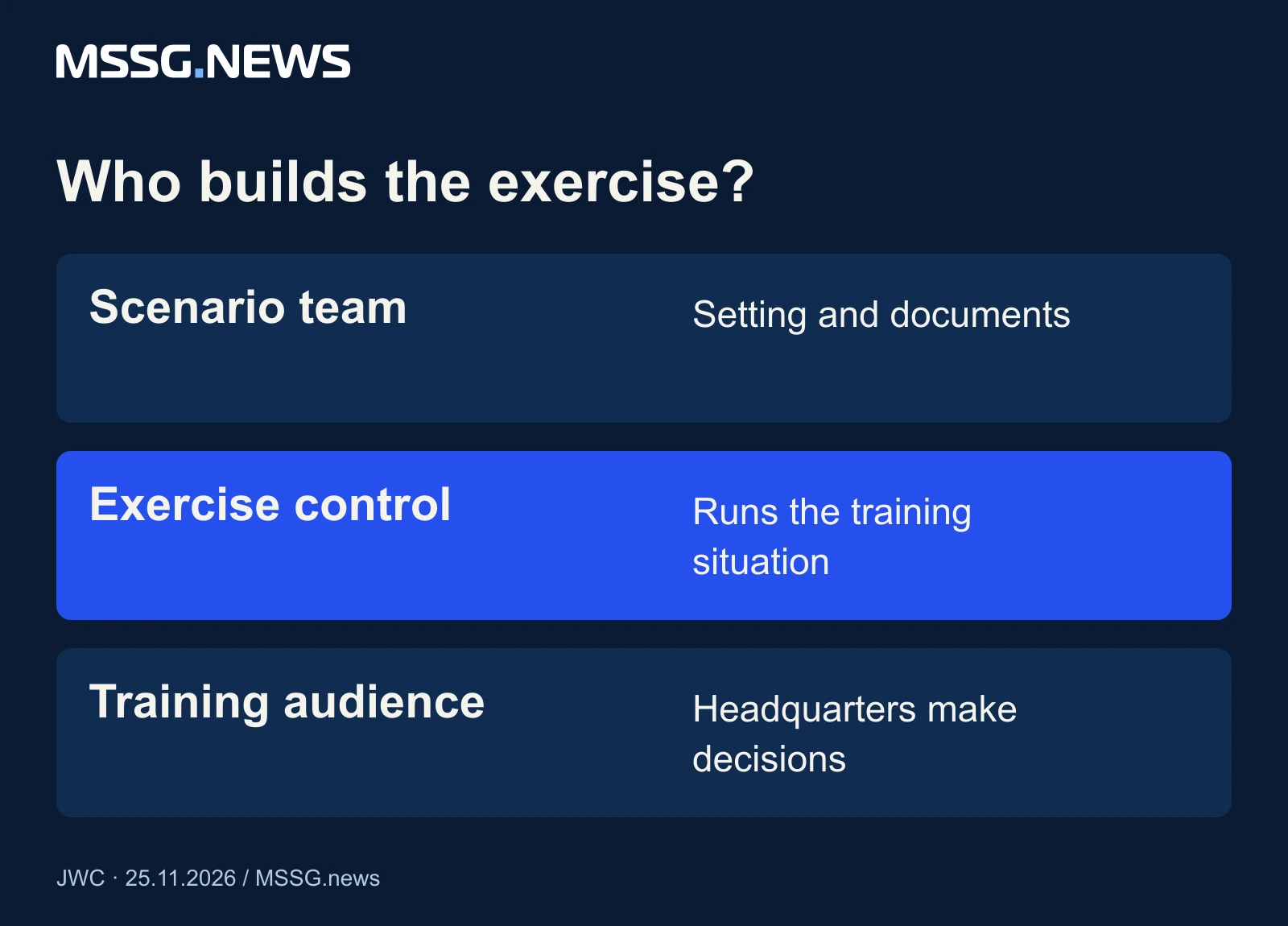
A headquarters exercise needs a world for participants to respond to. JWC's scenario team develops fictional settings and supporting documents, covering military domains and civil-military interaction. Exercise-control staff then bring that setting to life for the headquarters being trained. The task is broader than putting a map on a screen.
ECCOH addresses content development within that work. JWC says it developed the hub in collaboration with SHAPE, Task Force Maven and the U.S. Army's 39th Strategic Signal Battalion. Maven capabilities are being used during both planning and execution. The announcement does not describe every interface or assign every exercise-control task to ECCOH.
A training use of an established platform
Maven's role at JWC predates this exercise. An August report, republished by JWC from SHAPE, dated the platform's full technical operational capability to 22 June 2026. It also described earlier exercise work, including automated scripting and opposing-force responses during STEADFAST DETERRENCE. The November announcement adds a named content hub to this wider training story.
JWC's digital-transformation programme connects exercise design with the systems headquarters are learning to use. Its Audacious Training explanation also treats exercises as a way to expose weaknesses and develop better methods. That gives content tools two jobs to support: preparing a credible challenge and helping staff learn from the decisions it produces.
Where the practical benefit would show up
For an exercise planner, faster drafting is useful only if the scenario remains coherent. An illustrative logistics disruption may affect several headquarters, the information they receive and the options available later. Revising one document without updating the rest can make the training problem less credible. Human review and version control therefore remain important parts of the production process.
Useful follow-up measures would include preparation time, corrections needed before release, and the effort required to change a scenario consistently. These are editorial suggestions for assessing the workflow, not results reported by JWC. Its start-of-exercise announcement supplies no numerical time or cost saving. The next substantive evidence will be how the tools affect exercise delivery and subsequent lessons.
Sources & context
- JWC: STEADFAST DAGGER begins, 25 November 2026 ↗
- JWC: digitalizing the exercise environment ↗
- JWC: scenario development ↗
- JWC: AI in Audacious Training ↗
- JWC/SHAPE: Maven technical milestone, 12 August 2026 ↗
Published by Mitchell Strategic Solutions Group. See our editorial standards and corrections policy. Read more →
Related reporting

NATO wants AI to speed up learning. The result must be a changed capability.
NATO FUSE moves from experimentation to assessment. Interoperability still needs a documented result.