

NATO FUSE moves from experimentation to assessment. Interoperability still needs a documented result.
After nearly two weeks of work in Latvia, NATO identifies evaluation of findings and remaining challenges as the next phase. Publicly stated deployment ambitions remain future objectives.
- NATO
- Latvia
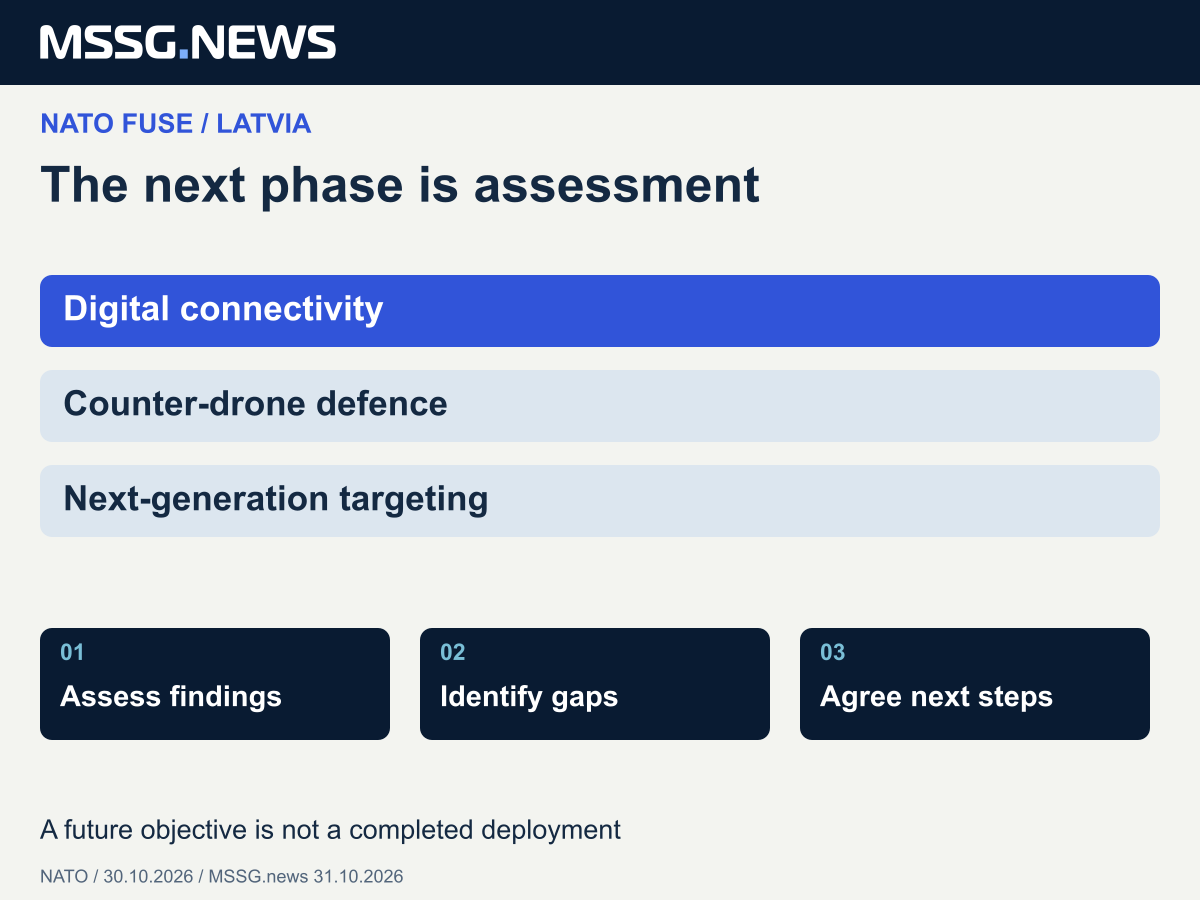
NATO’s 30 October update on Federated Unified Sensing and Effects, or FUSE, puts the emphasis on what follows the demonstrations in Latvia: assessing findings, identifying remaining challenges and agreeing next steps with nations, operators and industry.
That makes the evidence produced by the experiment more significant than the visitor programme alone.
The Chair of the NATO Military Committee attended the event after nearly two weeks of operational experimentation involving allied military operators and companies. Under Allied Command Transformation’s leadership, the effort connected digital communications, counter-drone defence and next-generation targeting. The announcement describes testing how different nations’ technologies work together, rather than publishing a final qualification report.
Three workstreams meet in one experiment
The Latvian Ministry of Defence’s 21 October account explains the structure. DiBaX examined the digital backbone, LCI-X addressed layered counter-drone capabilities, and NGT covered next-generation targeting. Activities took place at Ādaži and Sēlija. Latvia identified LMT Defence as the lead technology integrator for the digital experiment, alongside the national and NATO participants.
This provides context for the 30 October update. The issue is not simply whether a sensor, network or other component works alone. The experiment asks how components from different organisations can contribute to a connected capability. The Latvian account places FUSE at the concluding stage of the wider programme; NATO’s later statement now sets out the assessment work to follow.
An ambition for next year is a separate claim
The Military Committee chair set out an expectation for a multinational counter-drone chain to be fielded on the eastern flank in the following year. This is a stated objective for 2027, not evidence that such a chain has already been deployed. The announcement does not identify a completed purchase, accepted configuration or delivery quantity for that ambition.
Keeping the two stages separate helps a supplier understand what evidence exists. Participation establishes that a company joined an experiment. A successful component demonstration would establish something more specific. Acceptance of a complete capability for use by a military customer would be another step again. The public update does not collapse those stages into a single certification.
The result needs its operating context
Our interpretation is that the next useful industrial evidence should explain what was connected, under what agreed conditions and with which responsibilities. A result needs enough context for another user to judge whether it applies to their own system. That does not require publishing sensitive operating details; it requires a clear account within the appropriate channels.
For an integrator, the work after a trial may include resolving an interface problem or documenting a dependency on another participant’s equipment. For a specialist supplier, it may mean demonstrating the same contribution in a different agreed configuration. These are analytical examples of follow-up work, not disclosed FUSE failures or tasks awarded to named companies.
Watch the assessment and national decisions
NATO names evaluation of the findings and discussion with nations, operators and industry as the next phase. A published assessment, a defined further trial or a national acquisition decision would each clarify how experimental results are being used. They should be reported according to their actual status and scope.
The available public sources do not provide a comparative performance table, a list of certified products or a procurement budget for the next stage. This article updates the earlier account of DiBaX’s communications work with the subsequent FUSE statement, rather than presenting the same experiment as a new open call. Both institutional sources were checked on 31 October.
Sources & context
Published by Mitchell Strategic Solutions Group. See our editorial standards and corrections policy. Read more →
Related reporting
NATO wants AI to speed up learning. The result must be a changed capability.
NATO scales up its counter-drone network. Ukraine helps shape the test.