A better battery is not the whole space-power story
The European Space Power Conference brings generation, storage and power management into one discussion. Our engineering analysis explains why a component improvement needs to be assessed through the mission it enables.
- ESA
- space power
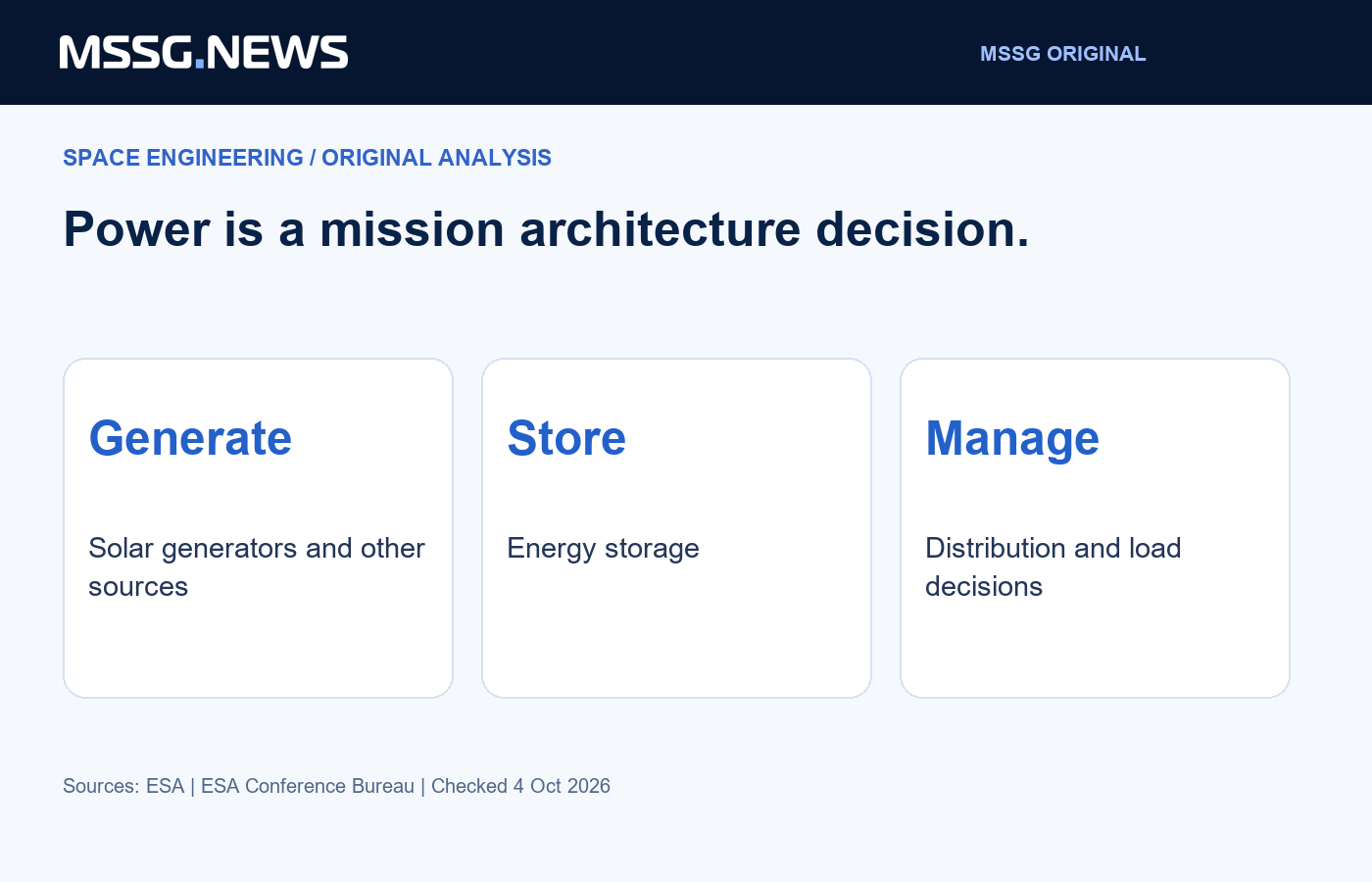
Space-power technology deserves more attention than its place in a component catalogue. The European Space Power Conference in Estoril, scheduled for 5-9 October, puts power management, solar generators, energy storage and nuclear power on the same programme. These are different ways to influence what a spacecraft can actually do.
This article is an engineering analysis of those relationships, prepared from the organiser’s published scope. It does not claim a new battery result or report conclusions from sessions that had not taken place when the text was prepared.
MSSG.news’s central point is that a component’s attractive performance figure has to be connected to a mission need. The valuable question is which system constraint it removes: unavailable energy at the required time, insufficient power for a task, or an integration burden that limits the payload.
Generation, storage and management form one decision
A generation source provides energy, storage makes it available at another time, and management connects supply to loads. Treating these as separate purchasing categories can obscure their dependence. A mission architecture combines them around the timing and intensity of useful work.
The organiser’s broad scope is therefore industrially relevant. A supplier developing one part needs to understand the assumptions of the others. A claimed gain should be described at the boundary where another subsystem can use it, rather than only within the component’s own test.
Translate the metric into an operating scenario
Our proposed comparison starts with the mission task. Which activity needs power, for how long, and alongside which other loads? The next step asks what the system can make available under that scenario. This helps distinguish a genuinely useful improvement from a performance gain unrelated to the bottleneck.
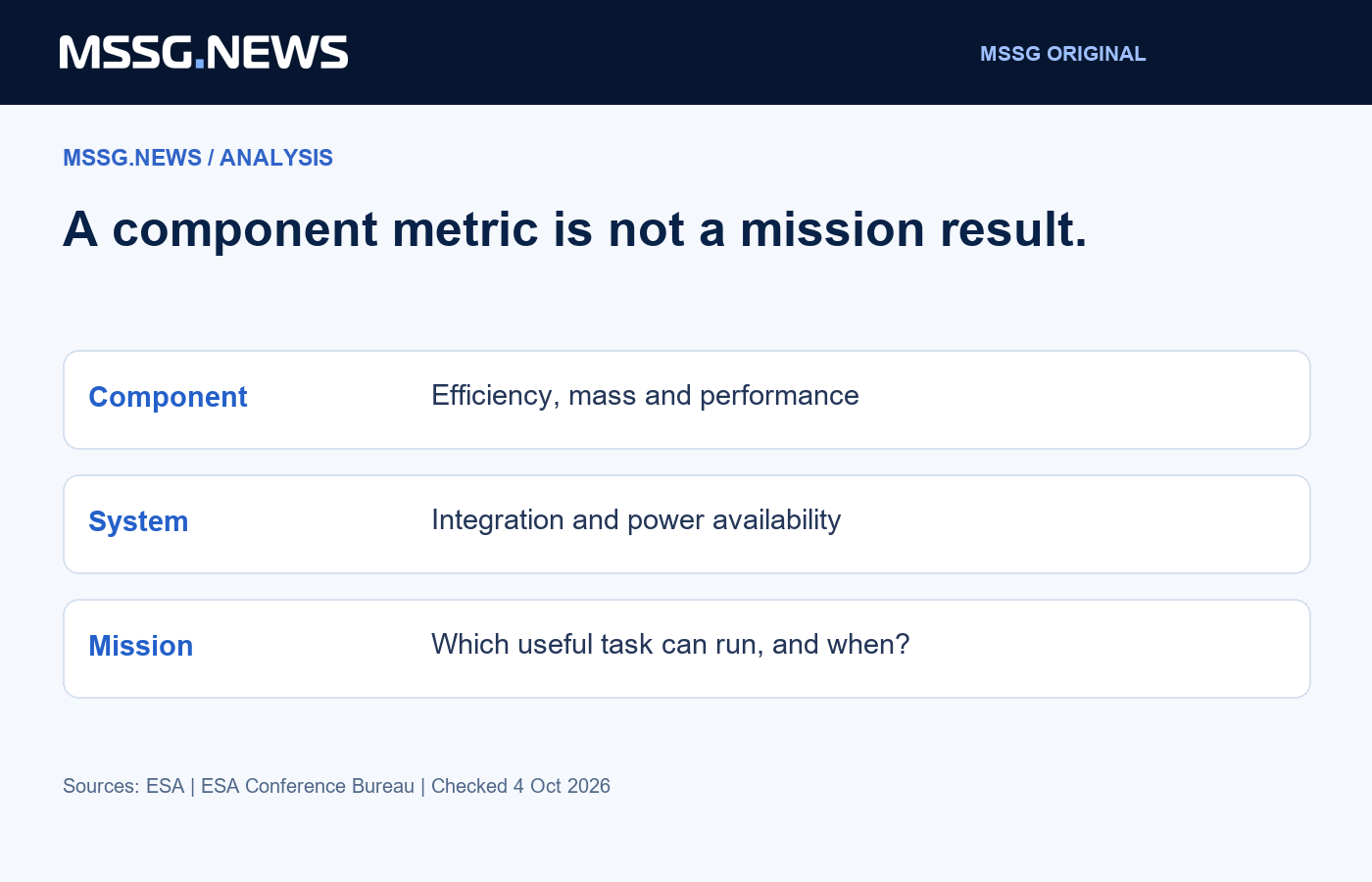
It also makes the trade-offs explicit. Mass, efficiency, integration and lifetime cannot be collapsed into one universal score without choosing a mission. The graphic separates component, system and mission levels so readers can see where an asserted benefit has actually been demonstrated.
The opportunity is in system understanding
For smaller suppliers, the strongest case is often a precise account of how a component fits a broader architecture. That may be more valuable to a prime contractor than an isolated headline about better performance. It identifies the integration problem the product is designed to solve.
Space power is consequently a useful example of a wider industrial lesson: improvements create value through the constraints they remove. The right story connects a measurable technical advance with a defined operational task. It does not need an invented percentage or a sweeping promise to be compelling.
Sources & context
- ESA: European Space Power Conference, 5-9 October 2026 ↗
- ESA Conference Bureau: ESPC 2026 topics and location ↗
Published by Mitchell Strategic Solutions Group. See our editorial standards and corrections policy. Read more →