Europe’s post-ISS choice is bigger than building a space station
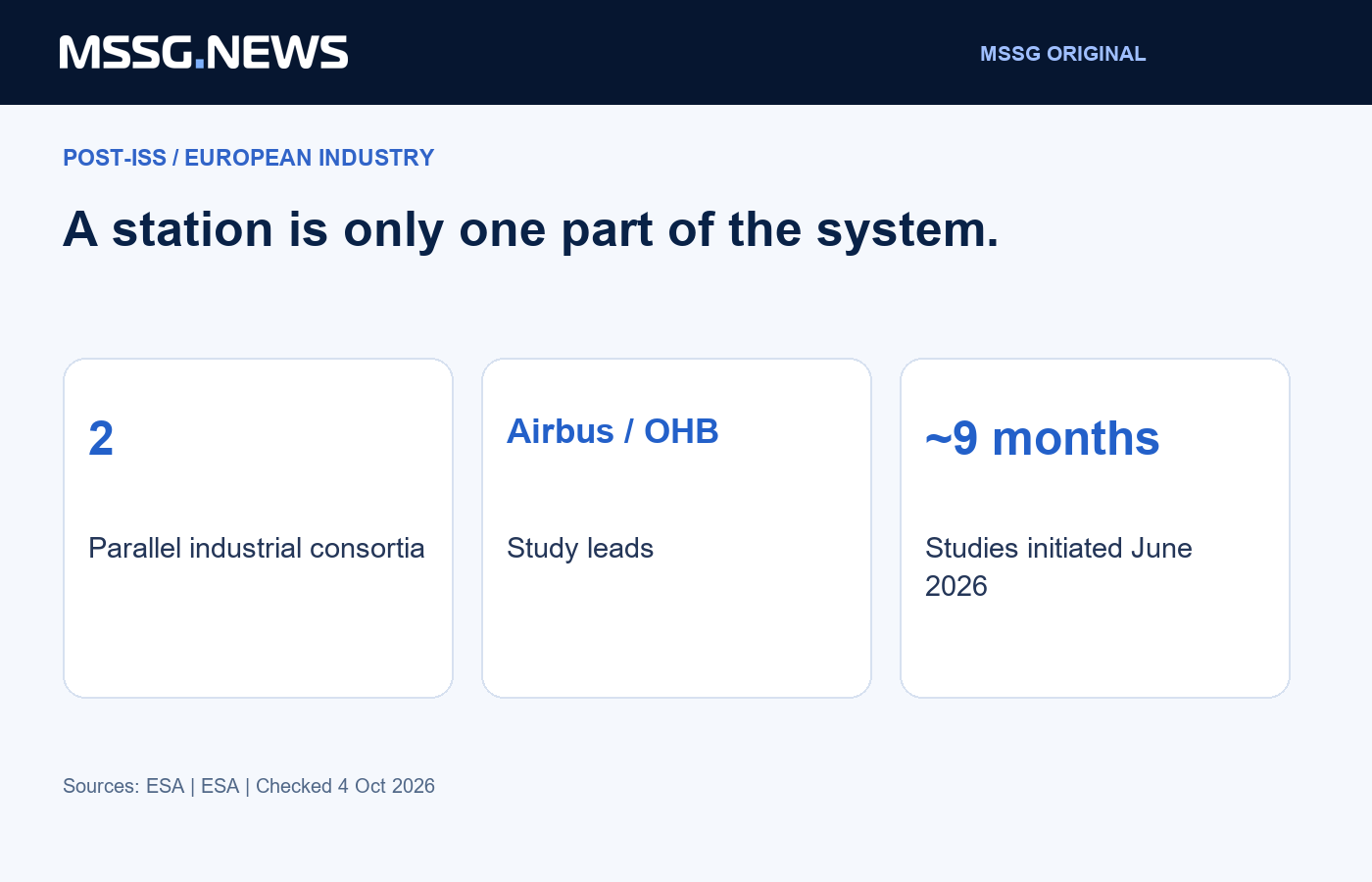
ESA has commissioned two parallel studies, led by Airbus and OHB, into a European-led orbital outpost. The industrial question is who supplies the complete system: habitation, transportation, operations and continued access to orbit.
- ESA
- Airbus
Europe is examining whether to lead its own orbital outpost after the International Space Station. ESA’s 29 September announcement names two industrial consortia, led by Airbus Defence and Space and OHB, to study the option. The consequential part is not a drawing of another station. It is the possibility of reshaping Europe’s role across the services that make one usable.
The Pre-Phase A studies began in June 2026 and are expected to last approximately nine months. They cover technical and programmatic feasibility, architectures, transportation and operational services. A European-led outpost is one option alongside cooperation with future commercial destinations; ESA has not announced a construction commitment.
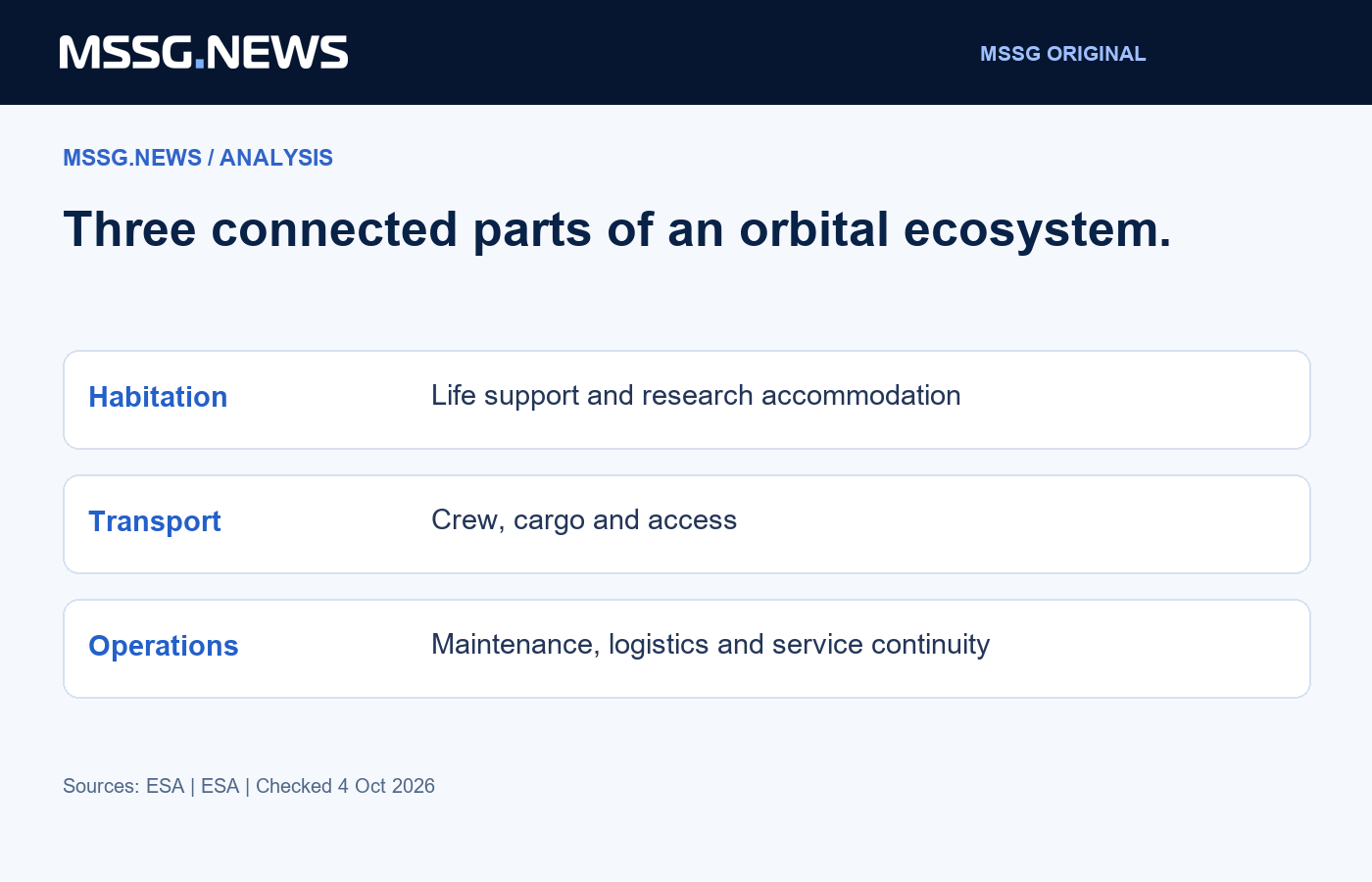
Our reading is that the industrial opportunity spans much further than pressure vessels or laboratory modules. A crewed infrastructure needs a dependable chain of transport, supplies, maintenance, research access and day-to-day operations. Each link changes the economics of the rest.
Access can matter as much as ownership
Owning orbital hardware does not by itself secure regular access to it. A research team needs a way to send equipment, maintain experiments and return results or samples. An operator needs an assured route for crews and cargo. Those are service requirements, not decorative additions to a station design.
This makes transportation part of the strategic choice from the outset. MSSG.news would compare options through the availability and continuity of the whole service, rather than treating European ownership of a single module as a sufficient measure of autonomy.
The supply chain crosses several markets
ESA identifies European expertise in habitation, life support, robotics, transportation and in-orbit servicing. The studies build on experience from Columbus and the European Service Module for Orion. These are industrial foundations; they do not establish that every capability for a new outpost is already complete.
For suppliers, an architecture study is valuable because it determines interfaces and dependencies before a future procurement takes shape. A life-support component, cargo service and robotic maintenance tool may sit in different market categories, yet the outpost would require them to work as one system.
What the studies should make visible
The useful comparison is a set of explicit choices: what services Europe must control, what it can buy from partners, how demand sustains operations and which technologies carry the greatest development risk. Our diagram highlights those dependencies without pretending to be an ESA-approved architecture.
The nine-month studies should inform later decisions by ESA Member States. For now, the strong industrial signal is the breadth of the question being studied. Europe is evaluating its position in the post-ISS value chain, not merely choosing the shape of a new station.
Sources & context
- ESA: European-led orbital outpost studies, 29 September 2026 ↗
- ESA: preparation and parallel feasibility studies ↗
Published by Mitchell Strategic Solutions Group. See our editorial standards and corrections policy. Read more →