The orbital servicing bottleneck may be the connection, not the spacecraft
ESA’s InSPoC-1 interface work covers grappling, docking and fuel, power and data transfer. Our analysis looks at the industrial hurdle behind a reusable service market: clients and service vehicles need compatible ways to connect.
- ESA
- InSPoC
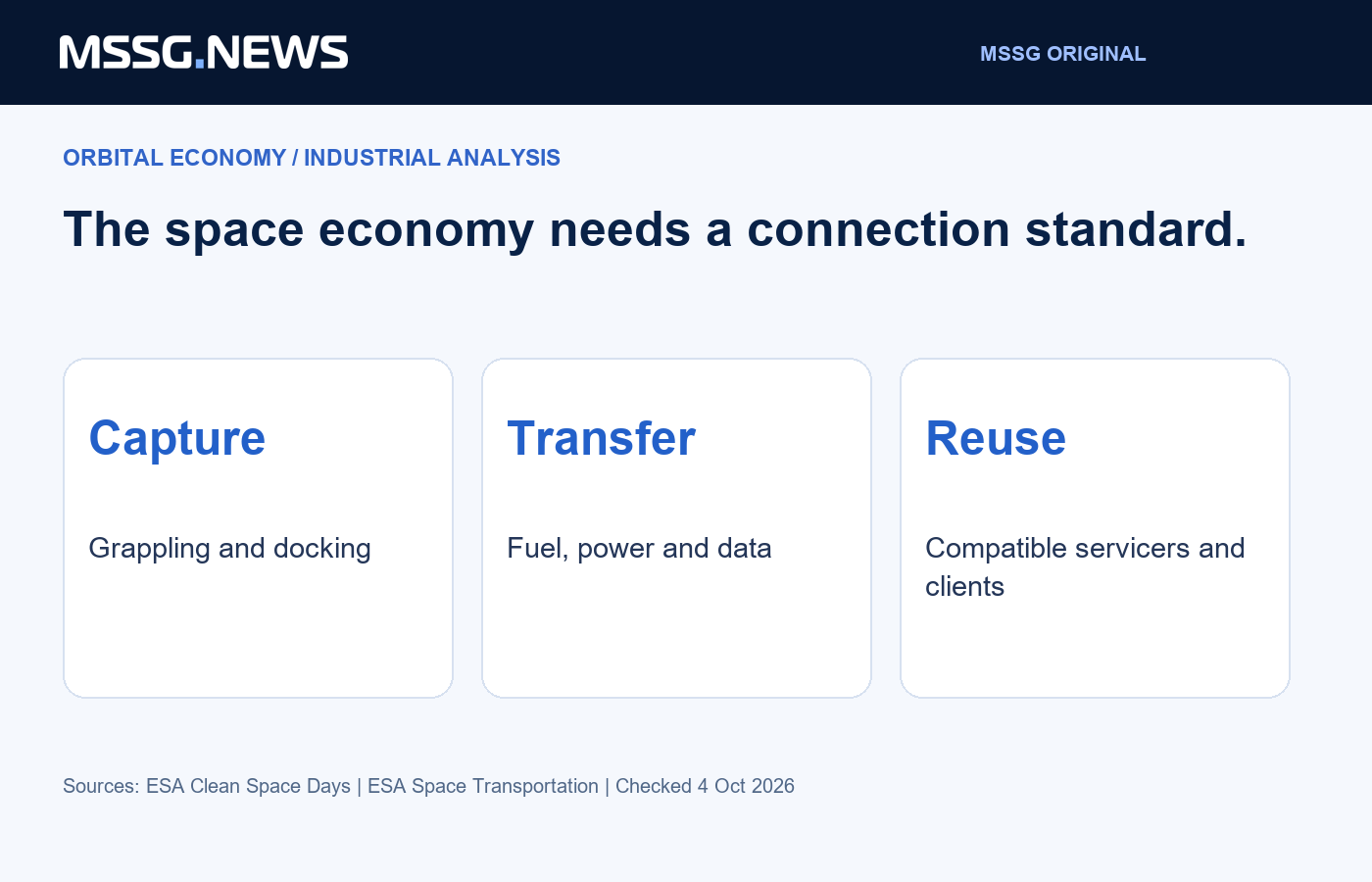
The orbital economy has an interface problem. A servicing vehicle can only build a repeatable business if client spacecraft support the connection needed for its task. ESA’s InSPoC-1 work addresses grappling, docking and the transfer of fuel, power and data. The industrial significance lies in making more than one mission possible around a compatible connection.
A June presentation at ESA’s Clean Space Days describes the project in Phase B2 and highlights a standardised interface capable of serving different satellite classes. We use that published development account as the basis for an analysis of adoption. It is not evidence that a general commercial refuelling network is already operating.
The same issue reaches across life extension, transport and cooperative de-orbiting. These services have different objectives, but each needs a reliable relationship between the vehicle performing the work and the satellite receiving it.
Compatibility is a two-sided investment
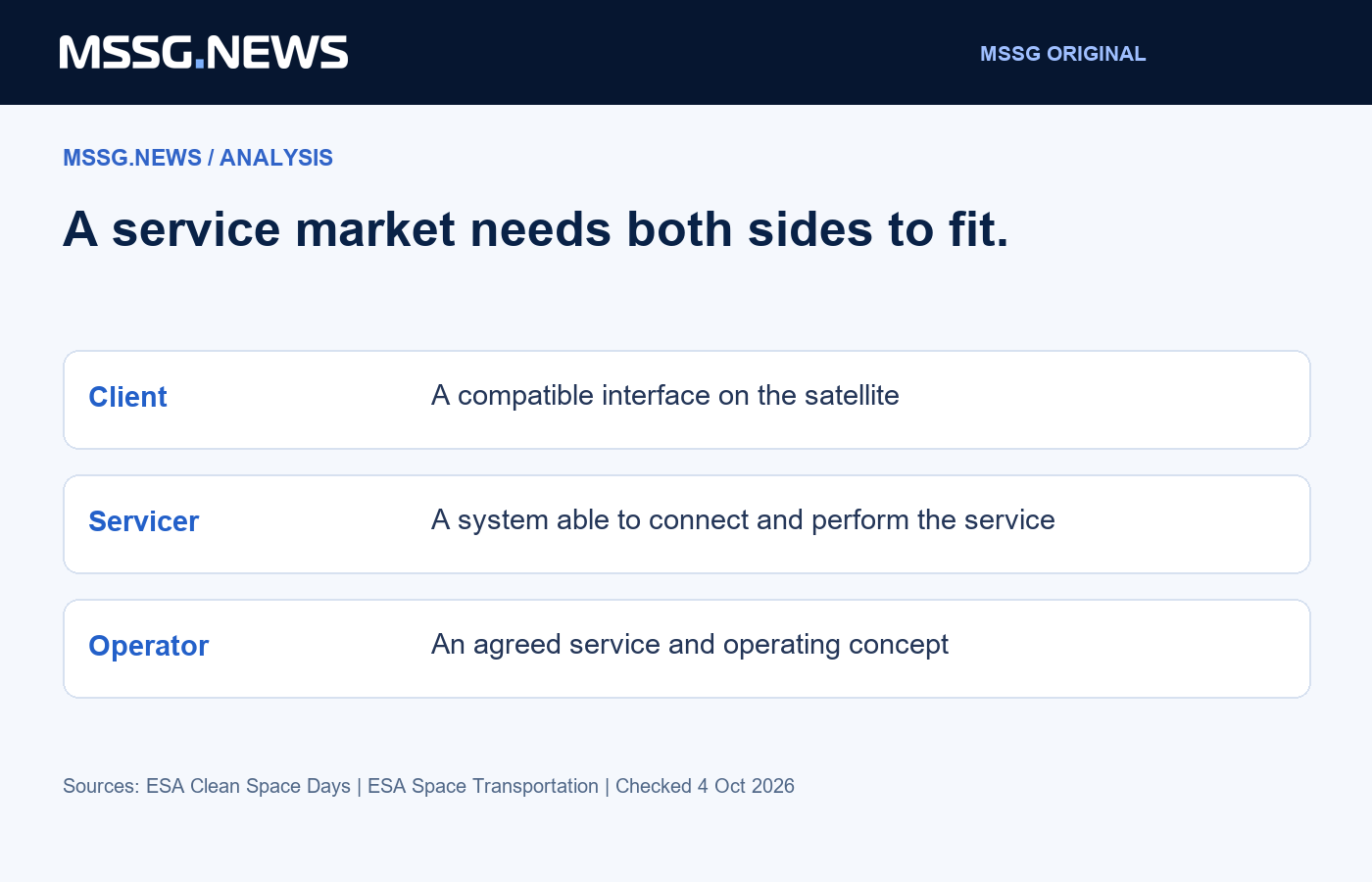
A satellite designer decides which interface to install before knowing all future service providers. A servicing company invests before having a complete future client fleet. MSSG.news’s reading is that these decisions are interdependent: neither side can create the full market alone.
A common interface can reduce that coordination burden, but only if enough participants adopt it and support its operating conditions. Publishing a specification and winning adoption are separate industrial tasks. Suppliers need to consider integration effort and lifetime support alongside the connector itself.
A single connection carries several obligations
Mechanical compatibility is only the first layer. Fuel transfer, power, data and the loads of transportation introduce additional requirements. The ESA presentation identifies these functions together, which is why we show them as a system rather than an isolated docking component.
This creates opportunities across hardware, controls, testing and operational planning. It also means that a claim of compatibility should specify the supported function. A successful mechanical connection does not automatically establish that every resource-transfer service is qualified.
The commercial question is repeatability
The useful market test asks whether the interface can support repeat operations with a range of compatible clients. That determines whether a servicing vehicle becomes a recurring platform or remains tied to one bespoke mission. Our diagram expresses this dependency; it is not a revenue forecast.
For Europe’s industrial ecosystem, common interfaces can be an important form of infrastructure. They influence which spacecraft can become future customers and which suppliers can compete to serve them. The connection standard deserves attention alongside the more visible launch and spacecraft announcements.
Sources & context
- ESA Clean Space Days: InSPoC-1 interface development, 30 June 2026 ↗
- ESA Space Transportation: in-space logistics programme and interface work ↗
Published by Mitchell Strategic Solutions Group. See our editorial standards and corrections policy. Read more →