Satellite 5G crosses a useful boundary: different vendors, one connected system
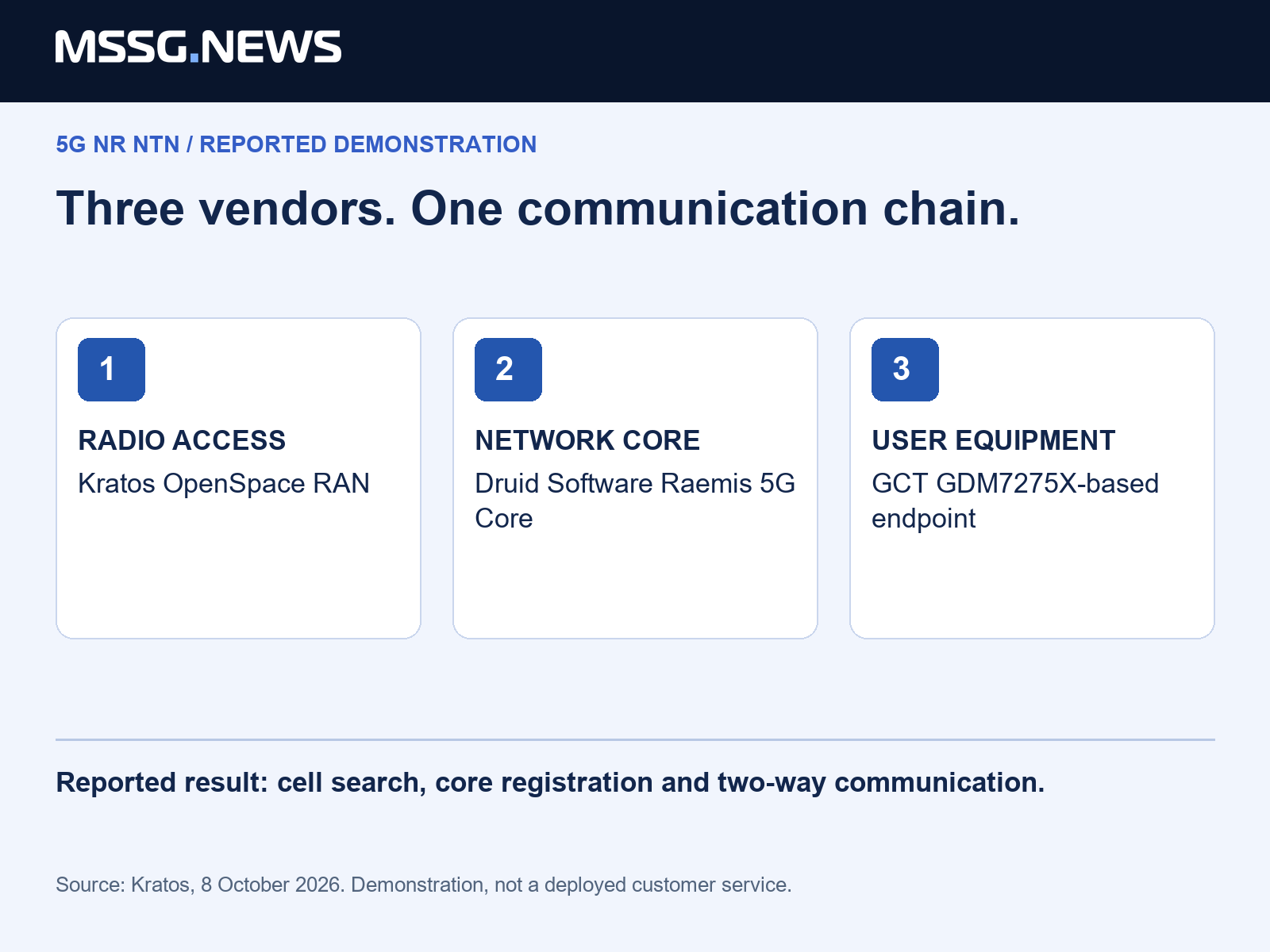
A Kratos demonstration linked its OpenSpace radio access network, Druid’s Raemis core and GCT-based user equipment. The reported result was registration and two-way communication.

- 5G
- Satellite communications
A satellite network becomes more interesting commercially when its components can be selected from different suppliers and still communicate.
Kratos reported that result on 8 October in a 5G NR non-terrestrial network demonstration involving KT SAT and partners.
The announcement describes an integrated system, rather than compatibility asserted separately for each component.
Three layers must agree
The reported chain used the OpenSpace radio access network, Druid Software’s Raemis 5G core and user equipment based on GCT’s GDM7275X. Kratos says it completed cell search, registered with the core and established two-way communication. These steps provide an intelligible account of what worked; the announcement does not supply customer-service performance measurements.
The radio access network connects the device to the network. The core handles the network functions behind that access, while the user equipment is the endpoint using the connection. If those layers come from different suppliers, the interfaces between them become commercially important. A specification on each product’s own datasheet is less persuasive than the products completing the same communication sequence together.
Choice becomes an engineering result
MSSG’s reading is that the useful industrial claim is freedom to combine components. Operators interested in resilience want options for replacing or upgrading one part without assuming that every other part must be replaced too. A working combination offers evidence for that discussion, although a single demonstration does not establish that all possible combinations work.
Virtualisation adds another dimension. Kratos describes OpenSpace as a software-defined ground platform intended to reduce hardware dependence and make services easier to scale. The practical question is where the boundary lies between software changes and equipment changes. That distinction determines whether an upgrade can be handled as a configuration task or requires additional deployment and integration work.
The next test is the service users actually need
A successful registration is a necessary part of connectivity, but a buyer also needs evidence about how the connection behaves over time. Relevant acceptance questions include the required data service, recoverability after interruptions and the responsibilities of each supplier when something fails. These are MSSG’s proposed evaluation questions, not outcomes reported by the demonstration.
For European civilian infrastructure and defence users, the relevance lies in having more than one way to assemble a communications service. Multiple suppliers can create useful alternatives if integration remains manageable. The strongest reading of this milestone is therefore specific: a multi-vendor chain communicated successfully. Its value for a real customer will depend on taking that working chain through the continuity, support and performance requirements of an actual service.
Sources & context
Published by Mitchell Strategic Solutions Group. See our editorial standards and corrections policy. Read more →
Related reporting

NATO’s quantum roadmap sets an industrial clock. Suppliers need evidence before 2027

A storm warning is not a response. SmartMetRoad connects satellites to the road crew