NATO’s quantum roadmap sets an industrial clock. Suppliers need evidence before 2027
NATO has put dates against quantum assessment, pilots and secure communications. The opportunity for dual-use firms is to prepare integration evidence before the first 2027 milestones.

- NATO
- Quantum
NATO’s quantum roadmap moves the discussion from strategic ambition to dated work. Approved on 30 July and released publicly on 29 September, it sets milestones for assessment criteria, pilot reporting and experimentation. For Europe’s technology industry, the relevant clock is now the sequence of decisions scheduled for 2027.
The roadmap covers computing, communications and sensing. They do not share a single maturity level or integration path. Our assessment is that suppliers gain more by identifying a specific operational problem than by presenting quantum technology as one universal capability. Timing, navigation, secure links and computation each require different evidence.
That matters for European security because a useful technology must keep working inside an Allied system. The industrial challenge combines performance, interoperability and support. A laboratory result is a starting point; an operator needs to understand the conditions under which it remains useful.
Three milestones change the supplier’s preparation
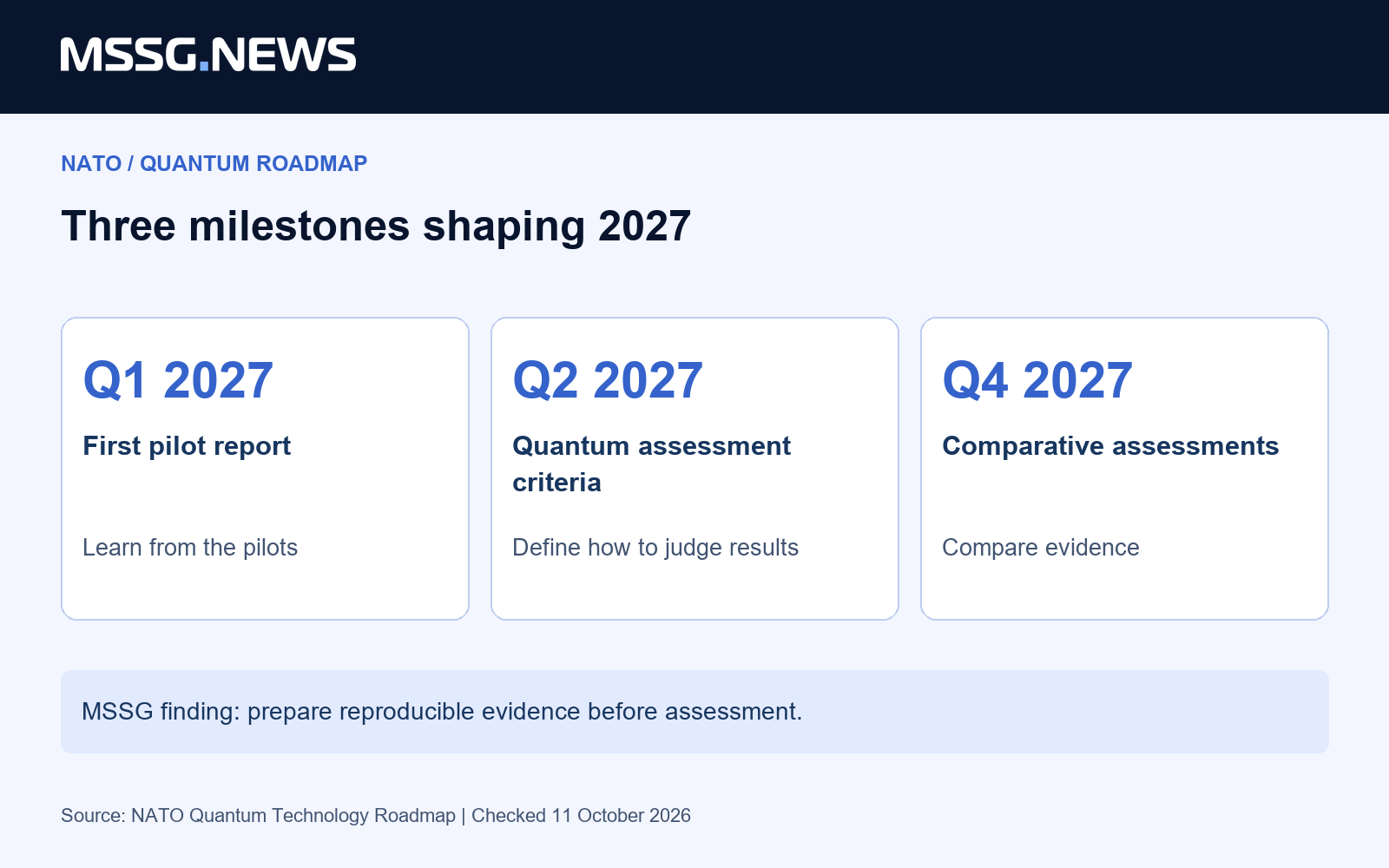
The roadmap schedules a first pilot report for the first quarter of 2027 and Quantum Assessment Criteria for the second quarter. Comparative assessments follow in the fourth quarter. This sequence creates a practical preparation task: record the baseline, the test conditions and the improvement that a proposed system can demonstrate. The criteria themselves are still to come.
QUESTOR trials in 2026 and 2027 address positioning, navigation and timing where GNSS is unavailable. That is a clear example of a defined user problem. In our reading, a supplier’s proposal should explain what reference it uses, how it handles uncertainty and how its output connects to the wider navigation system. These are analytical recommendations, not additional NATO entry requirements.
Communications have a separate track. A Quantum Zero Beacon Project pilot between NATO headquarters in Brussels and SHAPE in Mons is scheduled for the fourth quarter of 2027. An Allied Quantum Computing Access Network concept is also due that quarter. A concept milestone creates a design question; it does not mean a shared computing service is already available.
The strongest dual-use offer solves an interface
Post-quantum cryptography belongs in this discussion, but it is a different engineering task from building a quantum computer or a quantum communication link. It concerns cryptographic systems designed to resist quantum-enabled attacks and can run on classical hardware. Our recommendation is to map these activities separately, so that a procurement or migration discussion addresses the correct risk.
A company preparing for Allied use should assemble a short evidence package: the user problem, a reproducible test, the integration interface and the resources needed to maintain the capability. Commercial experience can help where it demonstrates those points. A civilian product becomes relevant through the problem it solves, rather than through a new defence label.
The roadmap gives the ecosystem a timetable, not an automatic order book. Its strategic value is that it links research, technical assessment and operational requirements. For industry, the immediate opportunity is to arrive at the next test with a clear claim and evidence that another organisation can reproduce.
Sources & context
Published by Mitchell Strategic Solutions Group. See our editorial standards and corrections policy. Read more →
Related reporting

NATO’s counter-drone problem is also a network problem: where 5G and dual-use fit

NATO backs seven counter-drone innovators: a faster route from dual-use to defence