

NATO uses minehunting drones to inspect Baltic infrastructure. The result is evidence, not automatic attribution.
New NATO footage shows a practical dual-use role for underwater vehicles: mapping, inspection and human identification. Linking those observations with infrastructure operators matters as much as deploying another sensor.

- NATO
- Baltic Sea
NATO’s new Baltic Sea footage shows a concrete way that mine-countermeasure equipment supports civilian security: underwater vehicles help crews inspect the seabed and assess possible damage to cables and pipelines. The material was released on 26 October and filmed on 19 October. It is evidence of a publicly described inspection capability, rather than a newly announced procurement.
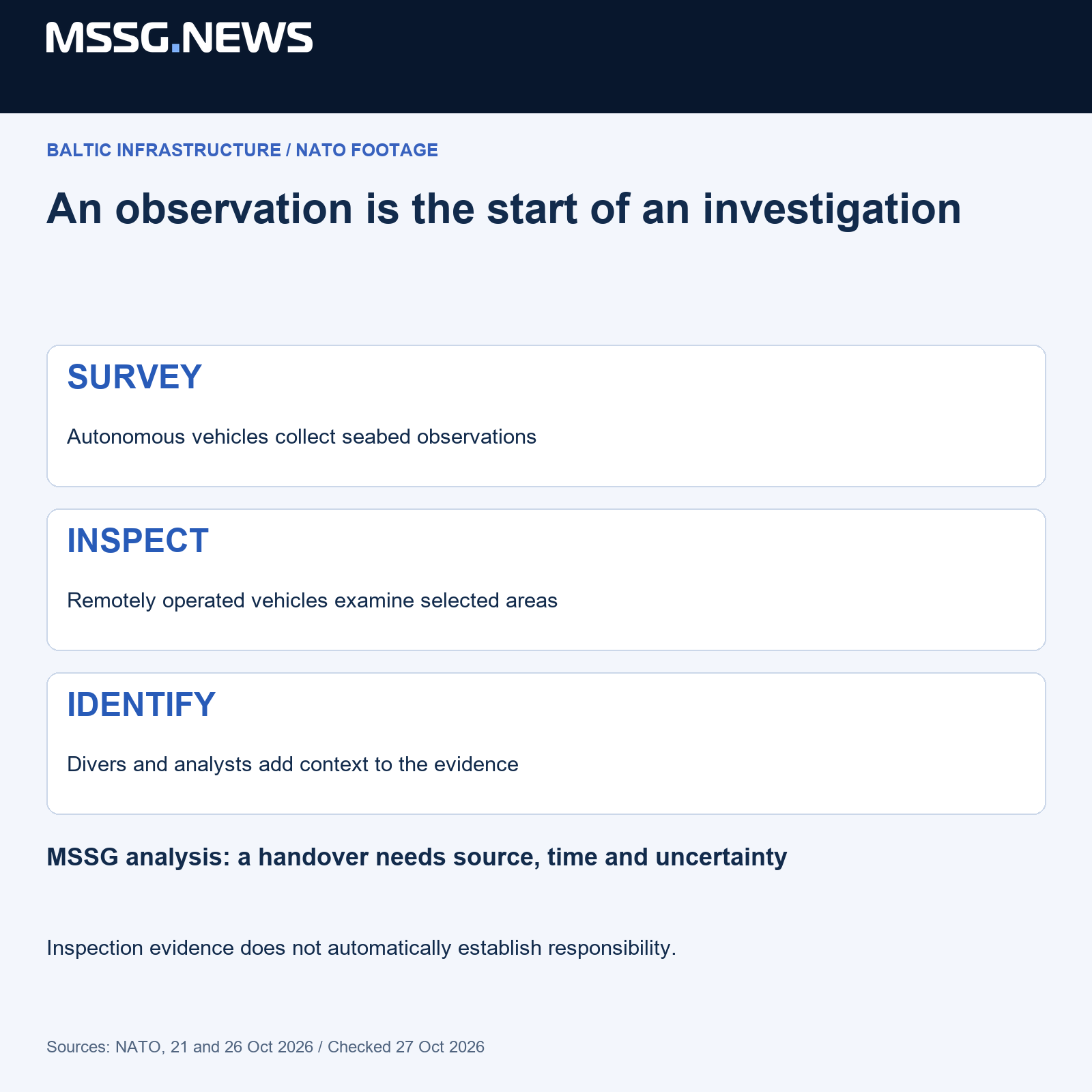
The important distinction is between finding something worth examining and establishing what happened. The official transcript describes autonomous vehicles gathering seabed imagery, remotely operated vehicles inspecting infrastructure, and divers identifying selected contacts. Those are different contributions to one investigation.
For Europe’s infrastructure owners and technology suppliers, our analysis is that the useful product is a traceable observation that another organisation can act on. A vehicle’s presence alone does not establish responsibility for a damaged cable or prove uninterrupted protection of the network.
Three tools, different jobs
The NATO shot list identifies a SeaFox remotely operated underwater vehicle aboard the German FGS Homburg and a HUGIN 1000 autonomous underwater vehicle deployed from the Finnish Purunpää. The accompanying interviews explain the reuse of minehunting equipment for infrastructure inspection and mapping. We describe these publicly released examples without deriving current patrol locations or operational coverage.
A Portuguese mine-warfare officer describes gathering contacts from autonomous-vehicle imagery and then examining them with explosive-ordnance-disposal divers. The sequence matters: an initial sensor observation is a reason to investigate. Human identification adds information that an image or automated detection may not settle on its own.
The civilian operator belongs in the chain
A separate NATO report on the Critical Undersea Infrastructure Network’s 20-21 October meeting in Rostock emphasises cooperation and data sharing among governments, infrastructure operators, industry and NATO. Participants also saw uncrewed maritime and mine-countermeasure technologies. This is a coordination effort alongside the military capability, not evidence of a single unified commercial service.
Our reading is that the handover between those organisations is an industrial opportunity in its own right. An inspection record should make its origin, time, asset reference and uncertainty understandable to the recipient. Otherwise, collecting more observations can increase the volume of material without shortening the next decision.
What the footage can and cannot establish
The video documents equipment and explains its intended role. It does not publish a detection-rate comparison, a continuous coverage map, an acquisition price or a confirmed finding about a particular attack. The Rostock statement places the work in NATO’s response to hybrid threats, including Russian actions against Allies; that strategic assessment is separate from attributing any individual damaged asset.
The practical supplier question is therefore how a result survives the journey from survey to inspection to an operator’s decision. Comparable records, an explicit distinction between observation and inference, and a clear receiving organisation are more useful than treating every underwater image as a conclusive incident report. NATO’s contribution combines maritime presence, specialist inspection and cooperation across borders.
Sources & context
- NATO video and full transcript, released 26 October; filmed 19 October 2026 ↗
- NATO Critical Undersea Infrastructure Network, 21 October 2026 ↗
Published by Mitchell Strategic Solutions Group. See our editorial standards and corrections policy. Read more →
Related reporting
NATO’s DiBaX tests the civilian networks behind military resilience.
ESSOR starts its narrowband phase. Poland’s Radmor is part of the common radio architecture.