Europe’s space-security upgrade closes a decision gap, not an engineering gap
The EU has expanded its Space Threat Response Architecture. Its most useful change is a defined route for urgent political action, with a four-week Council review of a provisional response.
- Space security
- European Union
Europe is making its response to hostile behaviour in space more explicit. The Council’s 28 September decision strengthens the Space Threat Response Architecture, or STRA. MSSG.news’s central finding is a distinction often lost in the word resilience: a clearer authority to respond does not itself restore an interrupted satellite service.
The architecture now covers threats linked to EU space and secure-connectivity programmes as well as threats to member states, their territory, space systems and services. The Council describes provisions for monitoring, alerting and mobilising foreign- and security-policy tools.
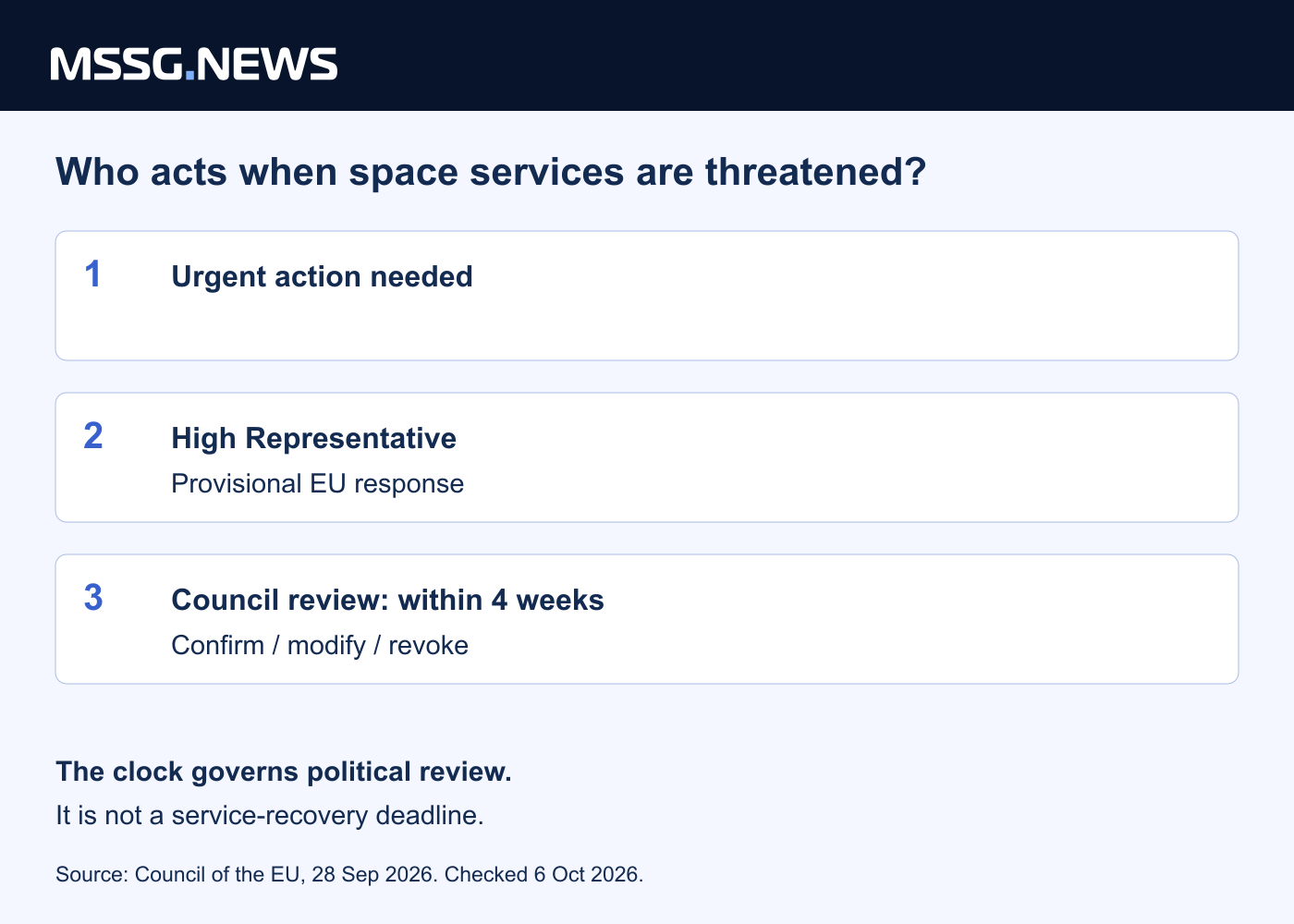
When urgent action is needed, the High Representative can adopt a provisional EU response. The Council must then confirm, modify or revoke it as soon as possible and within four weeks. That review period governs the political response; it is not a promise that a disrupted service will recover within four weeks.
Authority is an operational dependency
The decision also introduces a space-security toolbox, including the option for the High Representative to propose targeted restrictive measures, and an annual implementation exercise. These are instruments for coordinated action, rather than a new specification for spacecraft hardware.
Our analytical implication for service providers is straightforward: an incident plan should identify the evidence and escalation contacts needed for a political response, alongside the technical procedures needed to keep users operating. Assigning those roles before an incident is more useful than treating institutional coordination as something that begins after an outage.
Continuity has to work while politics moves
Positioning, communications and observation support activities far beyond the space industry. The Council’s policy overview recognises space as both an operational domain and an enabler for security and defence. A service failure therefore raises a user-continuity question as well as a security-policy question.
Operators can usefully separate two workstreams: document and escalate the threat; sustain the service or its fallback. That separation is MSSG.news’s framework for reading the decision, not a legal requirement added to it. It explains why governance and engineering should be tested together without pretending they are interchangeable.
Sources & context
- Council: strengthened EU Space Threat Response Architecture, 28 September 2026 ↗
- Council: EU space policy and security context ↗
Published by Mitchell Strategic Solutions Group. See our editorial standards and corrections policy. Read more →