€1.24 billion for Ukrainian drones and missiles: the next test is production
The EU has disbursed another €1.24 billion for Ukrainian-made weapons. The industrial question is how funding becomes repeatable output, with components, acceptance and support keeping pace.
- Ukraine
- European Union
A new €1.24 billion disbursement under the EU’s Ukraine Support Loan targets drones, drone interceptors, drone ammunition and missiles made by Ukrainian entities. Ukraine’s Ministry of Defence reported receiving the money on 7 October; the European Commission’s dedicated announcement is dated 8 October.
This is an industrially targeted payment. It directs financing towards equipment categories central to Ukraine’s defence against Russia. Its significance lies in the connection between financial support and production inside Ukraine.
The broader loan provides up to €90 billion across 2026-2027, with an indicative €60 billion defence component and €30 billion budget component. Those categories answer different needs. Combining them into one weapons-production figure would give readers the wrong picture of the industrial opportunity.
The remaining money has two different jobs
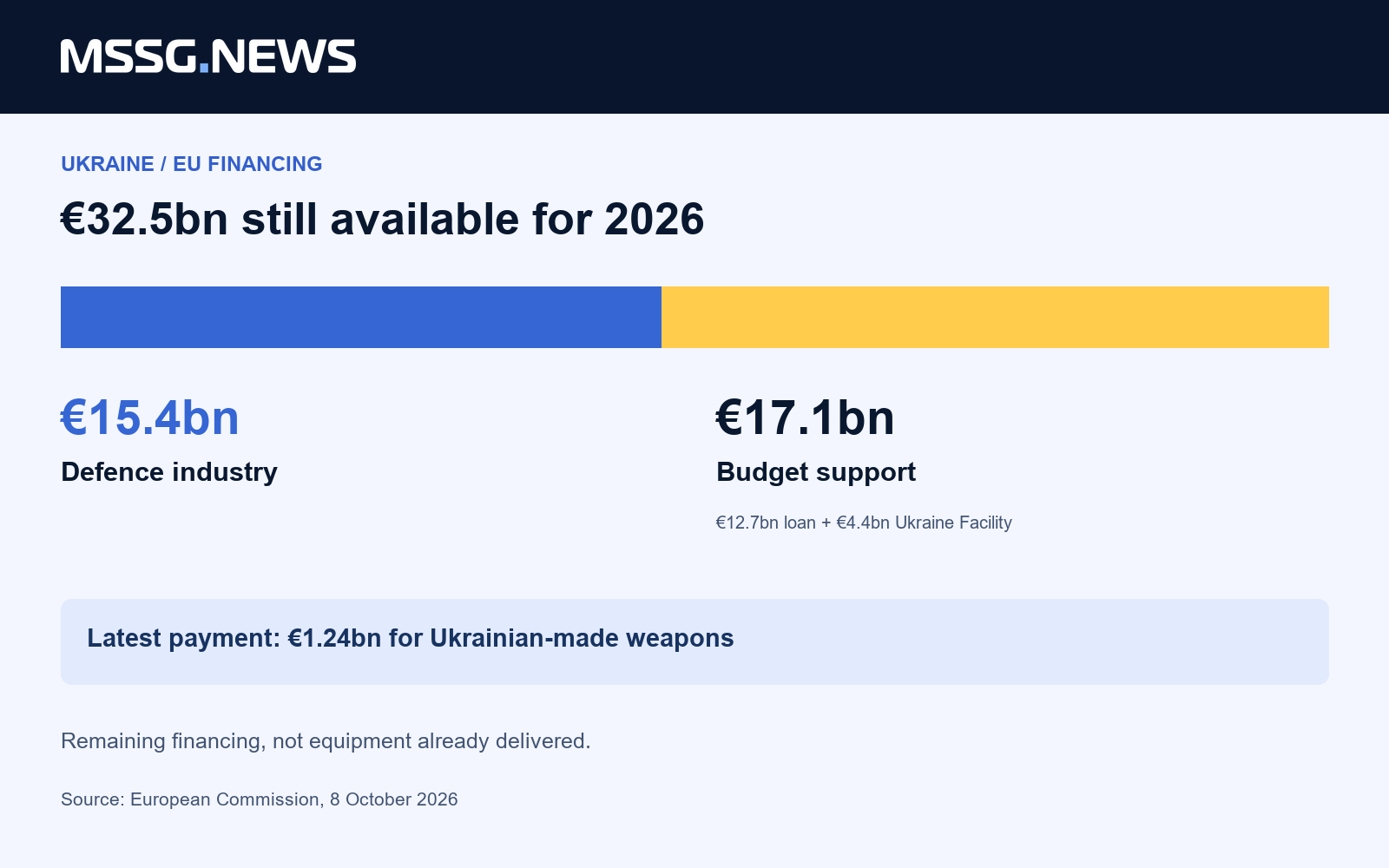
The Commission’s October announcement identifies €32.5 billion still available for the remainder of 2026 across two instruments. Of that, €15.4 billion supports defence industrial capacity through the Ukraine Support Loan. Another €12.7 billion under that loan and €4.4 billion under the Ukraine Facility support the budget.
Our diagram adds those two budget amounts to €17.1 billion and keeps them separate from the €15.4 billion defence allocation. It shows remaining financing, rather than equipment already produced. This distinction matters when assessing what new demand a supplier can realistically address.
A production system must absorb the demand
Our assessment is that the next challenge is converting finance into a sustainable production rhythm. A manufacturer needs enough components, appropriate quality controls and an acceptance process that matches the pace of assembly. Increasing output in one stage exposes constraints in the next.
For potential industrial partners, that points to a concrete task: identify which part of a Ukrainian production chain they can strengthen. Component supply, test equipment, production tooling and maintenance support have different buyers and integration requirements. A proposal should specify the bottleneck it addresses and the evidence that it can deliver.
For buyers, progress should be measured through completed deliveries and usable capability. Payment availability establishes purchasing capacity. Delivery schedules, acceptance results and support arrangements show how that capacity becomes equipment that can be put to work.
The loan’s defence component also aims to modernise Ukraine’s industrial base and support its integration with European industry. That gives this payment a wider strategic context: Europe is financing Ukraine’s immediate defence while strengthening an industrial base that matters to European security. The practical measure of that strategy is output that can be sustained.
- Latest disbursement
- €1.24 billion for Ukrainian-made weapons
- Remaining 2026 defence financing
- €15.4 billion under the Ukraine Support Loan
- Remaining 2026 budget support
- €17.1 billion across the loan and Ukraine Facility
Sources & context
- European Commission: €1.24 billion disbursement, 8 October 2026 ↗
- Ukraine Ministry of Defence: receipt of funds, 7 October 2026 ↗
Published by Mitchell Strategic Solutions Group. See our editorial standards and corrections policy. Read more →
Related reporting
Ukraine expands drone orders sharply. The next industrial test is repeatable delivery
EDF 2026 draws 49% more proposals with a smaller funding envelope