EU OPEX in Portugal: the next test is how systems work together
The campaign starts on 28 September. Its value for industry will lie in evidence from military users and increasingly complex trials.

- EDA
- EU OPEX
European defence innovators will begin a new round of operational experimentation in Portugal on 28 September. EDA’s announcement places more than 40 organisations and over 200 innovators, military specialists and users at the Santa Margarida training area. The question is how emerging systems perform within a wider operation, beyond a standalone demonstration.
The European Defence Agency and Portuguese Army are combining EU OPEX with ARTEX 26. BraveTech EU and the Sentinel Strike challenge also form part of the programme. For a company following European defence innovation, this brings several initiatives into one testing environment without making their individual purposes identical.
EDA describes a progression from initial standalone trials towards more complex work across domains. Cross-domain experiments are planned for 7–8 October, followed by a high-visibility event on 14 October. These are announced activities; the campaign has not yet produced the results that would support conclusions about any participant’s performance.
What integration changes
The January announcement already identified autonomous aerial and ground systems, logistics, reconnaissance and multi-platform experimentation as areas of interest. The September update makes the connection to military users more concrete. Our reading is that the strongest industrial outcome would be a clearer account of the conditions in which a system can contribute to a shared task.
Consider an illustrative logistics trial. Delivering supplies with an unmanned vehicle is only part of the workflow. The receiving team must know what is arriving, the operator must understand the vehicle’s status, and a disrupted task needs a safe recovery process. Those are questions for the test plan, not claims about the design of any OPEX participant’s equipment.
The same applies to information. A useful sensor output must reach a user in a form and at a time that support a decision. A successful transfer in one demonstration leaves questions about repeated use, responsibility for the interface and the handling of missing or unreliable data. Public campaign reporting can help reveal which of those questions were actually tested.
What to look for after the campaign
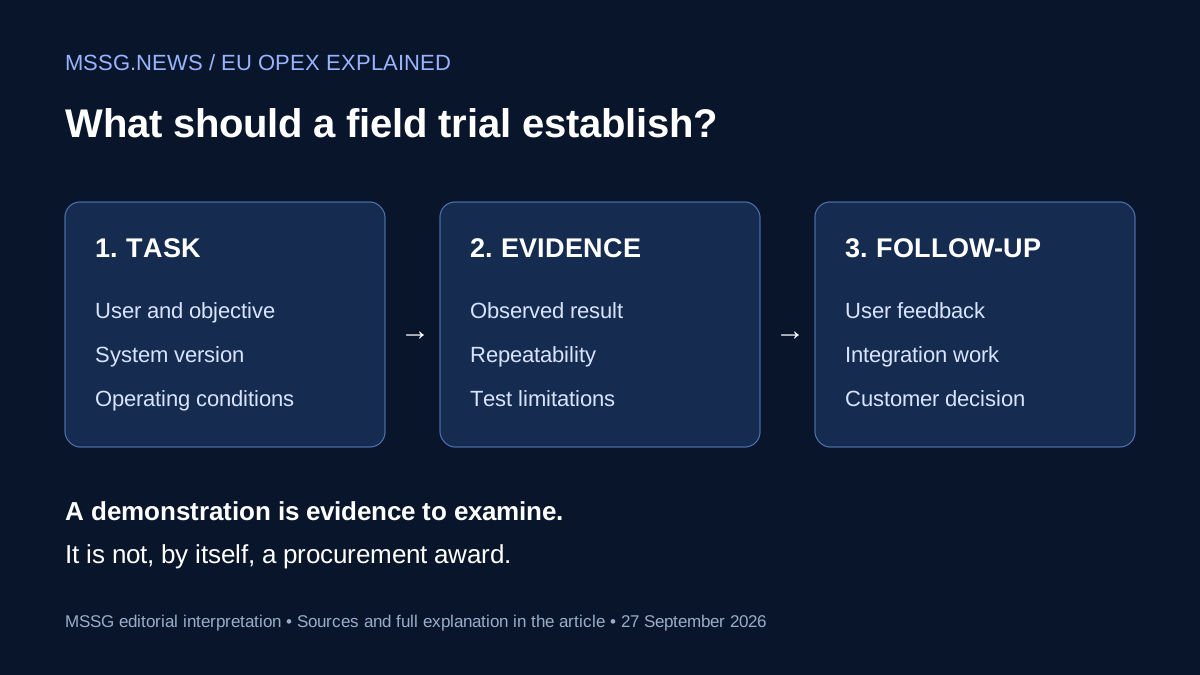
We would look for a description of the task, the participating system versions and the limits of the test. Evidence is more useful when a report explains both the observed result and the conditions required to obtain it. A list of participating companies or a video of a successful run cannot answer all of those questions.
For potential partners, the follow-up conversation should cover what changed after user feedback and what still needs integration work. That can identify a role for a component supplier, software team or support provider without assuming that the original developer already offers a complete deployable service.
Neither announcement establishes a procurement award to participating companies. The practical commercial implication is therefore an opportunity to build and discuss evidence, followed by whatever evaluation and purchasing process a customer actually uses. We will distinguish reported test findings from contracts if further official results become available.
Sources & context
Published by Mitchell Strategic Solutions Group. See our editorial standards and corrections policy. Read more →