
ESSI maps the research alliances behind European Earth-system science
The Commission and ESA have launched a website connecting projects across six scientific themes. Its project and alliance records offer a starting point for finding relevant research partners.

- Earth observation
- ESSI
The European Commission announced a new Earth System Science Initiative (ESSI) website with ESA on 4 November. The initiative dates from 2020; the new element is a shared place to explore participating projects, their collaborations and emerging results.
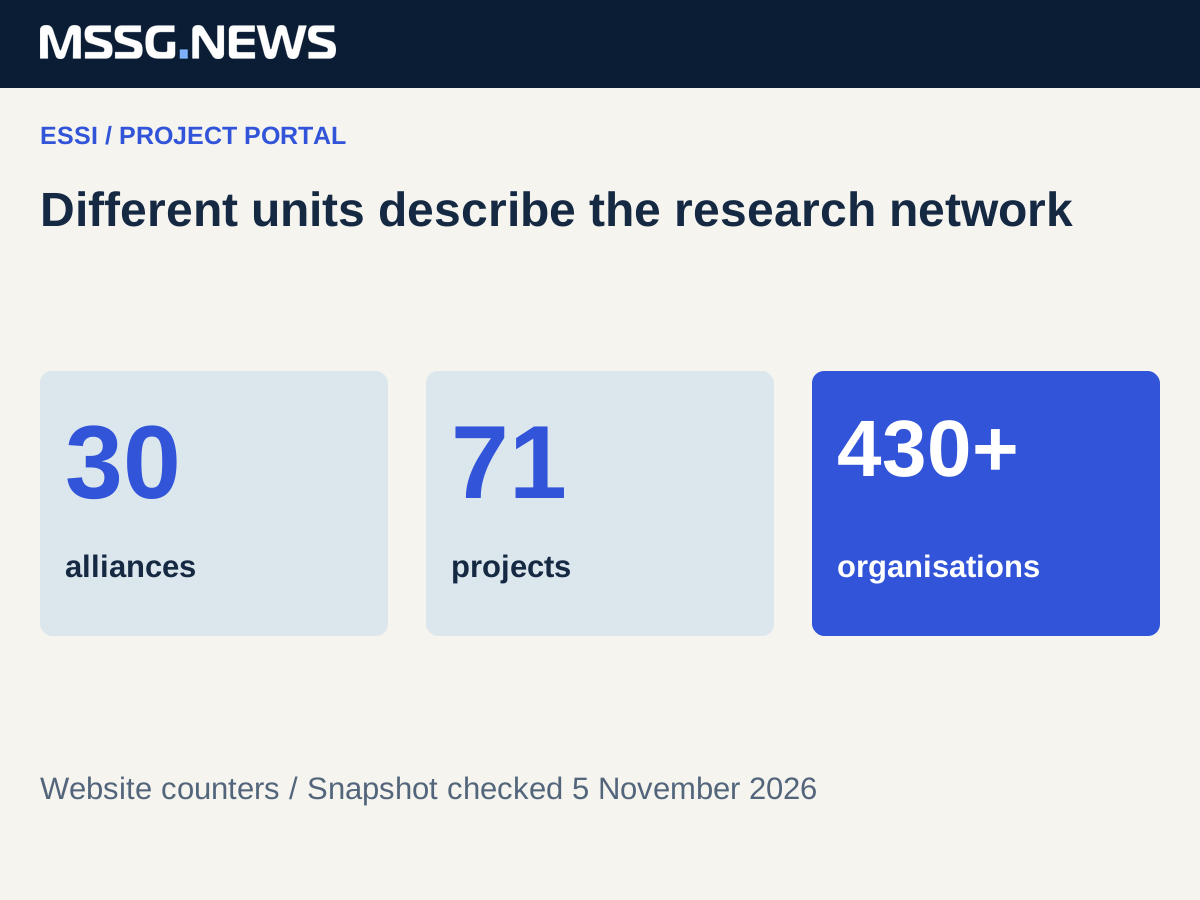
The portal displays 30 alliances, 71 projects and more than 430 organisations at the time of our review. These are the website’s own counters, with different units. They should not be read as a count of people, funded positions or currently open opportunities.
The six flagships cover atmospheric composition, biodiversity and vulnerable ecosystems, extreme events and climate adaptation, ocean health, polar change and global impacts, and terrestrial carbon science. The Commission describes an approach combining satellite observations, measurements on the ground and modelling across EU-supported research and ESA activities.
Six themes, with different stages of collaboration
The website distinguishes active, completed and in-preparation alliances. For example, it lists work on methane policy under atmospheric composition and marine heatwaves under ocean health as active. Its extreme-events section lists an ocean-climate-extremes alliance in preparation. Those labels matter when deciding whether to look for ongoing collaboration or an already completed result.
A useful research map for resilience work
For Polish and Ukrainian teams working on environmental monitoring or climate resilience, our assessment is that ESSI can help identify the projects and institutions behind a relevant method. A thematic match is only the beginning: the underlying project remains the place to check its datasets, geographical coverage, published methods and current contact or collaboration route.
The launch announcement concerns research visibility and collaboration. It does not set out a new grant budget, a universal application form or a funding deadline. The project counters therefore provide context for exploring the network rather than a measure of financing available to a new company.
A focused use is to start with a defined problem, such as coastal observations or emissions monitoring, find the relevant alliance, and follow the participating projects’ own evidence. This keeps a scientific result distinct from a proposed service and gives a potential partner a concrete basis for a first discussion.
Sources & context
- European Commission: ESSI website announcement, 4 November 2026 ↗
- EC-ESA Earth System Science Initiative: project and alliance portal ↗
Published by Mitchell Strategic Solutions Group. See our editorial standards and corrections policy. Read more →