ESA’s grid-resilience call opens a route from space data to infrastructure services
An ESA funding initiative with ENTSO-E challenges targets risk awareness and operational resilience. A 20 October webinar gives firms time to define a service before the early-November application window.
- ESA
- Energy
Europe’s electricity infrastructure creates a demanding market for space-enabled services. ESA’s forthcoming Space-Enabled Solutions for Resilient Grids initiative separates two opportunities: understanding risks before disruption and sustaining operations when disruption occurs. That division helps suppliers decide which customer problem they can credibly solve.
The initiative draws on challenges identified with ENTSO-E and supports proof-of-concept studies and pilot projects. Its focus is commercially viable services using space assets, rather than space technology in isolation. For dual-use companies, this connects civilian infrastructure resilience with capabilities also relevant to security: sensing, timing and resilient communications.
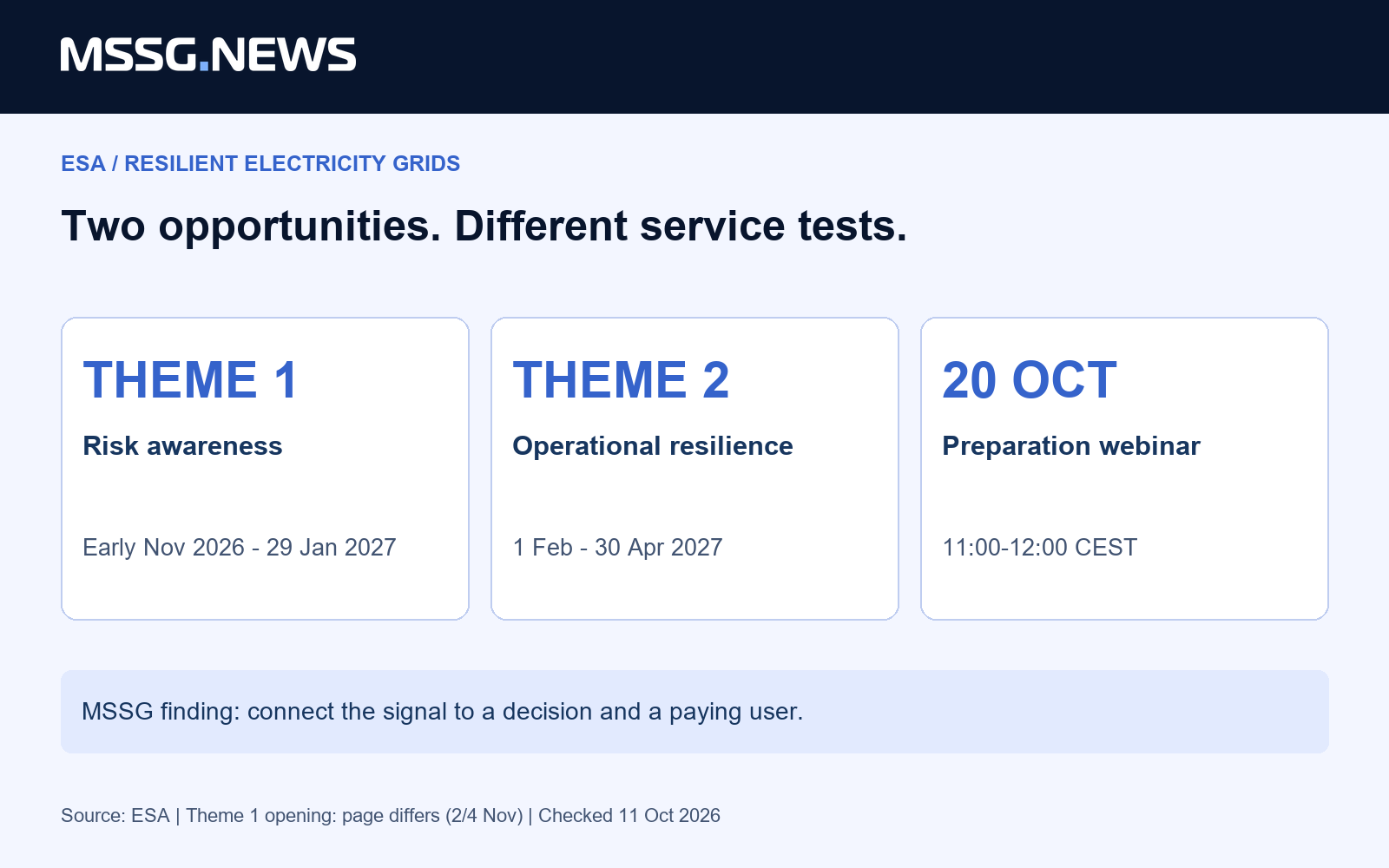
A webinar is scheduled for 20 October, from 11:00 to 12:00 CEST. That makes this a preparation opportunity before the application window. The immediate task is to define the intended user, the decision improved by the service and the evidence needed to demonstrate its value.
Choose risk awareness or operational continuity
The first theme concerns risk awareness, including threats linked to weather, infrastructure and space weather. The second concerns operational resilience, including timing, GNSS interference and backup communications. Our reading is that these lead to different demonstrations: earlier warning should improve a decision before an incident; continuity should preserve a function during one.
A useful proposal therefore needs an operational chain. Identify the input, the interpretation, the person responsible and the action that follows. A satellite-derived risk map creates more value when it changes inspection priorities or a preparedness decision. A backup link creates value when the operator can switch to it under defined conditions and sustain the required service.
These are our service-design recommendations, not additional eligibility conditions. The commercial test is whether a customer would pay to maintain the capability after the funded project. Internal access to space data and technical skill should support a repeatable service, rather than a demonstration that ends when the grant ends.
Prepare the application route before the deadline
The official page gives two opening dates for the first theme: 2 November in the theme heading and 4 November in the introduction. Both place opening in early November; firms should confirm the controlling date in the official tender documents. The listed closing date is 29 January 2027. The second theme runs from 1 February to 30 April 2027.
ESA describes maximum co-funding levels of 50-80%, depending on SME status and national delegation approval. Poland is among the participating countries listed for this opportunity; Ukraine is not listed. Companies should verify their eligibility and the applicable support level with their delegation before treating the percentage as secured funding.
The application route starts with registration and an Activity Pitch Questionnaire, followed by an outline proposal and a full proposal. ESA’s guidance sets an outline deadline within two months of the questionnaire submission and a full proposal deadline within four months of outline approval. Written national delegation authorisation is required for a full proposal. Preparing the customer case and delegation discussion now can remove avoidable delay when the window opens.
Sources & context
- ESA: Space-Enabled Solutions for Resilient Grids ↗
- ESA: application route for studies and pilots ↗
- ESA: 20 October webinar registration ↗
Published by Mitchell Strategic Solutions Group. See our editorial standards and corrections policy. Read more →