

EIC Accelerator: the November window for dual-use companies
The next full-proposal deadline is 4 November. Dual-use applicants need evidence of both civilian and defence demand, and new applicants must first pass the short-proposal stage.
- Deadline: 2026-11-04
Application deadline: 2026-11-04
See the call page for current conditions and closing time.
The EIC Accelerator’s next full-proposal batching date is 4 November 2026, at 17:00 Brussels time. For a company developing a dual-use product, the decisive question is whether it can substantiate demand in both markets.
A June amendment opened the Accelerator to dual-use innovation. That creates a financing route relevant to European technology companies, but it does not turn every defence project into an eligible Accelerator application.
This is a guide to the open application window, checked on 15 September, rather than an announcement of a new September call. The programme documents and application portal govern the final conditions.
A financing route below the large defence equity rounds
The Commission’s June announcement placed dual-use innovation within Accelerator and STEP Scaleup, while creating a separate defence scale-up instrument. For founders, the distinction affects the size and purpose of the financing sought. A smaller innovation project and a major industrial investment round should not be presented as interchangeable applications.
Accelerator combines a grant component normally below EUR 2.5 million with investment of EUR 1-10 million. Grant-only, investment-only and blended structures serve different needs. The grant addresses innovation activities; equity involves an investment decision rather than reimbursement of every development expense.
What counts as a credible dual-use case
The EIC FAQ requires a business case in civilian and defence markets. Potential military utility alone is insufficient, and sales to police or civil protection count as civilian applications. The dual-use label does not bring preferential scoring.
Our practical reading is that a market slide should identify who buys each version, what problem it solves and what evidence supports the expected demand. A sensor sold for infrastructure inspection might need a different qualification process, procurement route and support arrangement for defence customers. Those differences belong in the commercial argument, not only in a technical appendix.
Budget for development and the unfunded share
The amended work programme caps the grant contribution at 70% of eligible costs. It covers activities including prototyping, demonstration and relevant testing. Applicants therefore need a financing plan for the remaining eligible costs as well as expenditure outside the grant’s scope.
The applicant guide places the innovation beyond completed TRL 5 and excludes activities above TRL 8 from grant support. It also lists financial information, an implementation plan, freedom-to-operate analysis and letters of intent among the full-proposal documents. These are distinct evidence sets: technical maturity does not establish freedom to commercialise a product or the existence of customers.
November is a full-proposal date
A successful short proposal is normally needed before the full stage. EIC guidance recommends submitting the short application at least ten weeks before the intended full-proposal deadline. On 15 September, a newcomer is already inside that recommended preparation period for November.
For a company with an eligible GO already in hand, the immediate work is assembling the full dossier. For a company starting now, the sensible plan must allow for evaluation time and a later window rather than assume that submitting a short proposal guarantees access to November. Purely defence-focused projects should examine the separate STEP Scale Up Defence route.
Sources & context
- EIC Accelerator: funding and application calendar ↗
- EIC FAQ: dual-use eligibility and application stages ↗
- European Commission: amendment of 17 June 2026 ↗
- EIC Work Programme 2026, amended version ↗
- EIC Accelerator applicant guide ↗
Published by Mitchell Strategic Solutions Group. See our editorial standards and corrections policy. Read more →
Related reporting

- Apply by 31 October
- Independent evaluation · security clearance
EDF evaluators: expertise, clearance and the application process
This is an opportunity for individuals. Technical experience must be supported by an expert profile, security clearance and independence.
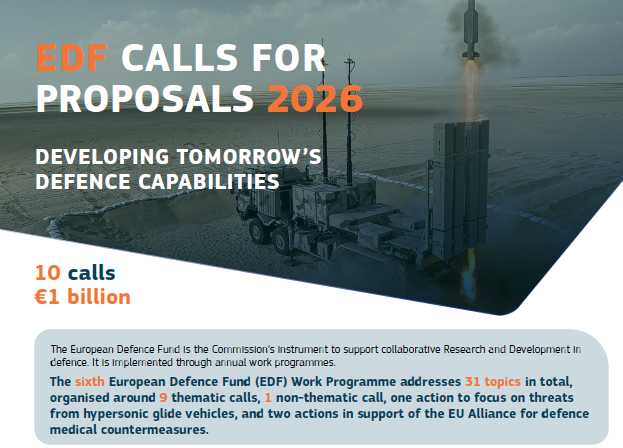
- 29 September · 17:00 Brussels
- Defence research and development
EDF SME calls: two routes, different budgets and co-financing needs
The 29 September deadline covers research and development, but their rules differ. We examine coordination, research-organisation budgets and prototype funding.

- EUR 180m · closes 13 Oct 2026
- EUR 80m · closes 16 Feb 2027
EDIP and Ukraine: €260 million across two production calls
October covers missiles and ammunition; February covers unmanned systems. We separate topic budgets, project ceilings and the scope of industrial investment.