
ESA offers up to €75,000 to test a space-based service. The next batch closes 30 October.
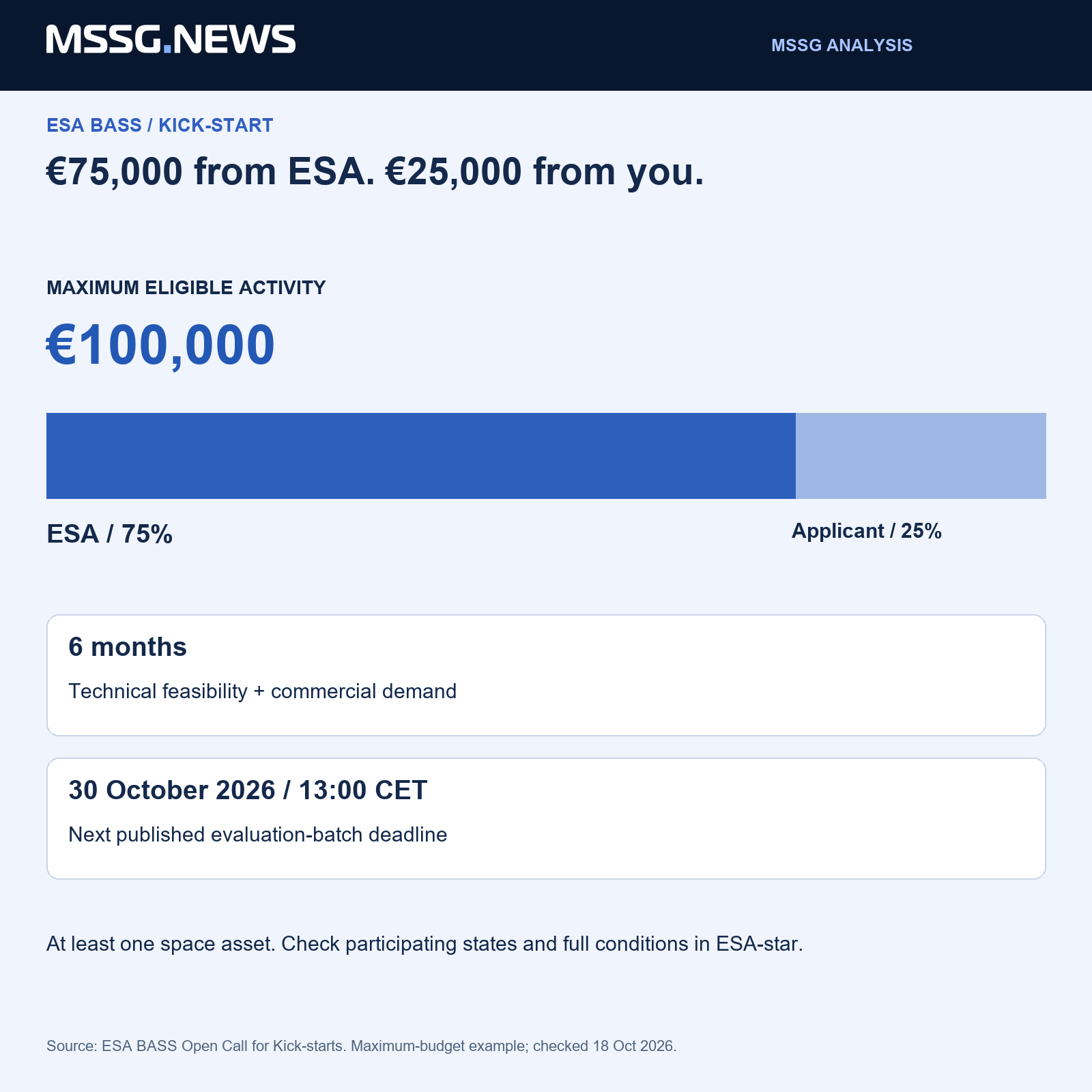
The six-month Kick-start study funds feasibility and customer demand. At the maximum budget, ESA covers €75,000 and the applicant covers €25,000.
- ESA
- Space
A space business does not need to build a satellite to have a space-based product. It can use satellite data or connectivity to solve a customer's problem. ESA's BASS Kick-start call offers a route to test whether that service can work technically and commercially.
The public call, checked on 18 October, lists 30 October 2026 at 13:00 CET as the next evaluation-batch deadline. Applications are accepted during the year and assessed in batches. A Kick-start lasts six months and must use at least one space asset, such as Earth observation, satellite communications or navigation.
ESA covers 75% of eligible activity costs, up to €75,000 per contract. The maximum eligible activity budget is €100,000. At that ceiling, the remaining €25,000 is the applicant's share; the programme does not offer a €100,000 ESA contribution.
Start with the user's decision
Our analysis is that the strongest starting point is a decision a customer already needs to make. For example, can an infrastructure operator use a satellite-derived indicator to decide where an inspection is needed? That is an illustrative service question, not an endorsed project or a claim that ESA has selected it.
The feasibility study should connect the proposed information to a practical action. A technically impressive map may still leave the operator with the same workload. The service becomes useful when the operator can explain what changes, what evidence supports that change and what it costs to use routinely.
This is where civilian resilience and dual-use capabilities meet commercially: data processing, connectivity and operational workflows can have several markets. The published call is a business-applications opportunity, not a general defence procurement programme.
Six months should settle a business question
ESA describes work on service architecture, customer engagement, the business plan and subsequent development. A useful endpoint is a supported decision about whether to proceed, rather than a list of features built.
For a small team, that means budgeting for customer access and validation alongside software. Data rights, recurring connectivity charges and support after the study should be considered early. Those costs can determine whether a promising prototype can become a service somebody will buy.
The 75/25 split also makes the scope important. Increasing a study's budget does not remove the applicant contribution. Work packages should match the question the study is intended to answer and the funding the business can actually provide.
Check eligibility before committing the budget
ESA directs applicants to ESA-star for the current list of participating states and authoritative tender conditions. Companies should verify their establishment and applicable national conditions there. Membership of the European market alone does not establish eligibility.
The full tender requires portal access, so we do not infer a country-specific entitlement from the public summary. The publicly verified figures and deadline provide a starting point; the official tender governs an application.
For European space-service companies, the immediate opportunity is focused: use a limited study to test a named customer's demand and the economics of delivering the service. A clear answer to those questions is more valuable than treating the funding ceiling as a target in itself.
Sources & context
- ESA BASS: Open Call for Proposals, checked 18 October 2026 ↗
- ESA-star: authoritative tender reference ↗
Published by Mitchell Strategic Solutions Group. See our editorial standards and corrections policy. Read more →