ESA’s FLOTTA contract puts the factory inside the satellite design
Hungary’s C3S will develop a 50-150 kg communications platform for constellations of more than 100 satellites. Series production and safe disposal are part of the same engineering brief.

- Space
- Satellite communications
ESA announced a contract with Hungary’s C3S on 7 October to develop FLOTTA, a microsatellite platform for communications constellations. Its target range is 50-150 kg, with an industrial architecture designed for programmes using more than 100 spacecraft. The news is as much about building a production system as building a satellite.
The project sits within ARTES 4.0’s Industrial Competitiveness programme line. C3S leads the engineering and verification work; Germany’s HPS contributes deployable-antenna expertise. ESA describes a platform that addresses manufacturing volume and space-debris requirements together.
FLOTTA’s design scope includes de-orbiting, passivation, demisability, trackability and collision avoidance. These are different functions: bringing an obsolete spacecraft out of orbit, reducing stored-energy hazards and designing it to break down during re-entry are not interchangeable tasks.
The hundredth spacecraft is the industrial test
MSSG’s assessment is that the critical shift is from a successful prototype to repeatable acceptance. At constellation scale, integration steps, test fixtures, supplier consistency and handling processes become part of the product. A design that needs extensive individual adjustment creates a bottleneck even when the first satellite works.
This changes the opportunity for European suppliers. Components and antennas matter, but so do inspection, assembly tools and verification software. The useful question for a prospective partner is where its contribution removes variability or time from a repeated production step.
A development contract, with concrete questions to follow
ESA’s announcement sets the development scope; it does not announce a launched constellation or a satellite purchase order. The next useful evidence will be the verified platform, its manufacturing approach and the consistency of repeated builds.
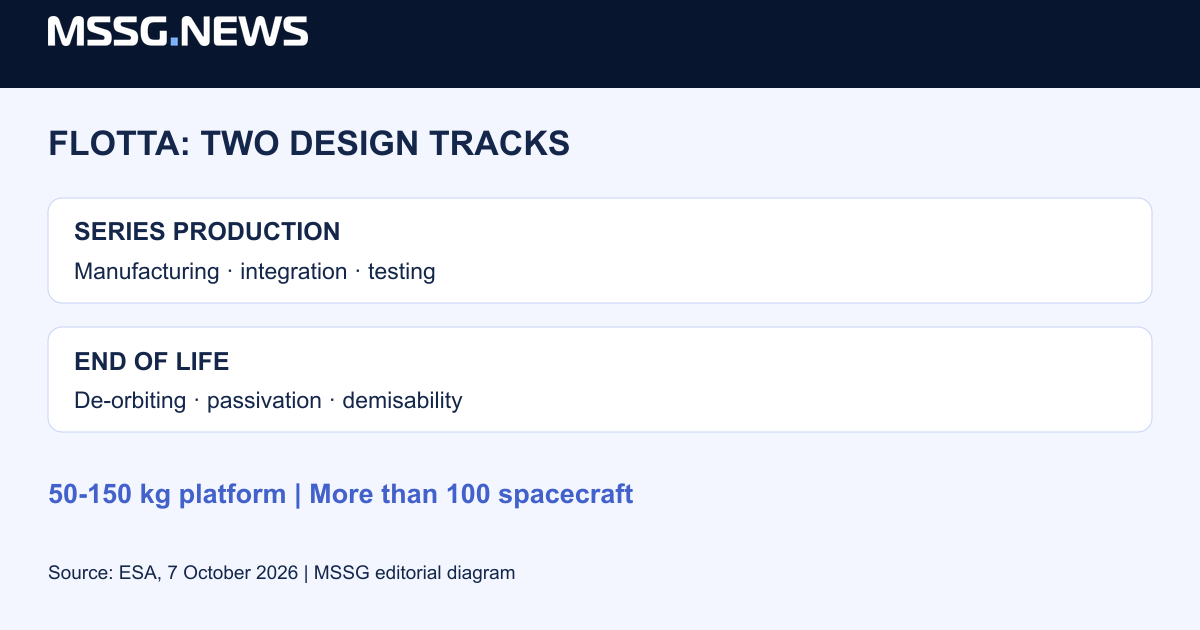
For readers following Europe’s communications resilience, the connection is direct: a constellation depends on the ability to manufacture and replace spacecraft as well as operate them. FLOTTA brings that industrial capacity into the engineering brief. Our accompanying diagram separates the two design tracks, without inventing a production-rate or cost target.
- Platform range
- 50-150 kg
- Intended constellation scale
- More than 100 spacecraft
- Prime contractor
- C3S, Hungary
Sources & context
Published by Mitchell Strategic Solutions Group. See our editorial standards and corrections policy. Read more →