
ERMIS-3 laser link joins a small satellite to its ground system. Availability is the next test.
ESA reports an optical link to Greece. Astrolight’s earlier operating figures show why data rate and service availability need separate scrutiny.
- ESA
- Optical communications
A laser terminal has to find its partner before it can deliver data.
ERMIS-3’s link to Holomondas is therefore evidence about the satellite and ground station working together, not simply about a smaller transmitter.
ESA described the demonstration on 2 November.
Two ends of one connection
The 8U satellite, developed by the National and Kapodistrian University of Athens, carries Lithuania’s Astrolight ATLAS-1 terminal. Its partner is the Aristotle University of Thessaloniki’s HolOGS-1 ground station. ESA supported testing and optical alignment at ESTEC.
The mission launched on 30 March 2026. The November report is a later account of the link demonstration, not a new launch or a statement that first contact happened that day.
Keep the operating figures attached to their source
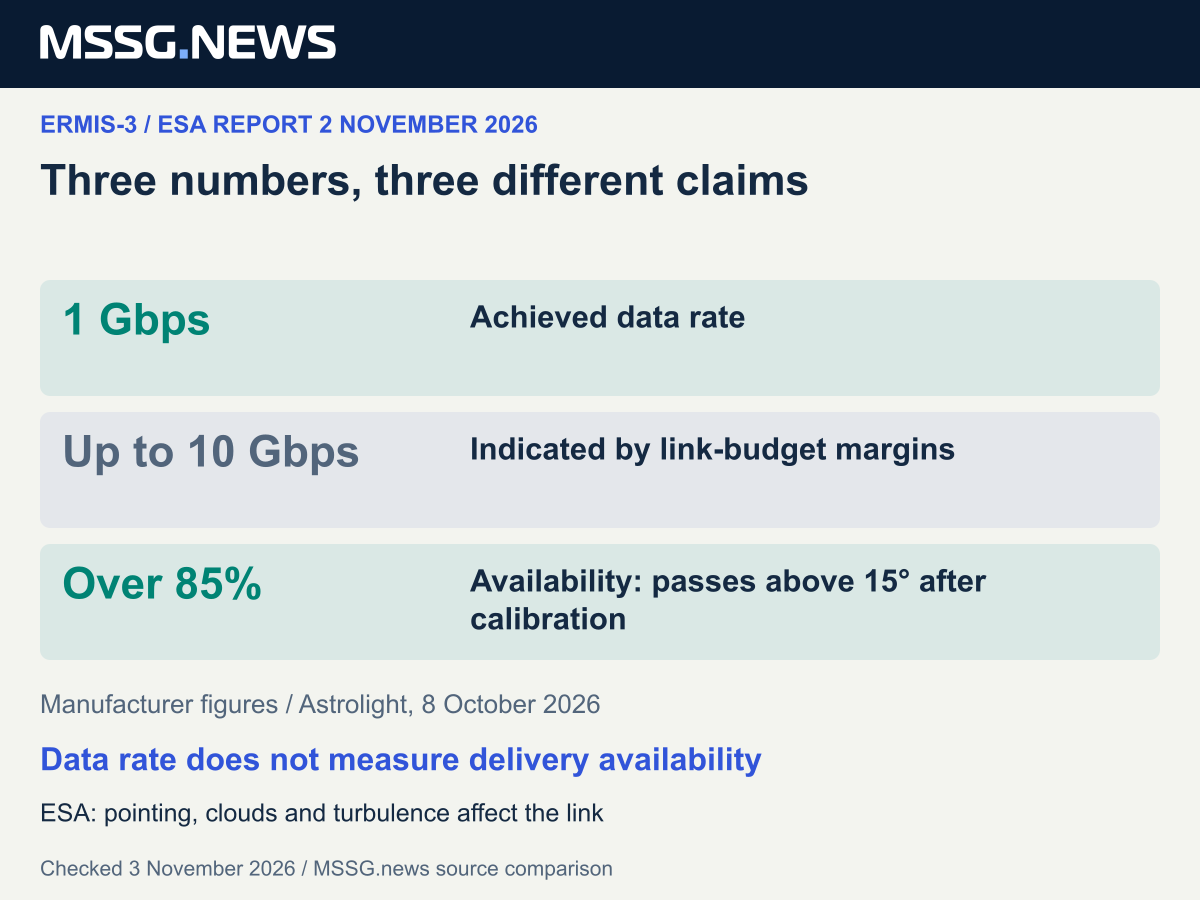
Astrolight had reported routine operation on 8 October: two links daily at 1 Gbps. It described up to 10 Gbps as indicated by link-budget margins, rather than an achieved transmission rate. The company also reported availability above 85% for passes above 15 degrees after calibration.
These are manufacturer figures. The availability denominator is those specified passes, not all hours or all weather. ESA notes that clouds can block an optical link and atmospheric turbulence can degrade it.
What an operator would still need to measure
Our assessment: a useful service comparison should count data delivered within the customer’s required time, alongside the headline data rate. For the same mission, we would ask for the eligible passes, attempted sessions, weather exclusions and completed transfers.
That record would help distinguish terminal performance from a ground-station coverage problem. A successful connection establishes a necessary capability; a repeatable operating record makes its commercial value assessable.
Sources & context
- ESA demonstration report, 2 November 2026 ↗
- ESA launch report, 31 March 2026 ↗
- Astrolight manufacturer operating report, 8 October 2026 ↗
Published by Mitchell Strategic Solutions Group. See our editorial standards and corrections policy. Read more →