Europe puts €168.2 million into defence production. Poland is in the warhead consortium.
Eight EDIP projects target industrial bottlenecks. E-WARP includes Zakłady Niewiadów; its €25.8 million grant covers the whole consortium.
- EDIP
- European Union
Europe's defence push is reaching the factory floor. On 14 October, the European Commission allocated €168.2 million to eight industrial reinforcement projects under EDIP, targeting production constraints that cannot be solved by announcing another weapons order.
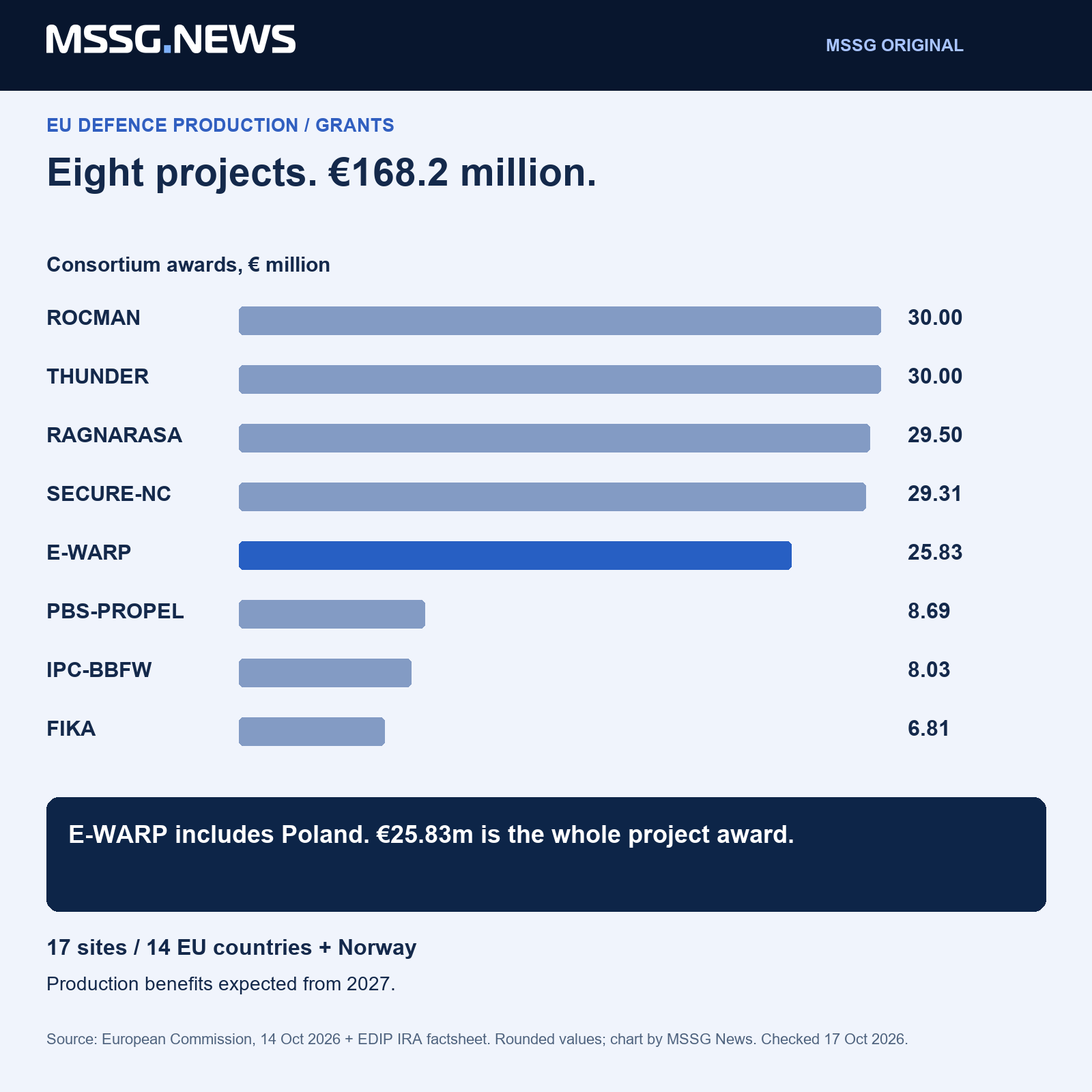
The Polish connection is E-WARP. The Commission lists Zakłady Niewiadów alongside KNDS France, KNDS Belgium, Valsts Aizsardzibas and Wolfram in a consortium working on loitering-munition warheads and explosives. The project's grant is €25,828,760. The factsheet does not break that sum down by company.
The key detail is the position in the supply chain. Propulsion and energetic materials underpin multiple finished systems. Expanding those inputs can matter beyond any one platform, provided the additional capacity reaches repeatable production and finds customers.
The money follows industrial constraints
The awards cover 17 sites in 14 EU member states and Norway. ROCMAN and THUNDER each receive €30 million, addressing solid-fuel rocket motors and military TNT respectively. SECURE-NC receives €29.3 million for military nitrocellulose, while RAGNARASA receives €29.5 million for warheads and explosives.
The smaller awards target defined production steps: PBS-PROPEL covers small turbojets, IPC-BBFW covers base-bleed units and warheads, and FIKA covers small-calibre cartridges. This is a portfolio of industrial inputs and processes, rather than eight interchangeable purchases of complete weapons.
The Commission expects the projects to mobilise €1.26 billion in industrial investment. That is a separate investment forecast, not another grant allocation to add to the €168.2 million headline. The distinction matters when comparing public support with the scale of the factories it is intended to unlock.
Poland participates through a named project
E-WARP offers a tangible Polish industrial link without requiring a new claim about Poland's share of the grant. Its consortium spans France, Poland, Belgium and Latvia. The official table identifies participants and the total award; it does not publish individual contracts or manufacturing work shares.
Our analysis is that prospective suppliers should start with the actual plant work package. Equipment, quality assurance, maintenance, process control and secure industrial IT have different buyers and acceptance conditions. A useful commercial proposal identifies which production milestone it would help complete.
The relevant questions are who orders the work, who accepts the installation and which milestone depends on it. Consortium membership alone does not answer those questions for a new subcontractor.
Capacity needs an operating customer
The Commission expects production and delivery-time benefits from 2027. These are forward targets. Follow-up should track sites entering service, qualified output and delivery schedules, rather than presenting forecast capacity as equipment already delivered to armed forces.
A factory expansion also needs a demand plan. Buyers need compatible specifications, dependable deliveries and a route for accepting the output. Suppliers need visibility over orders to maintain equipment and skilled staff after the investment phase.
EDIP's first eight awards sharpen Europe's defence-industrial agenda: remove constraints in the inputs that many systems share. The commercial result will be decided when funded plant becomes usable capacity, and usable capacity becomes sustained production under orders.
Sources & context
Published by Mitchell Strategic Solutions Group. See our editorial standards and corrections policy. Read more →
Related reporting

NATO Innovation Fund moves closer to eastern-flank customers with a Warsaw branch

€1.24 billion for Ukrainian drones and missiles: the next test is production