NATO Innovation Fund moves closer to eastern-flank customers with a Warsaw branch
NIF has opened a Warsaw branch and named Jan Duthel CEE Adoption Lead. Its stated focus includes taking portfolio companies from pilots towards procurement contracts.

- NATO Innovation Fund
- Poland
The NATO Innovation Fund has established a branch in Warsaw, bringing its technology-adoption work closer to Poland and Central and Eastern Europe.
Its 13 October announcement names Jan Duthel as CEE Adoption Lead and sets out a partnership with the Polish Dual-Use Chamber.
For the eastern flank, the significant question is how that local presence converts promising technology into capability that customers can use.
The hard part follows the first demonstration
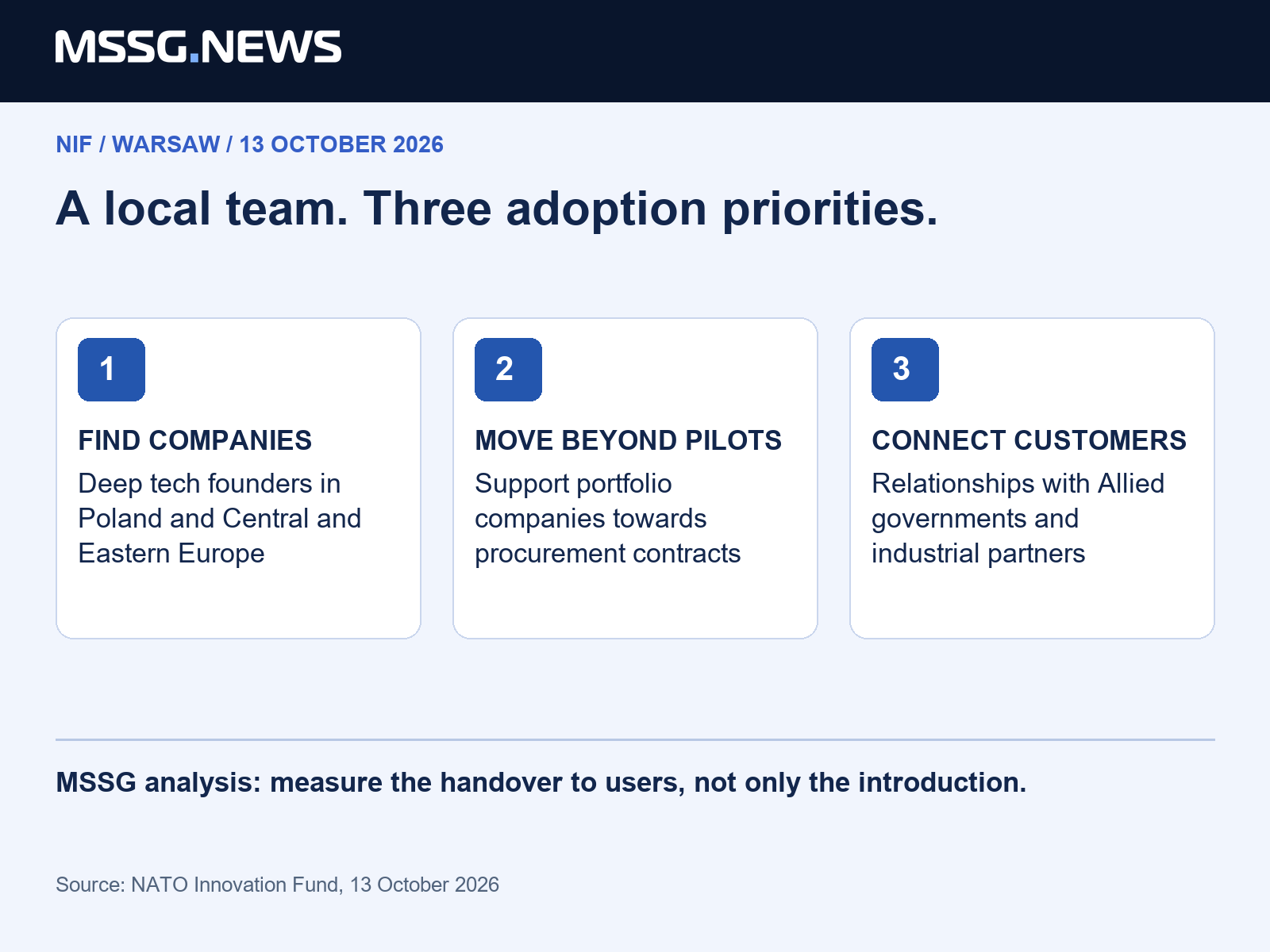
NIF identifies three priorities for the Warsaw team: finding deep tech companies, helping portfolio companies progress from pilots towards procurement contracts, and developing relationships with Allied governments and industry. These priorities put customer adoption alongside company discovery. A technically impressive demonstration is the beginning of that work.
MSSG’s analysis is that the local team’s strongest contribution could be continuity between meetings. A founder may leave a trial with useful feedback but still lack a clear institutional owner for the next stage. Repeated contact with the same customer can help turn that feedback into a defined requirement, a responsible decision-maker and a realistic purchasing process. Those are questions for the customer to resolve; an investor cannot substitute for the authority buying the system.
Capital and customer demand do different jobs
NIF describes a EUR 1 billion fund backed by 24 Allied nations, investing from seed to Series B with initial tickets of EUR 3-10 million. These are fund-wide figures. The Warsaw announcement does not establish a separate EUR 1 billion allocation for Poland. The local change concerns engagement and adoption, rather than a newly announced national funding envelope.
Financing gives a company room to improve a product, recruit staff and manufacture. A purchase gives it a specific delivery obligation and a customer against which performance can be measured. Connecting the two matters particularly for products with civilian and defence uses: a commercial reference may demonstrate reliability, while the defence user has additional integration and acceptance requirements.
A useful adoption discussion would therefore start with the problem and existing operating environment, rather than a broad claim that the technology is dual-use. What changes for the user if it works? Who pays for integration? Who accepts the result? Our view is that these questions make the commercial conversation more demanding and more valuable. They distinguish a promising introduction from a credible next step.
Judge the branch by the handover to users
The geographical move creates a practical opportunity to maintain relationships with founders, customers and industrial partners in the same region. It does not itself identify a newly awarded procurement contract. The measure of success should match the adoption mission: pilots that lead to decisions, products integrated into a customer’s environment, and a route to repeat orders.
The Warsaw announcement is consequently more than a change of address. It brings a named adoption function into a strategically important market. For companies, the useful response is to present a specific customer problem and evidence relevant to it. For readers tracking NATO’s technological role, the story is the work needed to translate innovation into the industrial and operational foundation of deterrence.
Sources & context
Published by Mitchell Strategic Solutions Group. See our editorial standards and corrections policy. Read more →
Related reporting

Drone World Expo returns on 23-25 March 2027: where drone suppliers meet industrial users
2027-03-23 · Nadarzyn
StormRider 550 at MSPO: a smaller maritime platform, distinct from the 850