
Two European drone hubs will test different problems. Shared methods are the industrial opportunity.
EDA plans 2027 exercises for pilot hubs in Latvia and the Netherlands. Their value will depend on how operational questions become comparable evidence.

- EDA
- Drones
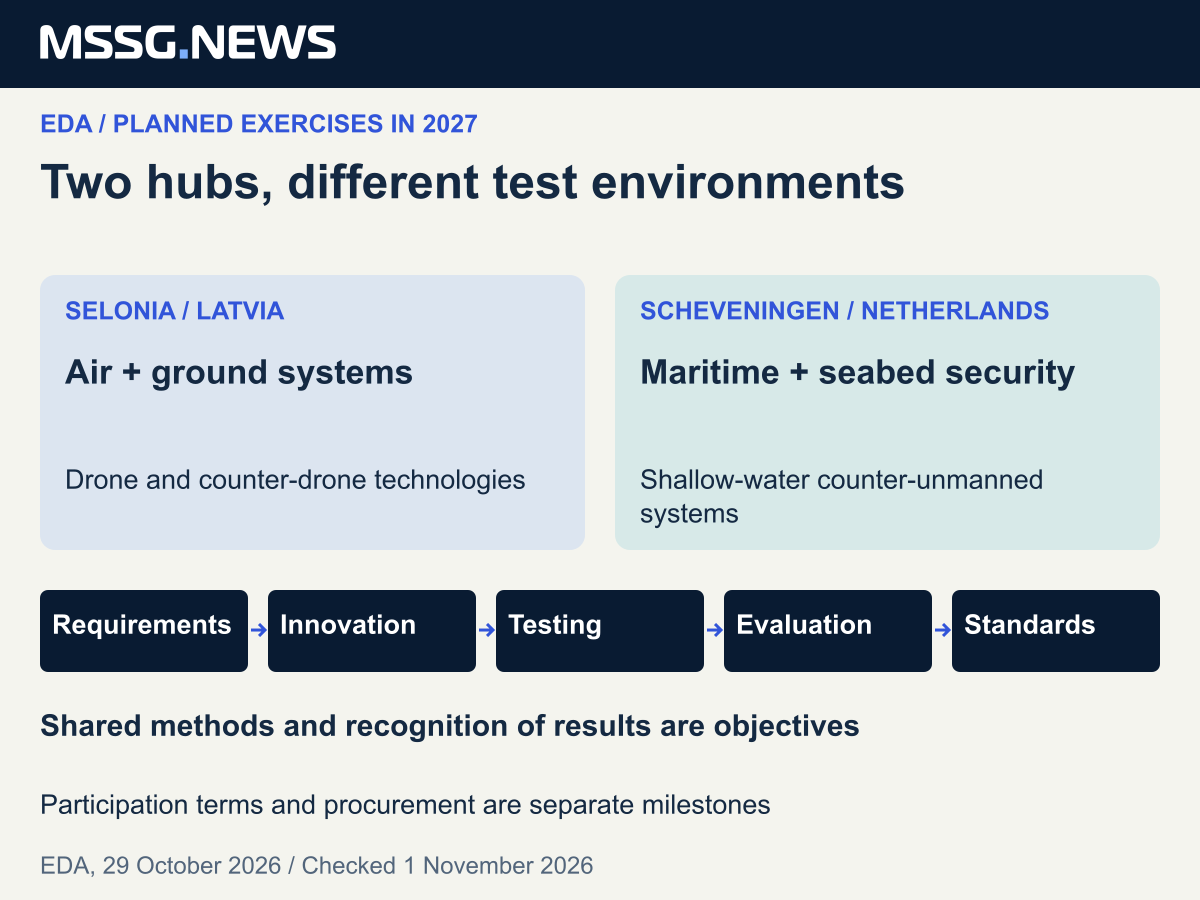
The European Defence Agency plans new operational exercises in 2027 to develop two pilot Drone Technology Hubs. The locations have distinct jobs: Selonia in Latvia will address air and ground systems, while Scheveningen in the Netherlands will concentrate on maritime and seabed security.
EDA’s 29 October announcement describes the pilots as the beginning of a European network. Its proposed common approach connects military requirements with experimentation, evaluation and standardisation.
Shared test methods and recognition of results are objectives to pursue where appropriate, rather than arrangements already demonstrated across Europe.
A common programme with different environments
The Latvian hub will cover drone and counter-drone technologies, including detecting, identifying, tracking and defeating unmanned systems. Scheveningen’s focus is shallow-water counter-unmanned maritime systems. These are related capability needs, but they require different physical environments and evidence. A successful aerial demonstration cannot establish performance against a maritime target.
The hubs sit within the EU priority capability area for drones and counter-drone systems and the DECODER European Defence Project of Common Interest. EDA names Latvia, the Netherlands, Croatia, Denmark and Spain as the priority area’s lead countries. Both pilots are to receive agency support and be co-located with NATO innovation ranges. That is a cooperation model; it is not a notice selecting a commercial supplier.
What a reusable test result needs
Our assessment is that the industrial benefit could come from making evidence easier to compare and reuse. A supplier’s report becomes more useful when a prospective customer can see the question tested, the configuration used, the conditions encountered and the limits of the finding. Without that context, another demonstration may add publicity while leaving a buyer’s uncertainty unresolved.
A common methodology could reduce the need to start the same assessment from scratch in each country. That potential depends on agreement about what was measured and whether the receiving organisation accepts the result for its own purpose. EDA’s reference to mutual recognition is therefore consequential, but conditional. It does not promise automatic certification, procurement approval or access to every national market.
Separate the next exercise from a purchase
EDA links the pilots to its wider operational experimentation in Italy, Portugal and Switzerland during 2025 and 2026. It also says experimentation will be central to the Centre for European Defence Innovation, planned within the agency for November 2026. These are institutional and testing developments. The announcement does not provide an open application deadline, a grant amount or a procurement timetable for participating companies.
For a manufacturer or research partner, the useful preparation is a defined testing question and a clear account of the evidence already available. In our view, integration assumptions and the remaining uncertainty should be visible alongside product performance. The next public milestones to follow are exercise arrangements, participation conditions and the methods used to evaluate results. Those will show how the two locations turn a shared ambition into work that customers can use.
Sources & context
Published by Mitchell Strategic Solutions Group. See our editorial standards and corrections policy. Read more →