

DELTA reports 1.8 million monthly result records. What does the number measure?
Ukraine’s latest update shows the scale of a military data workflow. Assessing software adoption and proving operational effectiveness remain different questions.

- Ukraine
- DELTA
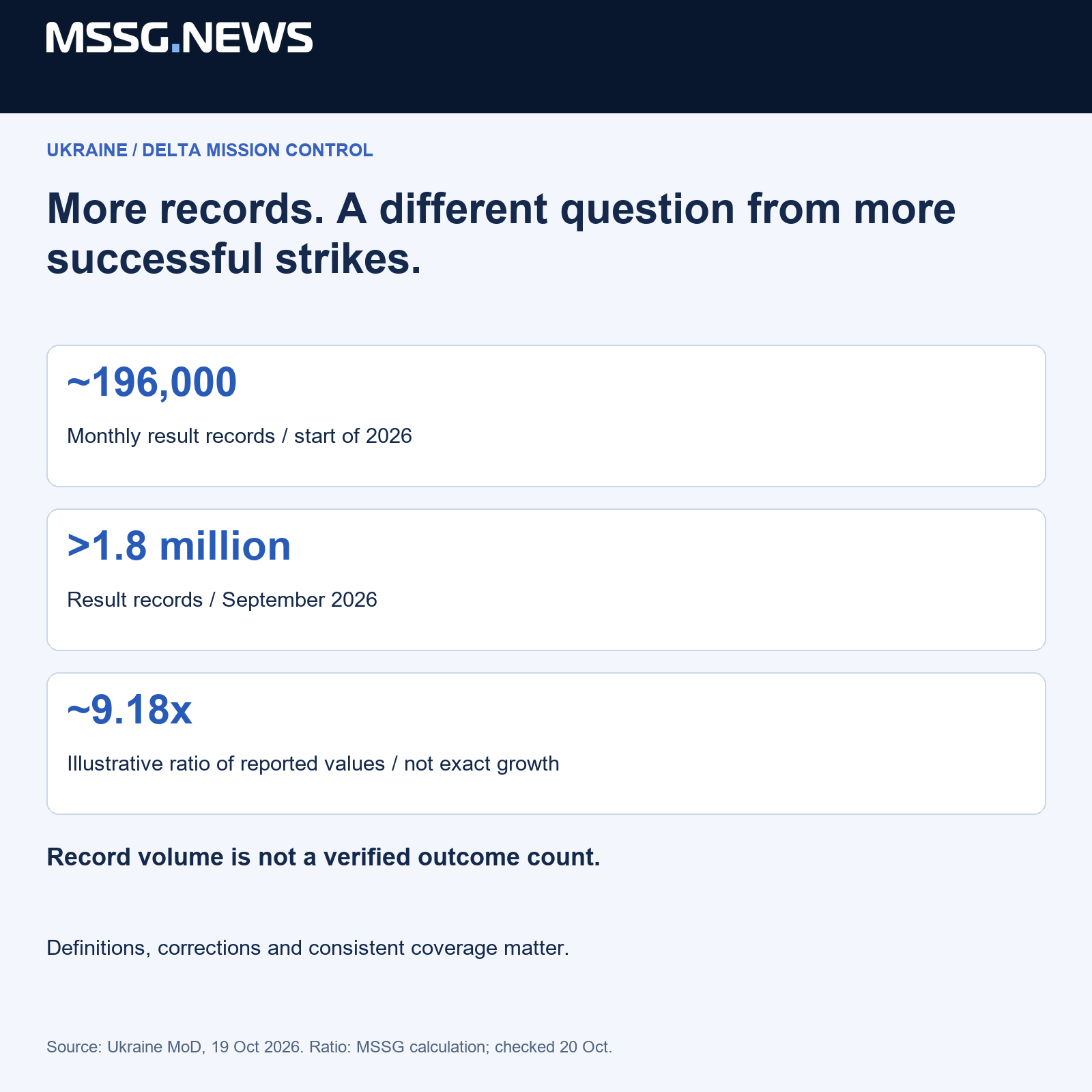
Ukraine’s Ministry of Defence reported on 19 October that DELTA Mission Control received more than 1.8 million completed-mission result records in September, compared with about 196,000 a month at the start of 2026. The ministry describes the module as a way to record results and support analysis.
That is a substantial change in reporting volume. It is also a metric with a specific unit: records. Reading it as the number of verified successful strikes would change the meaning of the announcement.
For European defence software suppliers, the commercially useful issue is how a growing stream of records becomes information a customer can trust. Our analysis concerns data quality and product assessment, not operational instructions or an independent audit of DELTA.
Keep the unit attached to the number
The ratio between 1.8 million and 196,000 is approximately 9.18. Because the ministry uses more than for the first figure and about for the second, this is an indicative comparison of the reported values, not a precise measurement of growth. The reporting interval also matters: these are monthly values, not the cumulative history of the platform.
A system can receive more records because more people use it, because existing users report more consistently, because its coverage changes, or because underlying activity increases. The announcement alone does not isolate those effects. A buyer should therefore ask what population and reporting rules sit behind a trend before comparing products.
A record needs a defined meaning
Our proposed assessment starts with the data contract: what counts as one record, how corrections are retained, how duplicate submissions are handled and which fields distinguish a report from a verified conclusion. These are ordinary questions about software assurance; they do not require publishing sensitive operational data.
For a supplier, the valuable deliverable could be an auditable change history or a reproducible quality report. The customer should be able to see whether a correction changes an aggregate and which version of the data produced a published result. A polished dashboard does not answer those questions on its own.
Adoption and effectiveness need separate evidence
Growing use can establish that a workflow has become important to its users. Establishing the value of a particular analytical feature requires a further comparison: what decision or administrative task improved, under which conditions and at what cost? A useful evaluation can measure completeness, correction rates and time spent reconciling information without presenting them as battlefield outcomes.
The distinction matters when transferring military software lessons into civilian resilience, logistics or industrial maintenance. Reuse the discipline of traceable records and explicit acceptance criteria. Do not transfer an impressive headline total into a claim that another customer’s problem has already been solved.
Sources & context
Published by Mitchell Strategic Solutions Group. See our editorial standards and corrections policy. Read more →