ARISE: designing the connections behind European space intelligence
ESA selected an ICEYE-led consortium for an architecture study. The immediate deliverable is a system design, rather than an operational constellation.

- technology
- Europe
ICEYE announced on 17 September that ESA had selected its ARISE consortium to study the architecture of the EU Earth Observation Governmental Service. The work belongs to the European Resilience from Space initiative and is funded on behalf of the European Commission’s defence and space directorate.
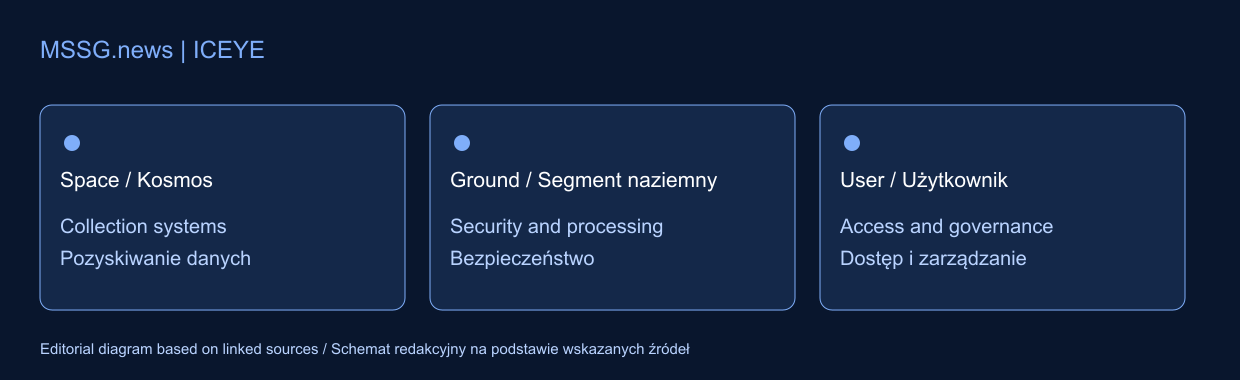
The announced study covers the space, ground and user segments, together with security and governance. Its stated duration is 12 months plus an eight-month component. Creotech Instruments is among the industrial participants.
For a European supplier, the most consequential work may concern how existing capabilities connect. A service has to carry an authorised request from a user to a collection system and return information the user can actually use.
An architecture is a set of decisions
Our assessment is that the study matters because interfaces and responsibilities influence later opportunities. An analytics company depends on usable data formats and access arrangements. A ground-system supplier needs to understand security boundaries and the division of responsibility between operators. Neither can infer its future role simply from the size of a proposed space programme.
A federation of capabilities also raises a practical question: who is accountable when one component is unavailable? A design should make service responsibilities understandable across organisational boundaries. That is different from assembling a list of satellites or technology vendors.
What the announcement establishes
The selection establishes a funded design activity and identifies its industrial lead. It does not establish an order for every spacecraft, an operational service date or an open subcontracting competition. Those require their own evidence. Suppliers should therefore distinguish participation in the study from participation in any subsequent implementation.
Evidence to follow
The useful next milestones are the architecture’s scope, interfaces and follow-on procurement decisions when they become public. For investors, this is a programme-development milestone. Treating it as recurring operating revenue would confuse the design phase with the service that may follow.
Sources & context
Published by Mitchell Strategic Solutions Group. See our editorial standards and corrections policy. Read more →