
SAFE: how European loans become industrial procurement
The €150 billion envelope goes to governments. Suppliers need a procurement route, documented component origin and the right degree of control over product design.
- EUR 150bn in loans to states
- Joint defence procurement
SAFE finances defence investment by EU Member States. The Commission borrows on capital markets and provides long-maturity loans against approved national investment plans. Its total envelope is €150 billion. It is not a grant application programme for individual manufacturers.
For Polish and Ukrainian companies, the instrument can nevertheless support demand for equipment, components and integration. Revenue comes through a procurement contract or through a prime contractor delivering a larger system.
This explainer combines the Commission overview with Regulation 2025/1106. The commercial implications are our analysis; eligibility for a particular offer depends on the instrument and the actual procurement documents.
From a national plan to a contract
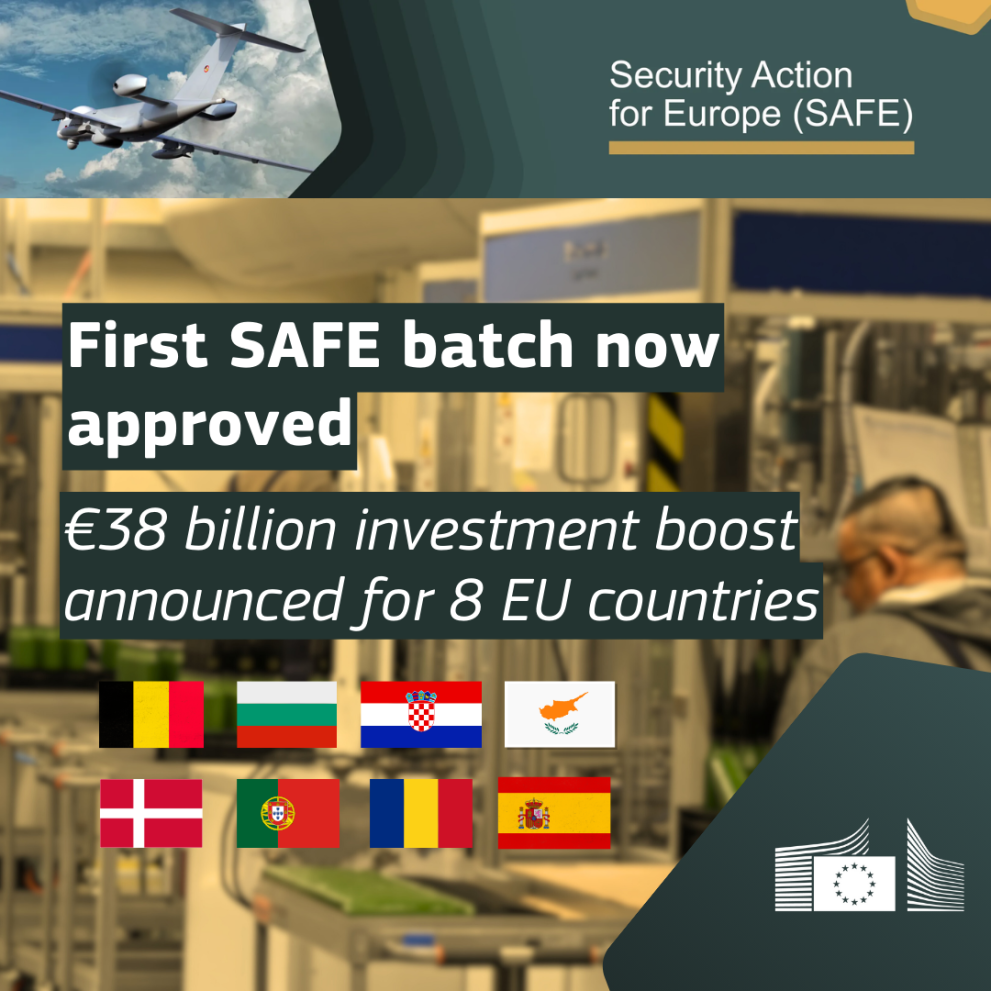
The Commission assesses the investment plan, the Council approves assistance and a loan agreement enables disbursement. Contracting authorities then translate capability requirements into orders. An announced national allocation does not establish that every proposed purchase has been contracted or that suppliers have received advances.
The general model is common procurement involving at least two countries, including a Member State benefiting from SAFE. Ukraine and EEA-EFTA countries can participate under the relevant conditions. Transitional exceptions also allow certain single-country purchases; these should not be described as a permanent replacement for cooperation.
The 65% threshold concerns component costs
Article 16 limits components originating outside the EU, EEA-EFTA states and Ukraine to 35% of the estimated component cost of the final product. That is more specific than saying 65% of the entire contract must be European. The address of a distributor or the nationality of a company’s employees does not answer the origin question.
An integrator therefore needs an auditable supply-chain account. Assembly in Poland does not by itself establish where electronics, propulsion or other subsystems originated. A bill of materials and supplier evidence should connect a compliance claim to the product version actually offered.
Ownership and freedom to change the design
The regulation also addresses establishment, management structures and control over contractors. Entities controlled by other third countries face additional conditions, including applicable screening or guarantees. Incorporating a company inside the EU is not the end of that assessment.
For category-two products, contractors must be able to decide on the definition, adaptation and evolution of the design without restrictions imposed by third countries. This includes legal authority to substitute or remove restricted components. For software suppliers and licensed subsystems, contractual rights can therefore matter alongside engineering performance.
Where a smaller supplier fits
A useful starting point is to identify the product and prime contractor that could use a component. Evidence on origin, lead times, production expansion and maintenance responsibilities makes that conversation concrete. It does not replace the procurement process or establish that an order is available.
Ukraine is included in the origin and industrial-cooperation framework, but a Ukrainian product does not automatically satisfy every condition. The actual supply chain and contract still matter. For partnerships across Poland and Ukraine, SAFE can connect existing capabilities to larger European purchases, provided the delivery and compliance conditions are documented.
Sources & context
- European Commission: SAFE instrument and implementation ↗
- Council Regulation (EU) 2025/1106, particularly Article 16 ↗
Published by Mitchell Strategic Solutions Group. See our editorial standards and corrections policy. Read more →
Related reporting
One in five DOT drones now goes through a marketplace. Stock is the speed advantage.
Ukraine orders 4,700 fragment-protection suits. Mobility is part of the specification.