A new AI grant asks for experimental proof. A better chatbot wrapper will not qualify.
Innovate UK is seeking reusable advances in AI mechanisms. The useful application starts with a falsifiable claim, a baseline and evidence that the new component caused the improvement.
- Deadline: 2026-11-18
Application deadline: 2026-11-18
See the call page for current conditions and closing time.
A new UK competition draws a clear line between developing an AI mechanism and repackaging an existing tool. For research-intensive startups, the opportunity is to finance a tightly defined experiment that creates a defensible technical asset.
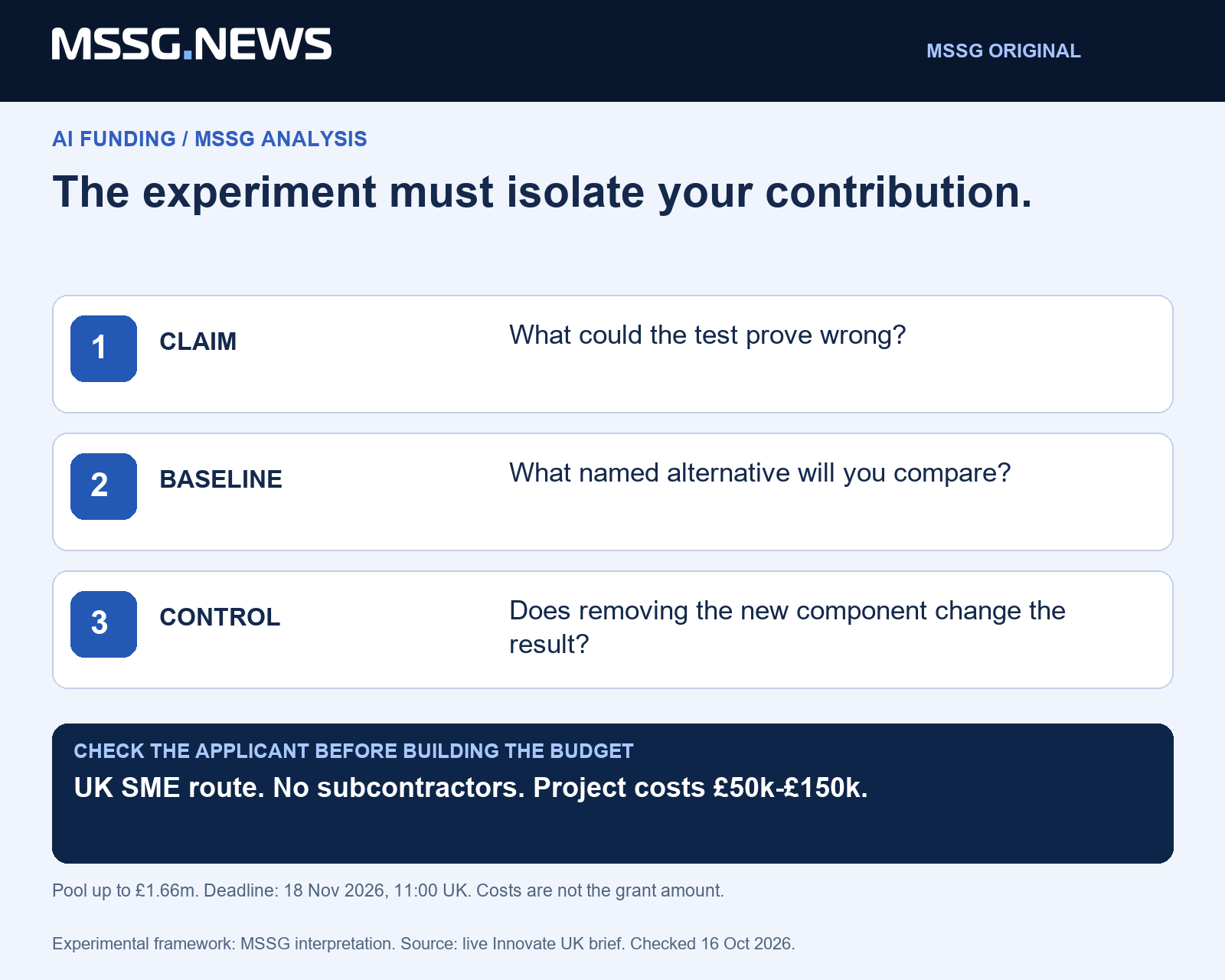
Efficient, Structured and Controllable AI Systems offers a pool of up to £1.66 million. Its current brief sets an 18 November 2026, 11:00 UK deadline, eligible project costs of £50,000-£150,000 and a UK SME applicant route. Subcontractors are not allowed.
The industrial implication is that a strong demonstration of an application is insufficient on its own. The applicant needs to explain what changed inside the technology and how the experiment will distinguish that contribution from the performance of existing components.
Start with a claim that can fail
The brief calls for experimental validation of a new mechanism and excludes routine integration or prompt-engineering projects. Its technical focus makes the design of the experiment a central part of the commercial proposition: the company needs an asset it can own and improve, rather than a successful demonstration it cannot reproduce.
Our suggested starting point is a short technical claim with a defined comparison. An example would ask whether a new component improves a specified result under stated resource constraints. That is an illustration of experimental design, not a project endorsed by the funder or a promise of selection.
A named baseline prevents a misleading comparison with an unspecified alternative. Removing or disabling the proposed new component can help establish whether that component caused the improvement. The result is more useful to an investor or potential industrial partner when another team can understand what was tested and repeat the comparison.
Scope the evidence before the product
A startup should separate the research question from its eventual product roadmap. A broad future market can explain why the work matters, but it should not make the short experiment depend on building every part of a complete service.
The proposed output should therefore be concrete: a working technical element, a documented test environment and a result tied to a decision about further development. The next decision may be to invest, change direction or stop an unproductive approach. A result that rejects the hypothesis can still be informative when the experiment is well designed.
For dual-use teams, this distinction is valuable because the same algorithmic advance may support more than one application. A technically credible result can travel between discussions; evidence for a particular customer's operating conditions must still be established separately.
Eligibility can end the discussion before technology does
Teams should read the live official brief before preparing a budget or forming a delivery arrangement. The UK applicant route and prohibition on subcontractors are substantive constraints. A Polish or Ukrainian firm should not treat a UK contact as proof that its own costs can be funded through this call.
Our conclusion is that this is an opportunity for a narrow, testable advance with a clear owner. Define the mechanism, the comparison and the next decision first. Only then decide whether the permitted applicant, team and cost structure can carry out that experiment. The best proposal makes its technical contribution easy to assess without promising an entire future industry in a short project.
Sources & context
Published by Mitchell Strategic Solutions Group. See our editorial standards and corrections policy. Read more →
Related reporting

ESA’s grid-resilience call opens a route from space data to infrastructure services

EIC Accelerator: the November window for dual-use companies
Apply by 2026-11-04