EDF 2026 draws 49% more proposals with a smaller funding envelope
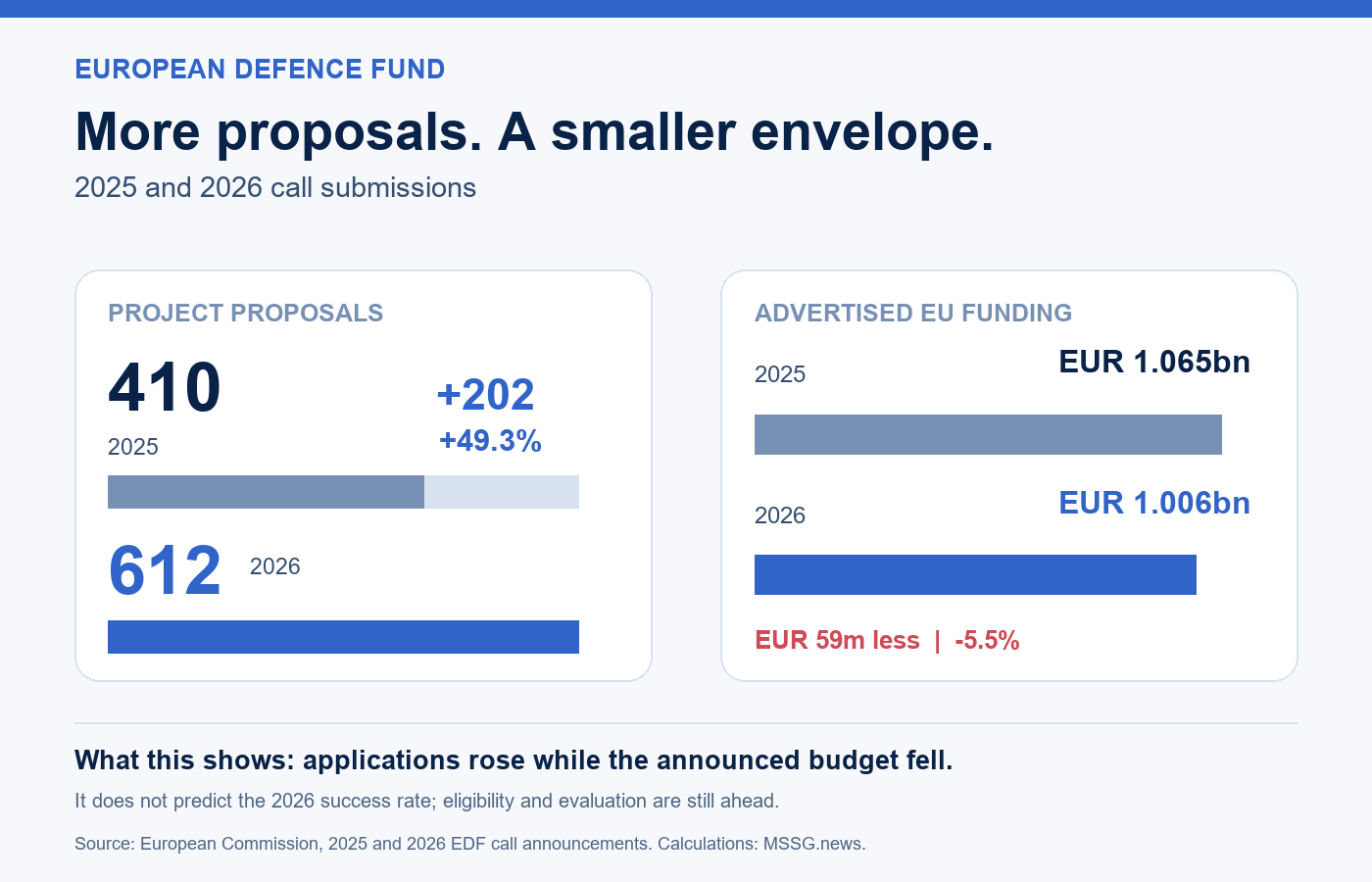
The European Defence Fund received 612 applications for its 2026 calls, up from 410 in 2025. The advertised EU funding envelope fell from EUR 1.065 billion to EUR 1.006 billion. The numbers put a sharper question on the table: which projects will make it through evaluation and into usable capability?
- European Defence Fund
- EDF 2026
The European Defence Fund has received a record 612 project proposals for its 2026 calls, the European Commission reported on 2 October. Last year the count was 410. That is 202 more bids, or 49.3% growth calculated by MSSG.news from the Commission's two annual announcements. Over the same period, the advertised EU funding envelope moved in the opposite direction: from EUR 1.065 billion in 2025 to EUR 1.006 billion in 2026, a fall of EUR 59 million, or 5.5%.
The two figures show a busier contest for a slightly smaller headline budget. They do not reveal how much funding applicants requested, how the bids split across topics, or the eventual chance of success for any one consortium. Dividing the envelope by 612 would produce a meaningless average: grants differ by topic and proposals are not all eligible or fundable. The useful signal is that the Commission now has a substantially larger field to evaluate.
The 2026 calls also mark the first opening to Ukrainian applicants, ahead of the EDF association agreement entering into force. That matters beyond the headline record: the fund is drawing from a wider pool while asking consortia to solve specific European capability problems. The Commission expects the evaluation results by March 2027, after eligibility, scientific and award assessments and ethics screening.
The money is concentrated on capability development
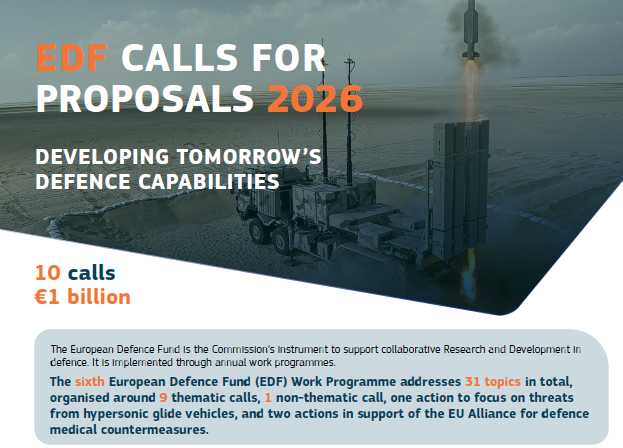
Half of the 2026 envelope is earmarked for collaborative research and development on major defence capabilities. The Commission names an endo-atmospheric missile interceptor, a next-generation main battle tank, a multiple rocket launcher and a semi-autonomous naval vessel among the topics. This is not an open cheque for all 612 teams. Each call has its own scope, consortium requirements and budget, so competition must ultimately be assessed topic by topic.
A quarter of the budget sits under the EU Defence Innovation Scheme, EUDIS. The Commission says roughly EUR 60 million supports disruptive technologies and reports especially strong interest in the EUR 60 million non-thematic SME calls. It also links that interest to a simpler application process. The announcement gives no count of SME submissions, so it is too early to quantify how much of the 202-proposal increase came from smaller companies.
The next measure is what the selection produces
The 2025 EDF round selected 57 projects from 410 submitted proposals, according to the Commission's results page. That historical outcome shows the scale of selection, but it is not a forecast for 2026: the calls, topic budgets and applicant mix changed. A meaningful 2026 assessment will compare eligible submissions, awards, grant amounts and capability areas after decisions are published.
Europe's financing problem is no longer simply whether industry will apply. The immediate challenge is to pick the strongest consortia from a larger field and move their results beyond the grant stage. The March 2027 decision will show where the Commission puts its resources; follow-up evidence on prototypes, production readiness and acquisition will show whether the record application volume translated into military value.
Sources & context
- European Commission: EDF 2026 proposals and budget, 2 October 2026 ↗
- European Commission: EDF 2025 proposals and budget, 20 October 2025 ↗
- European Commission: EDF 2025 selected projects ↗
- European Commission: 2026 procedure changes ↗
Published by Mitchell Strategic Solutions Group. See our editorial standards and corrections policy. Read more →
Related reporting
€1.24 billion for Ukrainian drones and missiles: the next test is production

BraveTech EU call: up to EUR 80,000 for bootcamp hosts, not startup teams
Apply by 2026-10-11