
Podkarpackie in a new EU study on regional defence industries
A September policy brief examines regional support for dual-use companies, with a Polish case among three examples.
- REGDUALOSA · 19 recommendations
- Poland · Spain · Estonia
On 8 September, the European Commission announced a REGDUALOSA policy brief prepared by its Joint Research Centre with input from the European Network of Defence-related Regions.
The study examines Andalusia, Podkarpackie and Estonia. It considers regional policy, financing and links to EU instruments, and sets out 19 recommendations. It is a policy study, rather than a funding call.
For a Polish supplier considering cooperation with Ukraine, the regional level deserves a place in its partner search. Our suggestion is to ask a regional institution about a specific production or research need. Identifying the team, facility or partner able to help is more useful than a general declaration of support.
Three specialisations and different conditions
JRC examines Podkarpackie through unmanned aircraft, Estonia through cyber defence and Andalusia through space technology. This is neither a regional ranking nor a claim that those industries exist only in those locations. The cases support comparison of how cooperation and policy are organised.
The research activity ran from March 2024 to March 2025. The final brief’s record is dated 12 August 2026, while DG DEFIS announced it on 8 September. These distinguish the research period from publication and subsequent dissemination. The findings are not a fresh survey of the whole industry at this year’s MSPO.
The gap between technology and market
JRC identifies missing system integrators, skills shortages, restricted SME defence-market access and weak links between civil innovation and defence planning. A laboratory and a promising prototype may therefore be insufficient without a partner able to incorporate the technology into a larger product.
One grant cannot necessarily address all those constraints. Integrators, test facilities and purchasing customers perform different functions. Our assessment is that regional programmes should distinguish them rather than judge success solely by the number of funded projects.
Regions do more than promotion
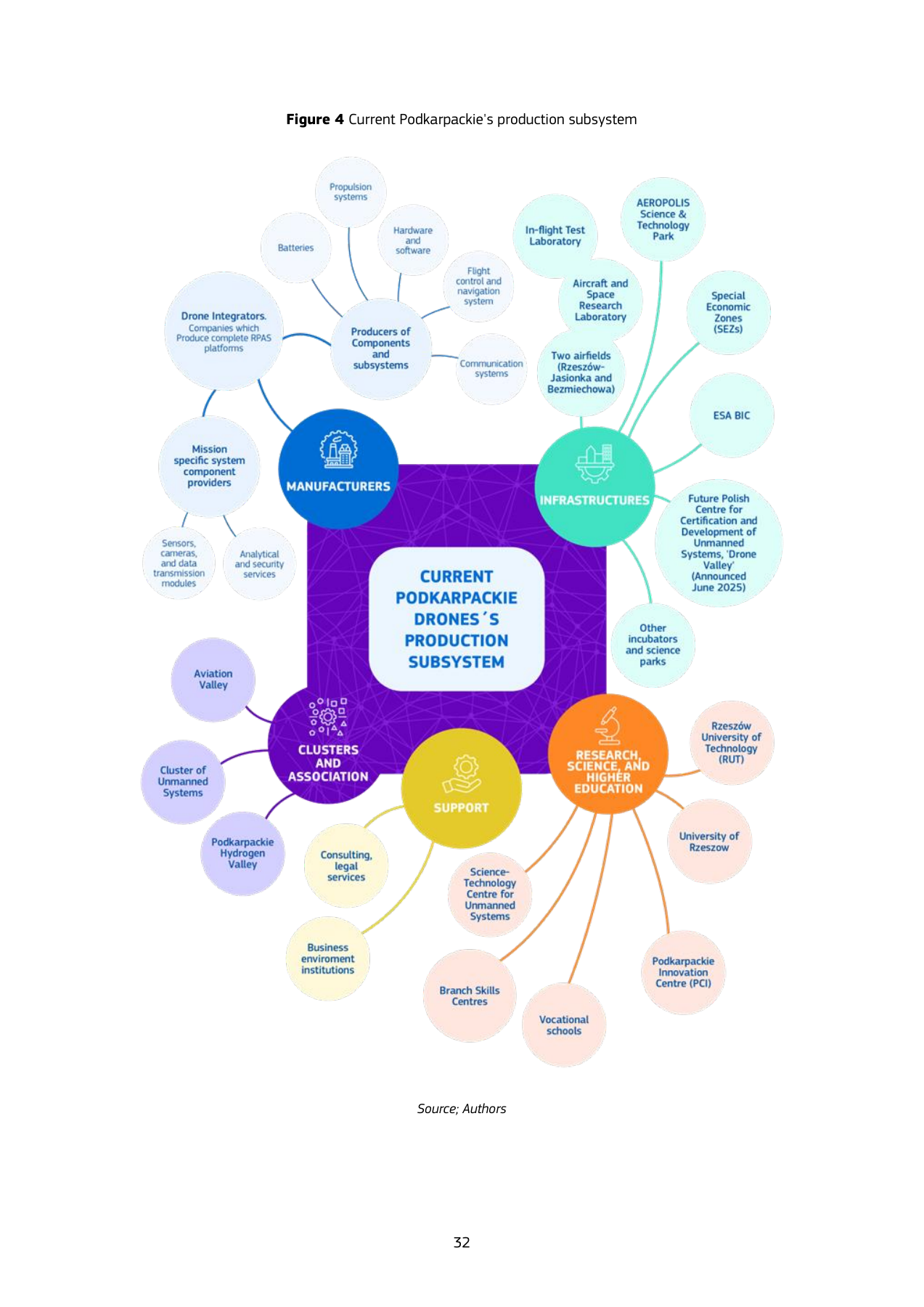
JRC describes territorial administrations as facilitators connecting organisations and levels of government. It identifies clusters, shared testing infrastructure, government coordination, regulatory experimentation and venture capital among factors supporting success. The brief sets out 19 recommendations.
For Podkarpackie, the framing matters: industrial capabilities need a connection to user requirements and a market route. This is not endorsement of a particular company or a funding award. The document informs regional policy; it is not a call for applications.
How companies can use the work
A business can use these findings to define what it needs from its environment: testing access, an industrial partner, development financing or skilled staff. A precise account of the missing capability helps determine whether a regional instrument actually addresses it.
The project considers fragmented financing across regional funds, Horizon Europe, EDF and national instruments. The type of work and participant eligibility should determine the route. We do not assume these funds can be combined freely or that publication of the report opened a new competition.
Sources & context
- DG DEFIS: REGDUALOSA announcement, 8 September 2026 ↗
- JRC: Territories - Competitiveness, defence and preparedness (JRC147349) ↗
- JRC: project, methodology and regional case studies ↗
Published by Mitchell Strategic Solutions Group. See our editorial standards and corrections policy. Read more →