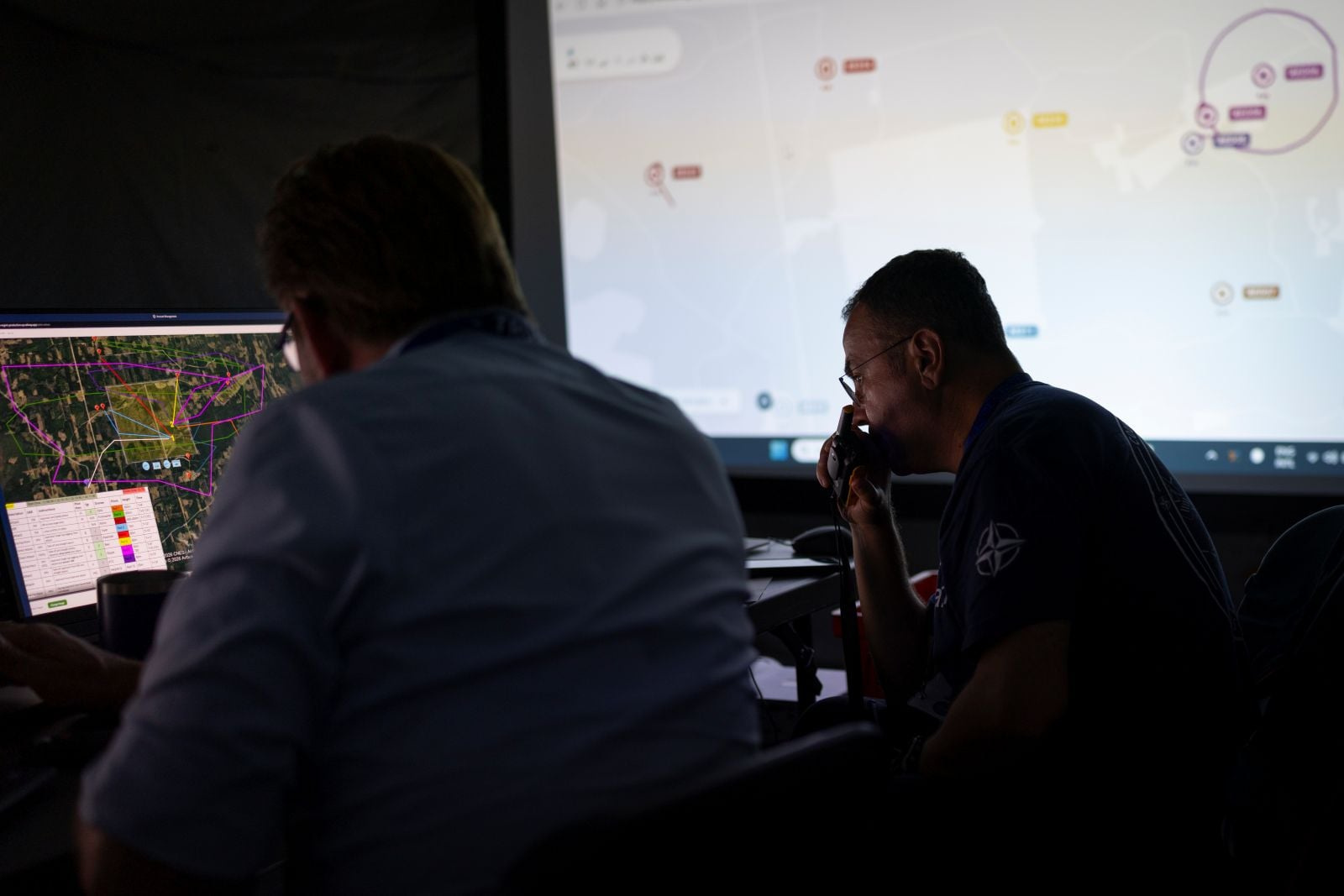

NATO’s Oulu demonstrator will test the connections between defence technologies
The 28-29 October event in Finland links resilient communications, sensors, AI and unmanned systems. Attendance is by invitation, through the relevant national delegation.

- 2026-10-28
- Oulu
Event: 2026-10-28 / 2026-10-29 · Oulu
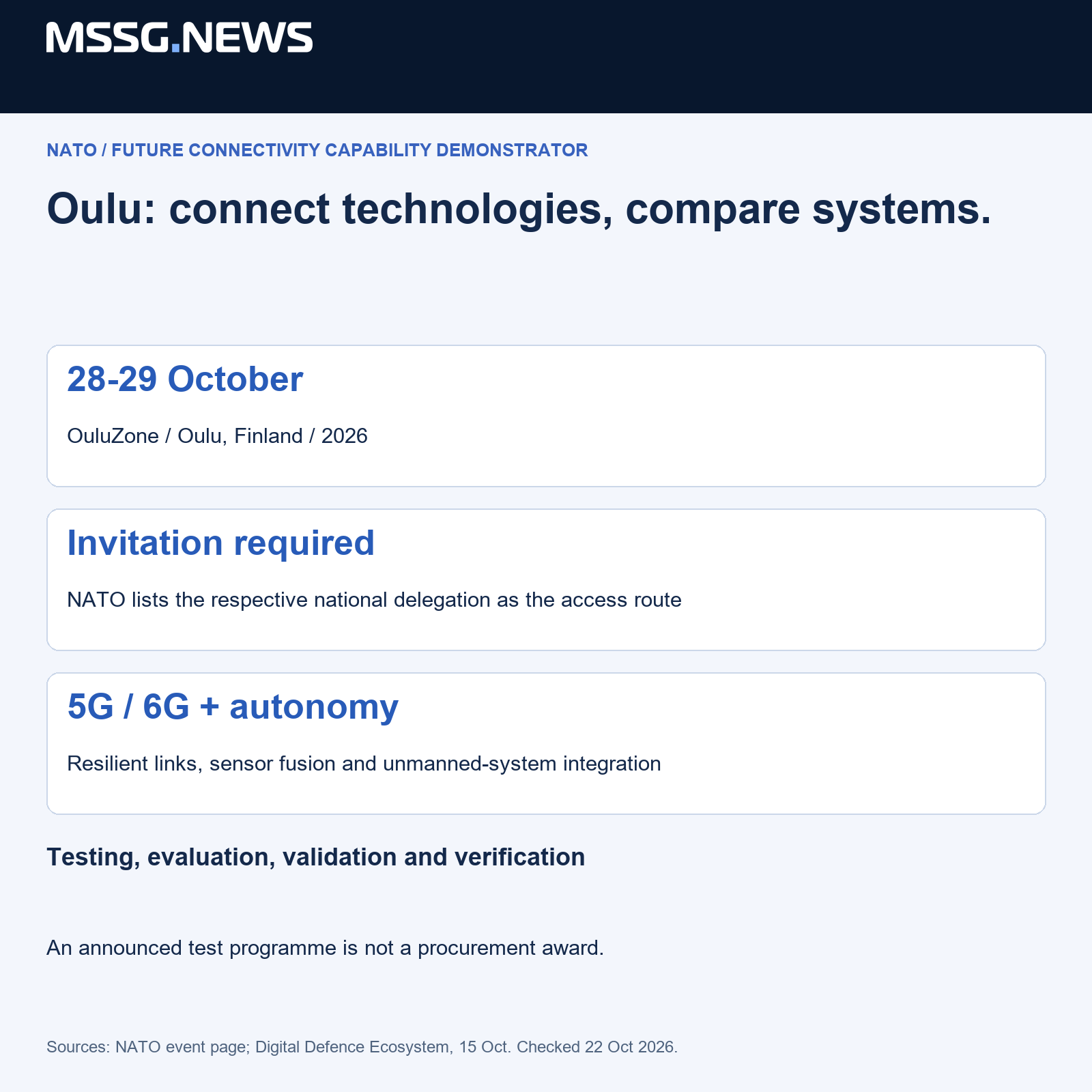
NATO’s Future Connectivity Capability Demonstrator is scheduled for 28-29 October in Oulu, Finland. The official NATO calendar confirms that an invitation is required and directs prospective participants to their respective national delegation. This is not a public exhibition with open visitor registration.
Digital Defence Ecosystem, one of the organisations handling practical arrangements, identifies OuluZone as the testing environment. Its 15 October announcement describes work across resilient communications, sensor fusion, AI-enabled command and control and the integration of unmanned systems.
The relevant industrial theme is how components work together under changing conditions. A capable sensor, a communications link and a decision-support application do not become an interoperable system simply because they are demonstrated at the same venue.
Future Connectivity has a defined institutional setting
The organiser describes NATO Innovation Range Future Connectivity as a Finnish-Swedish initiative. Finland’s Ministry of Defence is the national authority for the framework and the Oulu demonstrator. Practical arrangements involve the Finnish defence administration, BusinessOulu, Digital Defence Ecosystem and DEFINE in cooperation with NATO.
The NATO event page describes a demonstration of capabilities, testing models and the related industrial ecosystem. It gives the meeting an Allied connection beyond a local technology showcase. It does not announce a joint procurement contract or certify the products taking part.
Communications and autonomy meet at the interface
The announced scope includes 5G and 6G communications, counter-drone technologies, sensor fusion and unmanned-system integration. Testing, evaluation, validation and verification are part of the purpose described by the organiser. Those terms concern different kinds of evidence, rather than four names for a promotional demonstration.
In our analysis, the useful comparison is between the performance of a component and the performance of the connected chain. An application may process a correct input quickly while the wider system still receives late or inconsistent information. A communications demonstration can therefore be relevant to software and sensing suppliers as well as to radio manufacturers.
What suppliers can learn from an invitation-only event
Access is limited, so firms outside the invited group should not plan travel on the assumption that a visitor ticket will become available. The verified route in NATO’s listing is the respective national delegation. There is no public application deadline or admission guarantee in the material we reviewed.
For participating suppliers, our suggested preparation is a concise description of interfaces, assumptions and the evidence their partner needs to reproduce a result. The event’s value would be clearer if later reporting distinguished an isolated demonstration from integration into a larger system under stated test conditions.
For Europe, that is a practical part of NATO’s innovation role: bringing national expertise into a setting where Allies can examine compatibility. The announced programme establishes an opportunity to test and compare. Results and any later purchasing decision must be reported when they actually exist.
Sources & context
- NATO: official Oulu event and invitation requirement ↗
- Digital Defence Ecosystem: Oulu announcement, 15 October 2026 ↗
Published by Mitchell Strategic Solutions Group. See our editorial standards and corrections policy. Read more →