NATO’s industry strategy tackles the signal factories need before they expand
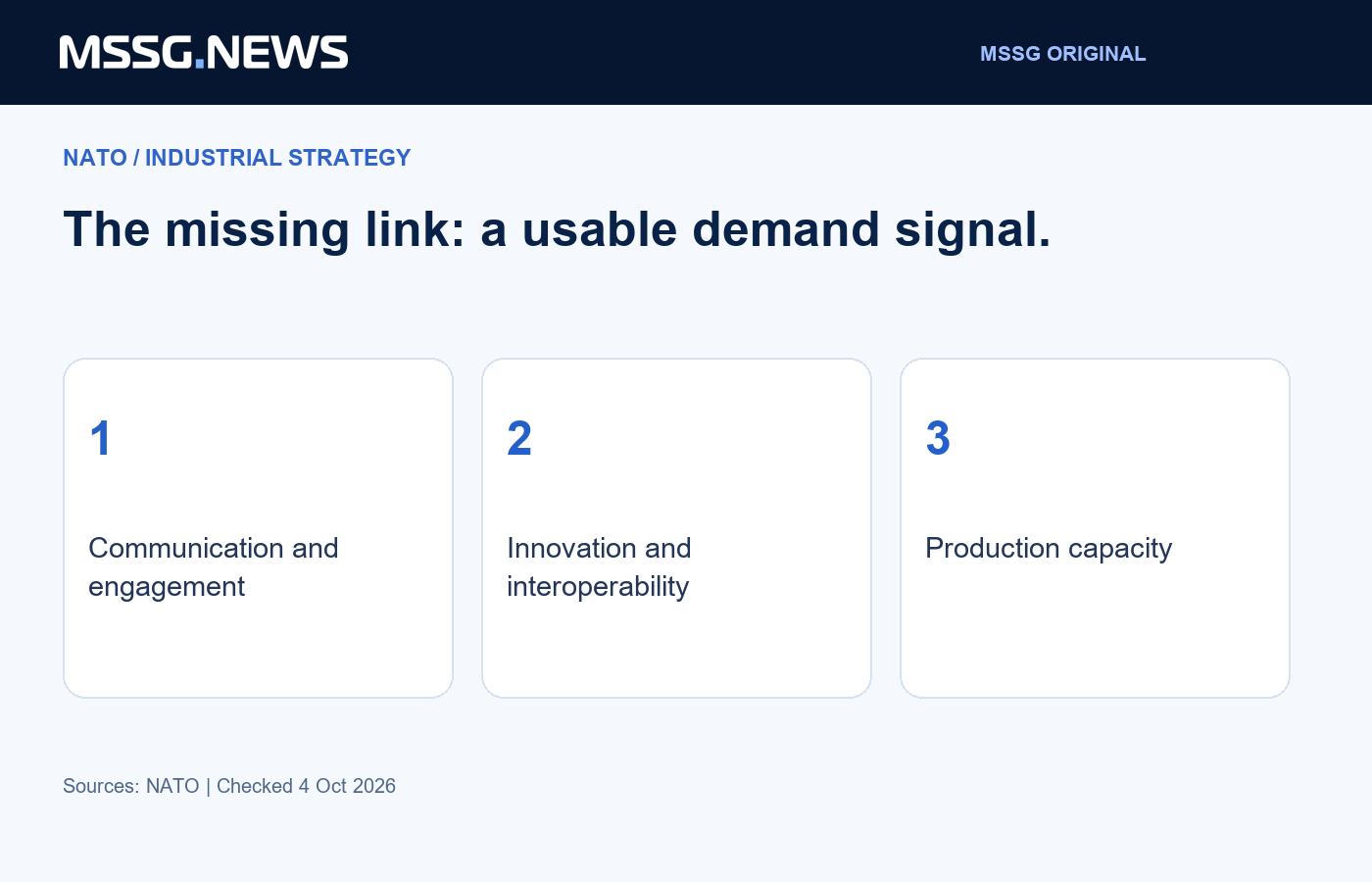
The July strategy connects early industry engagement, interoperability and production capacity. Its most consequential promise is a clearer demand signal: enough information to turn a military need into an industrial investment decision.
- NATO
- SMEs
A factory cannot expand on the strength of a general statement that defence spending will rise. It needs to understand the capability required, the potential order horizon and the constraints on delivering it. NATO’s July Strategy for Industry-NATO Cooperation addresses that information problem alongside innovation and production capacity.
The strategy says NATO will share an aggregated demand signal derived from its defence planning process and seek earlier consultation with industry. It also describes a Front Door for Industry to connect procurement, testing and innovation information. These measures belong to a strategy for improving engagement, not a new direct grant for manufacturers.
The document calls for an implementation plan by October 2026. We analyse the published strategy; we do not claim that an implementation plan or every planned platform function is already available. Its principles preserve existing procurement and security rules.
Why early consultation changes the sequence
In a purely reactive model, a supplier sees a finished requirement and decides whether to bid. Earlier consultation creates room to identify unrealistic timelines, manufacturing bottlenecks and interface problems before a specification becomes difficult to change. That is a different contribution from promoting a product to a buyer.
For SMEs, a useful consultation explains a capability gap in terms that an engineer can act on. It should connect technical performance with qualification, integration and support needs. Otherwise more meetings simply generate more visibility without producing a clearer industrial decision.
Interoperability is a production issue too
Compatible interfaces can let more than one supplier serve a requirement and make equipment easier to sustain across partners. MSSG.news’s reading is that interoperability therefore belongs in industrial planning, not just in the final operational test. Designing it late can create expensive rework after production investments have been made.
The strategy brings standardisation and capacity into the same framework. This is significant for firms deciding whether to develop a specialised component, join an integrator’s supply chain or pursue a complete platform. Each route requires a different understanding of who defines the interface and who accepts the output.
The evidence that would make expansion credible
The industrial test is whether engagement leads to sufficiently clear priorities, repeatable requirements and a procurement horizon. A company can then distinguish a short experiment from a capability that merits investment in tooling, people and supply-chain resilience. Those are our assessment criteria for implementation.
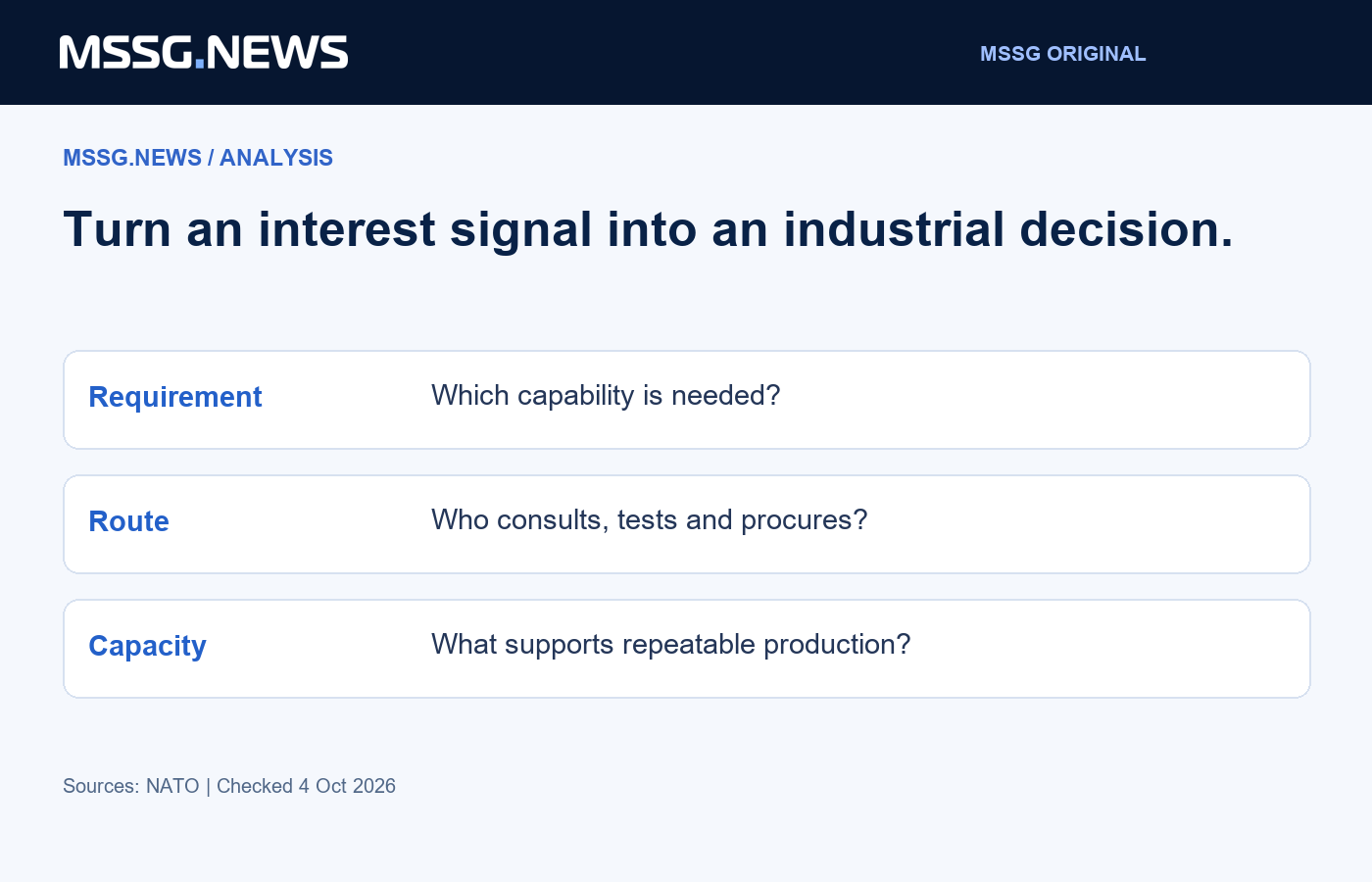
The strategy’s strength is its recognition that communication, innovation and production are connected. Its value will be judged through those connections in practice. For suppliers, the useful starting point is a map of the requirement, the responsible institution and the route to testing and purchasing.
Sources & context
Published by Mitchell Strategic Solutions Group. See our editorial standards and corrections policy. Read more →
Related reporting

Britain opens a permanent industrial gateway in Kyiv. SMEs need more than another trade mission

NATO’s quantum roadmap sets an industrial clock. Suppliers need evidence before 2027