

Ukraine signs UAH 12.5 billion in defence loans. The factory and its cash cycle need different money.
The ministry reports 211 agreements and a 5% borrower rate. Our breakdown separates investment finance, working capital and what the headline total actually measures.
- Ukraine
- Defence industry
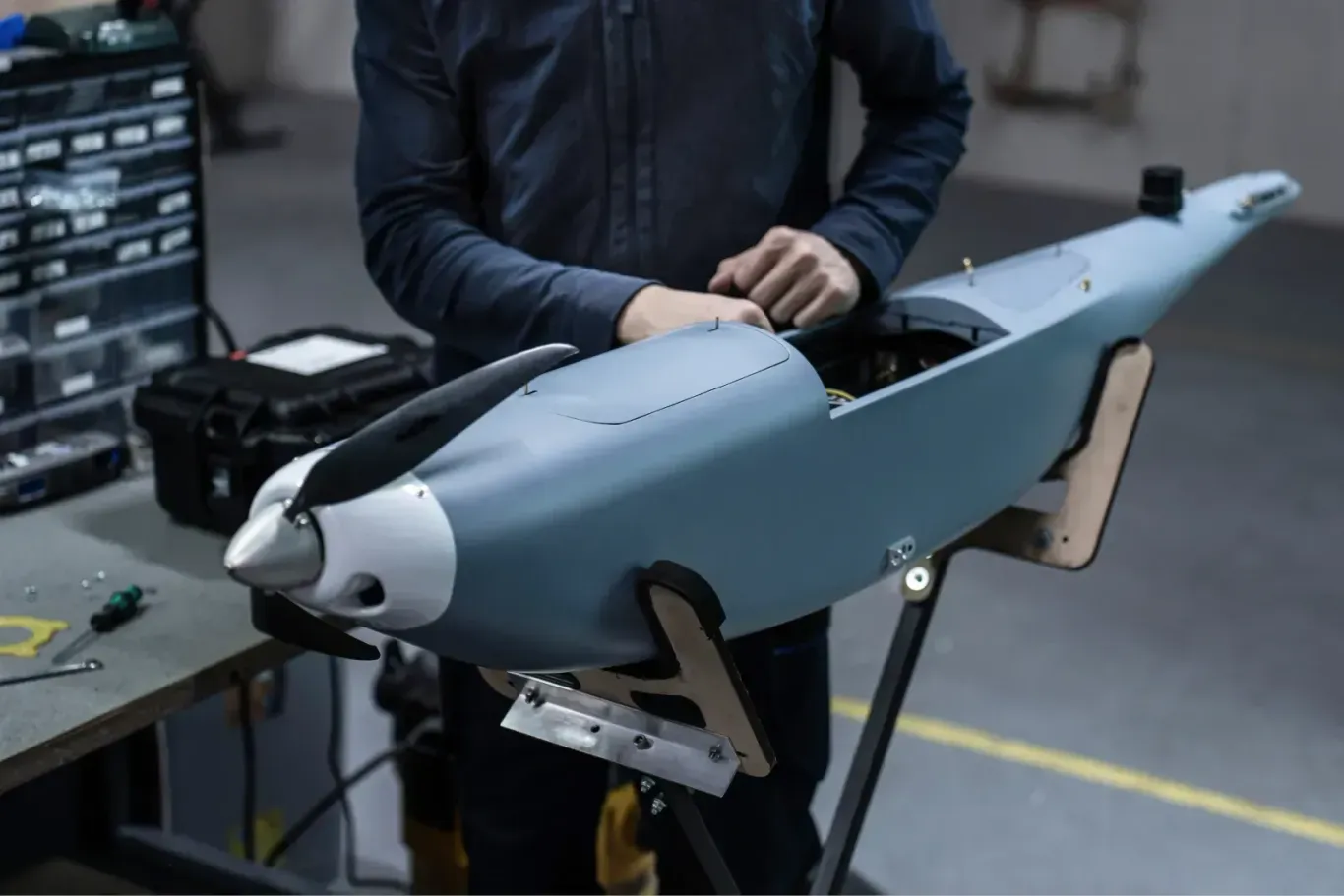
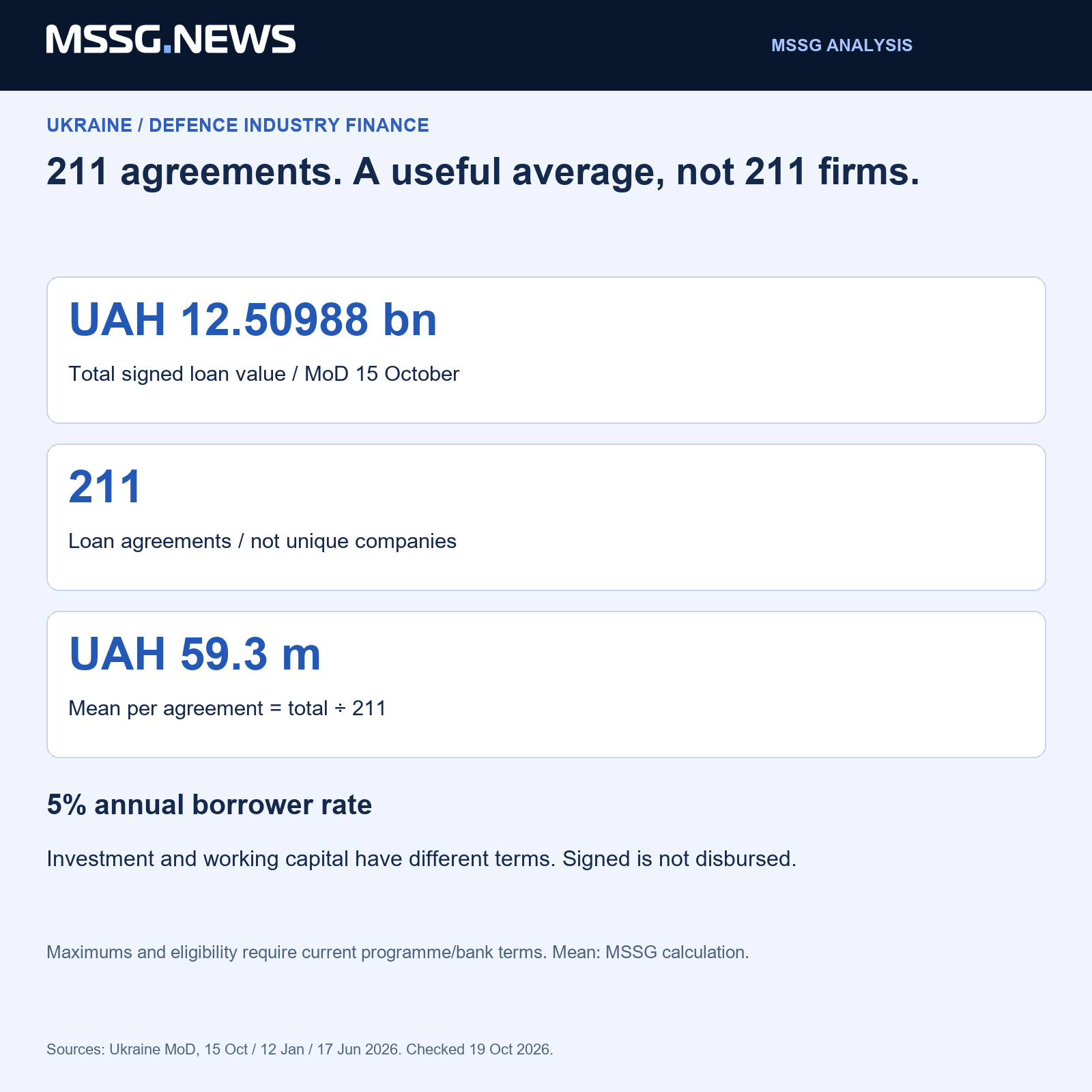
Ukraine's concessional defence lending programme has reached 211 signed agreements worth UAH 12,509.88 million, according to the Ministry of Defence's 15 October update. The industrial significance is broader than a cheap interest rate: a factory needs both equipment and enough liquidity to turn that equipment into deliveries.
Dividing the reported value by the number of agreements gives about UAH 59.3 million per agreement. This is our arithmetic, not a ministry performance indicator. The denominator is agreements, not unique companies, and the signed total does not establish how much money has already been disbursed.
The ministry states that participating enterprises pay 5% annually, with the state covering the remaining financing cost. That support changes the cost of capital; it does not make debt a grant or remove the need for a viable repayment plan.
A machine and a component batch have different clocks
The October summary describes loans of up to UAH 500 million and separates investment terms of up to five years from working-capital terms of up to three years. More detailed ministry explanations published in January and June put the investment ceiling at UAH 500 million and the working-capital ceiling at UAH 100 million.
The October summary does not explicitly announce that the older working-capital ceiling has been raised. We therefore do not read its general maximum as confirmation of a UAH 500 million working-capital entitlement. Current bank terms and programme rules need to resolve that point for an applicant.
The financing distinction itself is important. An investment loan can support machinery whose productive life extends across multiple orders. Working capital supports the shorter cycle between paying for components, completing a batch and receiving payment. Increasing installed capacity without financing that cycle can leave a production line technically ready but commercially idle. This is our industrial interpretation, not a reported outcome at a specific borrower.
The state subsidy is a different budget number
In January, the ministry identified UAH 1 billion for partial interest compensation on concessional loans and leasing in 2026. That is a support allocation, not the principal value of all loan agreements. Comparing it directly with UAH 12.5 billion as though both measured loan money would confuse the subsidy with the financing it supports.
The programme began in 2024 and targets defence enterprises designated critically important to the economy during the special period. Public reporting covers development, manufacture, repair, modernisation and disposal of defence equipment and components. Those stated purposes do not establish automatic access for a foreign company, a component vendor or any startup using the label dual-use.
A financing headline is not a production scorecard
For European industrial partners, the useful question is which constraint a Ukrainian production plan actually faces: long-lived equipment, components and stock, or the timing of customer payments. A partnership built around the wrong constraint can offer additional capacity without the means to use it.
The new total shows the scale of signed financing arrangements. To judge industrial results, a further set of facts would be needed: disbursement, commissioned capacity, completed orders and repayment performance. The public update does not supply that scorecard. Its clear message is that Ukraine is using subsidised debt to address the practical cost of scaling production, alongside grants and procurement instruments that serve different purposes.
Sources & context
- Ukraine MoD, signed loan agreements, 15 October 2026 ↗
- Ukraine MoD, financing and leasing explanation, 12 January 2026 ↗
- Ukraine MoD, investment and working-capital limits, 17 June 2026 ↗
Published by Mitchell Strategic Solutions Group. See our editorial standards and corrections policy. Read more →
Related reporting
Ukraine orders 4,700 fragment-protection suits. Mobility is part of the specification.
Britain opens a permanent industrial gateway in Kyiv. SMEs need more than another trade mission