
Nordic and British AI cooperation puts data compatibility on the military agenda
Five countries met in Lund to compare AI-enabled reconnaissance and strike work. The useful industrial question is what partners need to exchange and how they will evaluate it together.
- AI
- Nordic countries
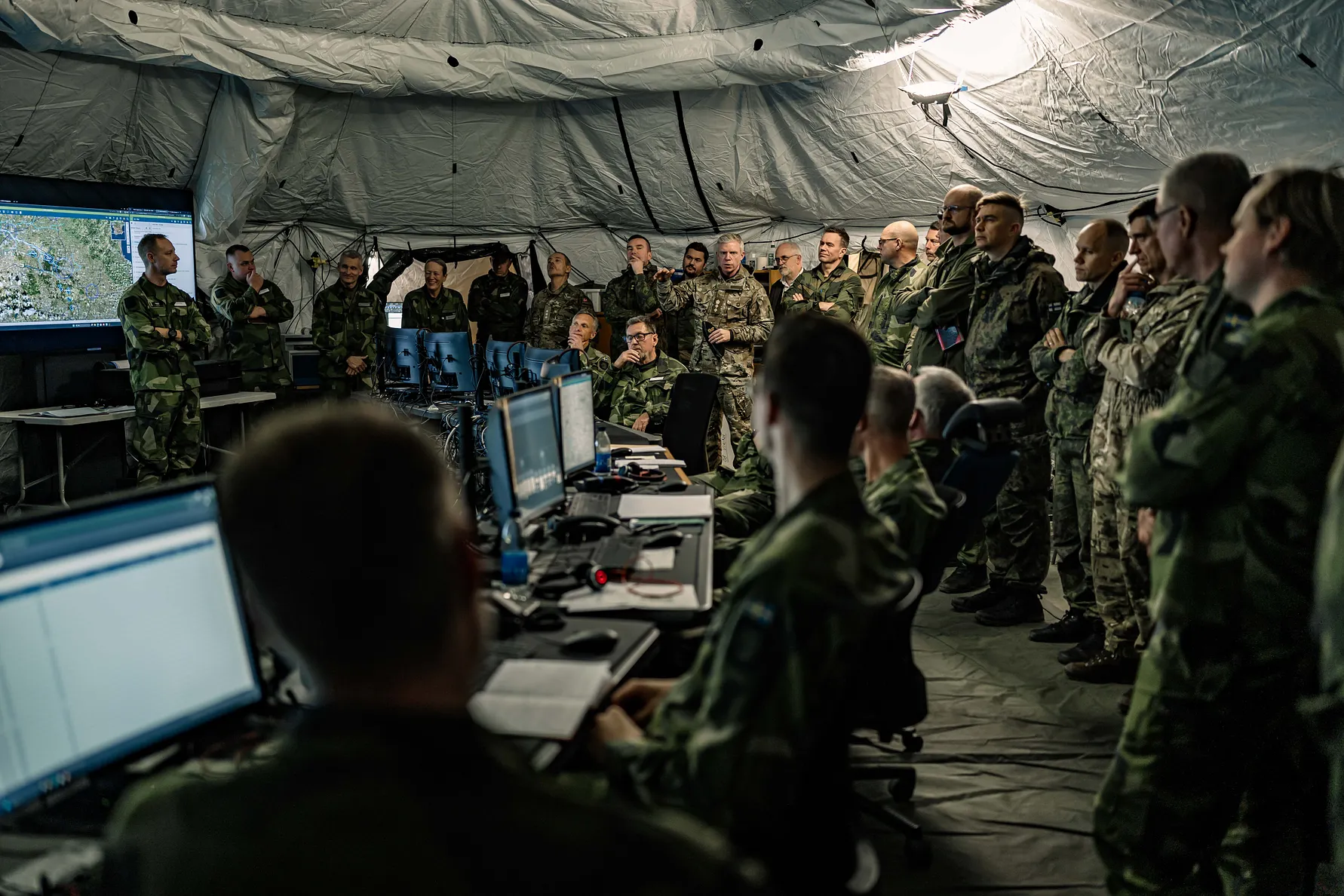
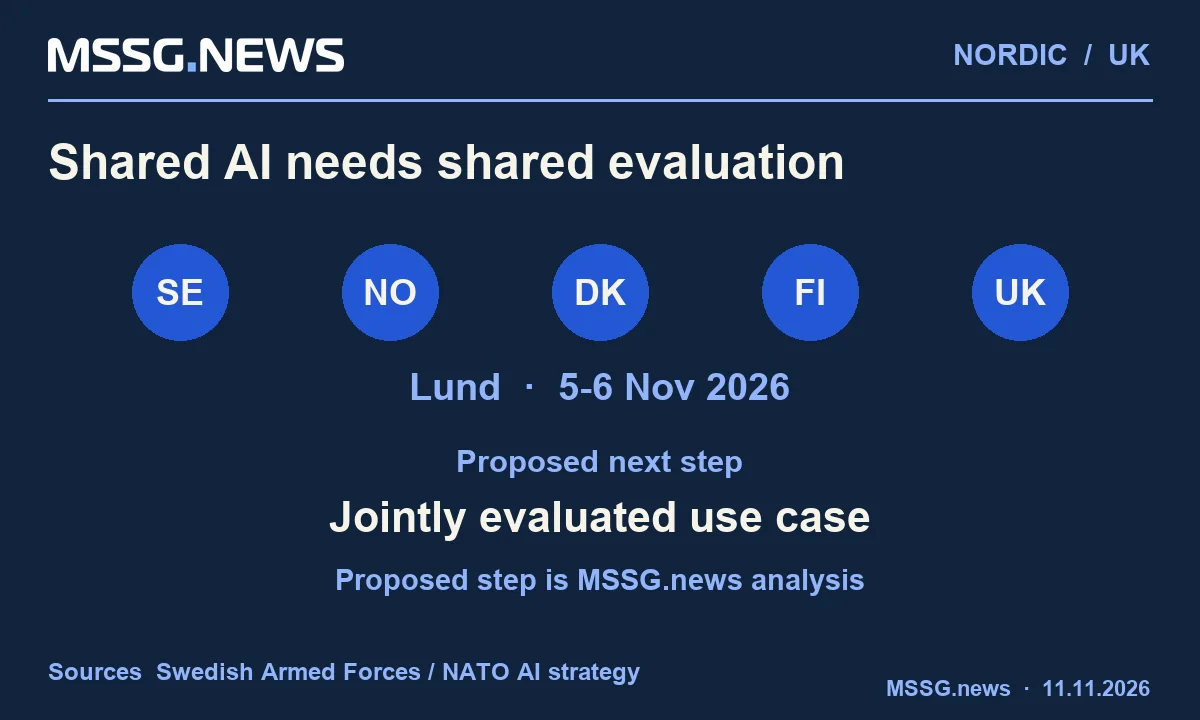
Sweden, Norway, Denmark, Finland and the United Kingdom held their first Nordic-UK AI-Enabled Recce-Strike Symposium in Lund on 5-6 November. The Swedish Armed Forces published its account on 10 November. Military representatives, policy specialists and technical experts compared national approaches and lessons from experiments.
Sweden and Britain hosted the event for the Nordic-UK Community of Interest. The agenda joined decision support, targeting and information integration with interoperability and coalition operations. Participants also visited the South Skåne Regiment, P 7, to discuss Swedish experimentation and practical integration challenges.
The industrial consequence is that a military AI product will increasingly be judged in relation to the organisations that must use its output. In MSSG.news’s analysis, a model’s performance on one national dataset is only the beginning of that discussion. Partners also need a shared understanding of the information, its limits and the decisions it supports.
What the meeting establishes
The Swedish account describes an exchange of experience and examination of emerging technology. It reports attention to responsible, lawful and ethical AI use. It gives no common procurement budget, named selected system or jointly accepted performance result.
That leaves room for a practical next step. A multinational experiment could define a shared use case, the information participants are permitted to exchange and how each organisation will assess the outcome. These are MSSG.news’s proposed measures of progress, derived from the integration problems on the agenda.
NATO’s existing framework supplies context
The Alliance’s revised AI strategy, published in July 2024, treats high-quality, AI-ready data as a prerequisite. It calls for growing interoperability, a skilled workforce and testing, evaluation, verification and validation. It also recognises the difficulty of applying civilian-market dual-use technology in a military context.
The strategy supports cooperation with industry and research organisations and gives attention to non-traditional defence suppliers. For firms entering the sector, this makes demonstrable testing and the ability to work with other systems relevant alongside the underlying algorithm. The strategy is background to the Lund discussion. The Swedish release makes no claim that the symposium certified a product against it.
- Participants
- Sweden, Norway, Denmark, Finland and the UK
- Meeting
- Lund, 5-6 November 2026
- Public account
- 10 November 2026
Where a specialist supplier can contribute
For a company providing data preparation, evaluation or decision-support software, the concrete question is which step a military partner needs improved. A bounded offer can specify the intended user, the permitted data and an observable test result. That makes it easier to discuss technical fit and responsibility across organisations.
For Poland and Ukraine, the meeting is a signal to watch how nearby European partners make their experiments compatible. The published list of participants comprises the five countries named above. Wider participation and commercial opportunities would require separate confirmation through the relevant institution.
Sources & context
- Swedish Armed Forces, full symposium account, 10 November 2026 ↗
- NATO, revised AI strategy, 10 July 2024 ↗
Published by Mitchell Strategic Solutions Group. See our editorial standards and corrections policy. Read more →