
HYPER-EDGE studies a ten-minute fire alert. The next evidence is a benchmark, not a launch.
An ESA-supported concept asks whether a different computing approach can make onboard alerts more efficient. The public project record still describes a pre-Phase A study.

- ESA
- Earth observation
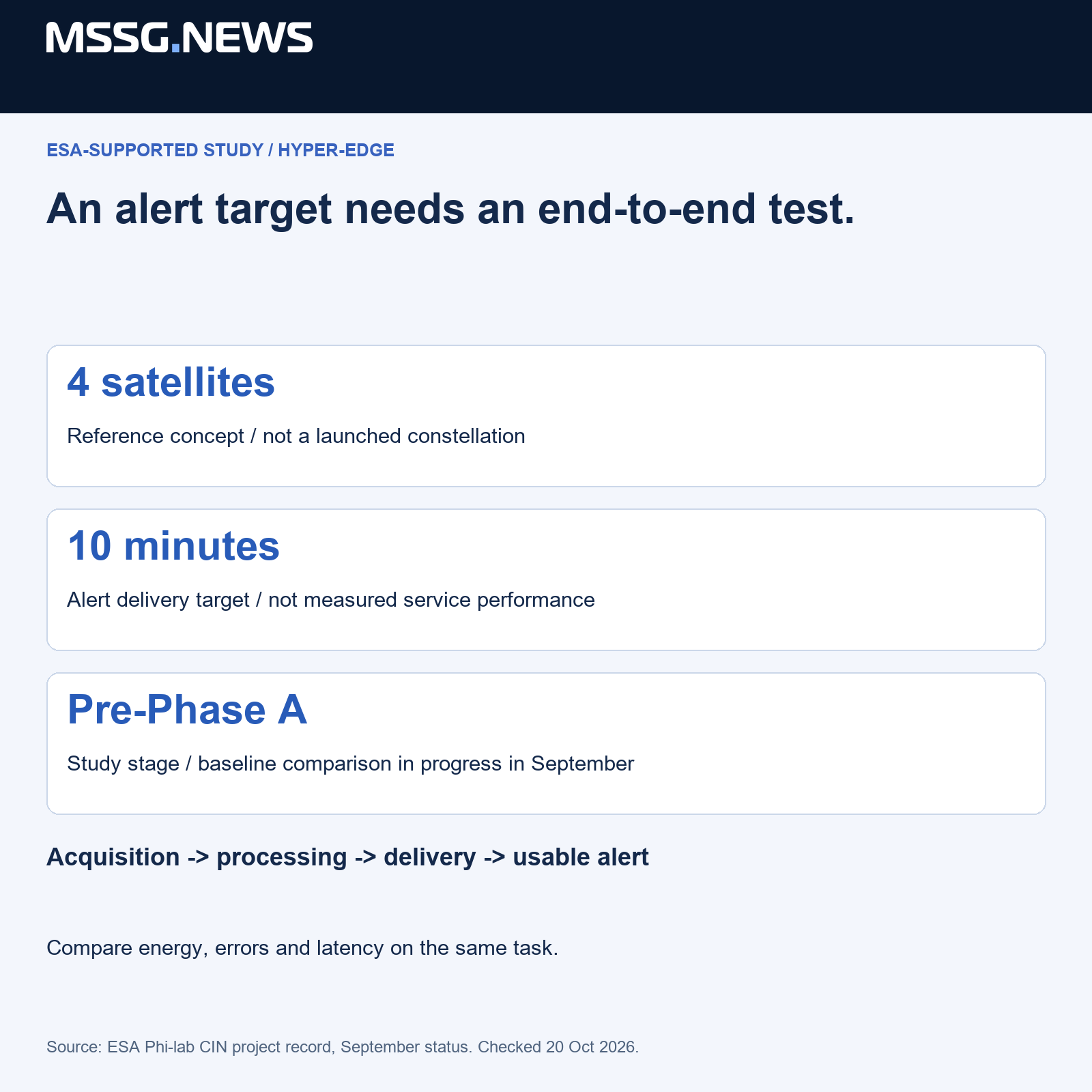
The HYPER-EDGE entry in ESA Phi-lab’s project catalogue describes a pre-Phase A study of onboard fire detection using hyperdimensional computing. Its reference concept has four small satellites and a target of delivering alerts within ten minutes.
The September status says comparison with a conventional deep-learning baseline is still in progress ahead of an October final review. The published latency budget is therefore a design assessment, not demonstrated service performance.
The interesting industrial question is whether a computational saving survives the rest of the service: acquisition, communication, ground processing and the user’s response. A faster classifier matters only if it improves a decision the customer needs to make.
Compare a service, not just a processor
A fair comparison would give both candidate processing chains the same input data and the same definition of a useful alert. It would measure computing energy alongside detection errors and delivery time. Otherwise a supplier could improve one number by moving work elsewhere or by changing what qualifies as a detection.
Our proposed evaluation would also state what happens when the experimental method is uncertain or unavailable. Does another processing route keep the service usable, and what does that do to energy and latency? A fallback belongs in the total system cost. It is not free redundancy merely because it exists on an architecture drawing.
A latency budget needs measured handovers
An end-to-end design allocates time across several steps. Each handover needs an observable timestamp and a common start and finish definition before a future test can establish whether the budget held. Reporting only the fastest nominal case would not describe the experience of all users.
For a civil-protection customer, the useful endpoint might be a usable alert in an existing workflow, with enough evidence for a responsible operator to assess it. A notification arriving at a server is an earlier event. The contract and evaluation should make clear which endpoint the quoted time represents.
Study completion is a decision point
A concept study can reduce uncertainty about architecture, costs and the next experiment. It does not by itself establish flight readiness or a procured constellation. A sensible next investment decision would identify which assumptions need hardware testing, which depend on data quality and which require an agreement with the intended customer.
The archive NASA image illustrates the environmental problem that satellite data can help observe; it does not demonstrate HYPER-EDGE. Similarly, the project’s targets should remain labelled as targets until a published evaluation supports a stronger claim. That separation makes the opportunity easier to assess without underselling the value of early research.
Sources & context
- ESA Phi-lab CIN: HYPER-EDGE project and September status ↗
- NASA MODIS: archive fire-smoke image and acquisition date ↗
Published by Mitchell Strategic Solutions Group. See our editorial standards and corrections policy. Read more →
Related reporting
MetOp-SG-B1 reaches French Guiana. Europe’s weather upgrade also needs a ground chain.
ESA puts maritime radar processing on a concrete procurement timetable