
ESA’s Earth Virtual Expert puts scientific retrieval inside the AI workflow
EVE answers Earth-science questions from texts. Its public retrieval pipeline offers a useful way to examine grounding, while image-based capabilities remain a later step.
- AI
- ESA
ESA introduced its Earth Virtual Expert, EVE, on 8 October. Developed with Pi School, Mistral and Imperative Space, the system is intended to help users question Earth-observation and Earth-science literature.
Its current scope is text. ESA describes scientific sources, including material from space agencies and peer-reviewed literature, combined with retrieval to bring additional documents into an answer. Image search and presentation are planned for 2027; users should not assume that a text answer is already an analysis of a satellite image.
For European environmental and resilience teams, the useful development is a route through a large scientific knowledge base. Our analysis focuses on the publicly documented retrieval method, rather than treating fluent answers as verified scientific conclusions.
What the public pipeline makes visible
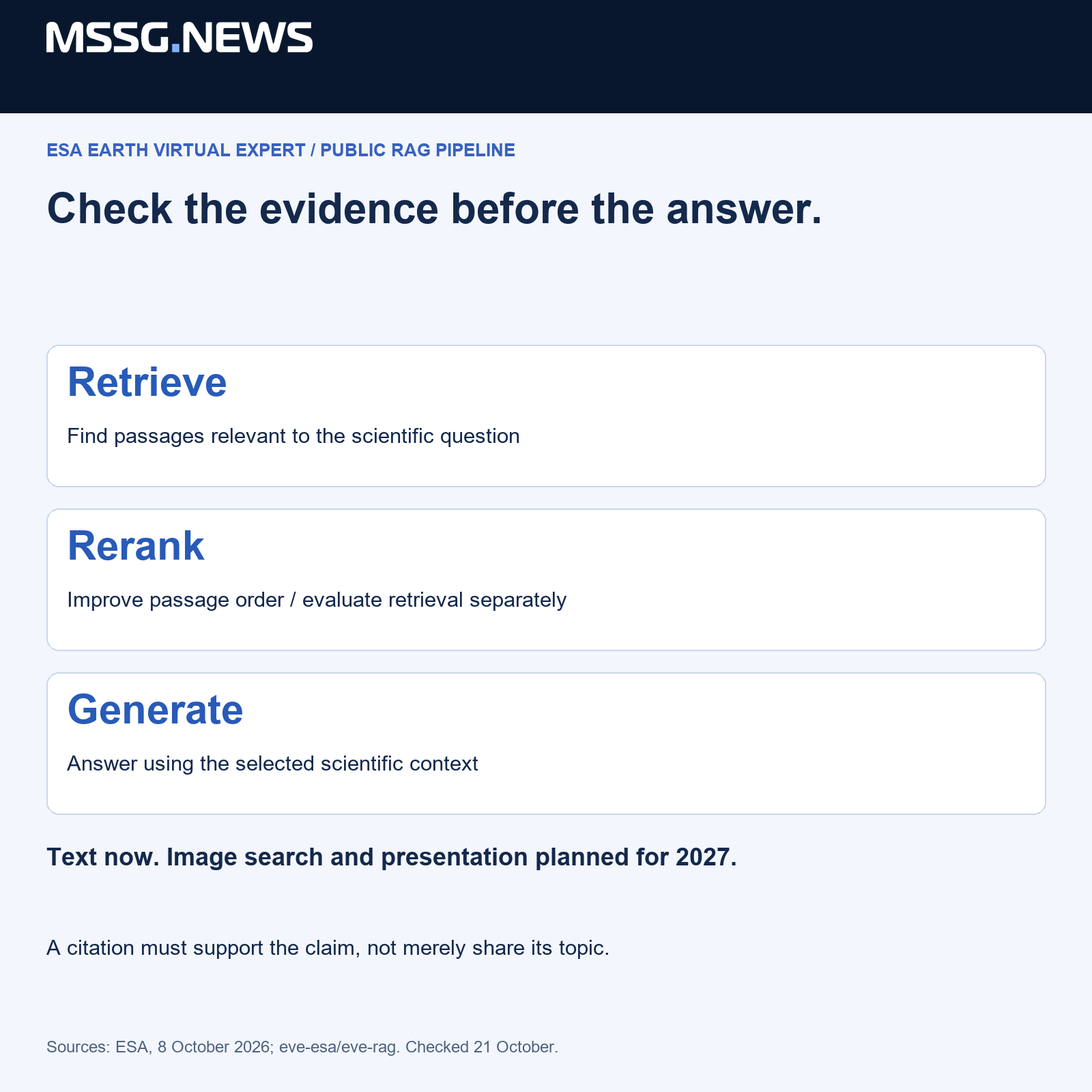
The eve-rag repository describes a sequence: split documents into retrievable passages, embed and store them, retrieve relevant material and pass it to the language model. Its examples include hierarchical chunking to preserve document structure, a query rewriter for follow-up questions and a reranker to reorder retrieved passages.
That separation matters. A system can miss the right paper before generation begins, or retrieve the right paper but the wrong passage. Improving the generator alone cannot establish that the evidence presented with an answer supports its claim. The repository is a public implementation reference, not an independent inspection of the live service’s exact configuration.
Evaluate retrieval and answers separately
The repository documents retrieval metrics including coverage, precision, recall and F1, and reranking measures such as mean reciprocal rank. These assess aspects of the evidence-selection process. They should be read alongside a separate assessment of whether the final answer faithfully uses that evidence.
ESA also describes a language-model judge intended to identify and revise unsupported responses. That is a checking component, not a guarantee of correctness. In our view, an evaluation set should include unanswerable questions and conflicting or superseded sources, alongside straightforward questions with a known supporting passage.
A science assistant is one layer of an operational service
A team advising an infrastructure operator could use this kind of tool to locate a method, understand its assumptions and find the relevant publication. Turning that into a warning or maintenance decision still requires the actual data, a validated method and responsibility for the decision.
EVE’s staged development makes that boundary especially relevant: text retrieval today and planned image capabilities are different products to assess. Open code helps researchers inspect the method, but a code licence does not by itself establish reuse rights for every retrieved document. Track the evidence and its permissions as carefully as the model version.
Sources & context
- ESA: Introducing Earth Virtual Expert, 8 October 2026 ↗
- EVE public retrieval pipeline and evaluation documentation ↗
Published by Mitchell Strategic Solutions Group. See our editorial standards and corrections policy. Read more →
Related reporting

HYPER-EDGE studies a ten-minute fire alert. The next evidence is a benchmark, not a launch.
ESA puts maritime radar processing on a concrete procurement timetable