

EDIP and Ukraine: €260 million across two production calls
October covers missiles and ammunition; February covers unmanned systems. We separate topic budgets, project ceilings and the scope of industrial investment.
- EUR 180m · closes 13 Oct 2026
- EUR 80m · closes 16 Feb 2027
Application deadline: 2026-10-13
See the call page for current conditions and closing time.
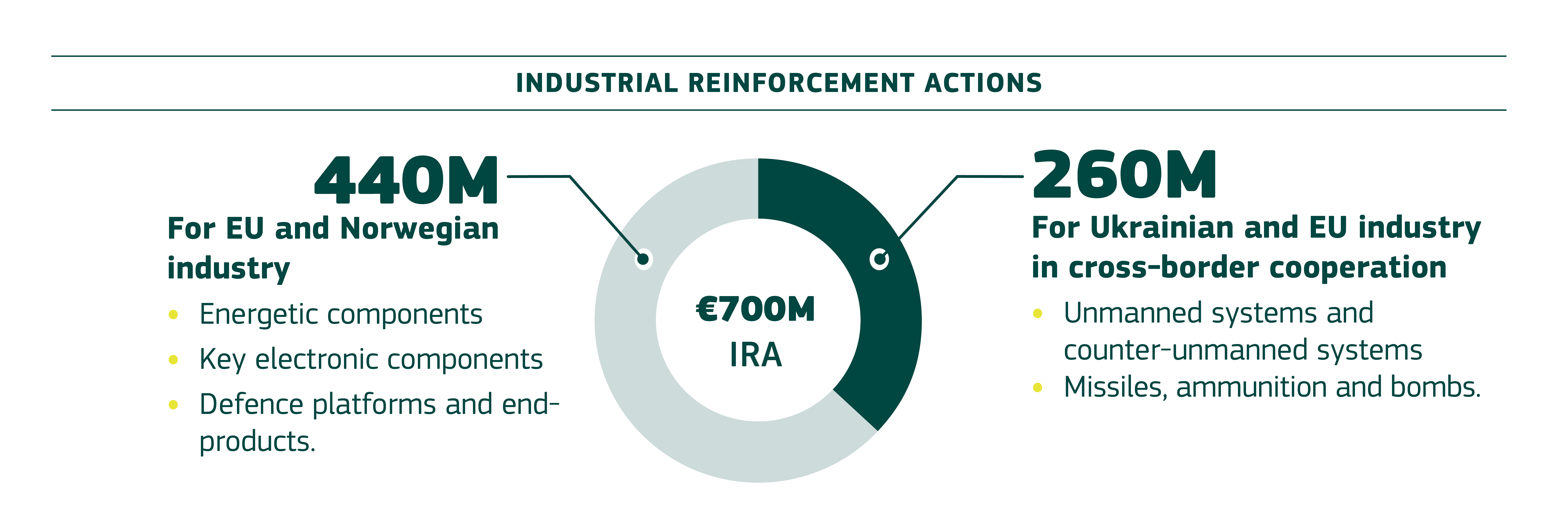
The Commission has published two Industrial Reinforcement Actions calls under the Ukraine strand of EDIP. The first has a €180 million budget and closes on 13 October 2026. The second provides €80 million with a deadline of 16 February 2027.
Both sit within the Ukraine Support Instrument, whose total envelope is €300 million. That overall amount should not be confused with the two calls: their combined budgets are €260 million.
The instrument concerns industrial capacity. The Commission focuses on production, shorter delivery times and cooperation between Ukrainian and European businesses. A proposal therefore needs to explain the manufacturing change, not simply the attractiveness of the product.
Two deadlines and different scopes
The October topic covers missiles, ammunition and bombs, with a maximum EU contribution of €30 million per project. The February topic concerns unmanned and counter-unmanned systems, with a €10 million project ceiling. These are different topics rather than two rounds of an identical competition.
An investment must be mapped to the correct scope. A subsystem manufacturer should not apply merely because a summary mentions drones. It needs to explain how its activities fit the topic and what additional industrial capability will result.
What industrial investment can involve
The USI-IRA description includes joint plants and production lines, reinforcement of specific capacity, scaling Ukrainian systems and ready-to-use manufacturing lines. It also covers Manufacturing as a Service and conversion options for dual-use heavy industry to support increased defence output.
For a cross-border partnership, our reading is that responsibilities need to be explicit: who provides technology, facilities, integration and commissioning. A cooperation agreement without a defined manufacturing result does not show where the additional capacity will come from.
Up to 100% applies to the right strand
The Commission describes support up to 100% of eligible costs for USI-IRA and eligibility for entities from EU Member States and Ukraine. Eligible does not mean every company expense or automatic reimbursement for any purchase. The call documents define the conditions for activities and costs.
Parallel IRA calls for industry in the EU and Norway have different rates: up to 35%, potentially rising to 50% where conditions are met. The USI rate cannot be applied to every European factory investment. The overall €1.5 billion EDIP programme must likewise be distinguished from its individual instruments.
What an industrial plan should establish
In our assessment, a useful plan starts with the baseline: current throughput, lead time and the constraint that investment is intended to remove. It then needs a commissioning schedule, supplier dependencies and resources to sustain the larger operation. Sensitive information about production sites should not be published to make that case.
The Commission provides webinars and slides explaining the calls. They should be used alongside the Funding & Tenders documents. Before the October deadline in particular, partners need a shared understanding of investment scope, ownership of results and evidence of completed work.
Sources & context
- European Commission: EDIP industrial reinforcement calls ↗
- European Commission: adoption and allocation of the EDIP work programme ↗
Published by Mitchell Strategic Solutions Group. See our editorial standards and corrections policy. Read more →
Related reporting
EDF evaluators: expertise, clearance and the application process
Apply by 2026-10-31
EDF SME calls: two routes, different budgets and co-financing needs
Apply by 2026-09-29